



The ASX 200 has finally broken its four-week losing streak, but momentum has already started to fade. With December’s strong seasonality now in play, traders are weighing whether a Santa rally can override weakening technicals and falling sector breadth. Key levels now determine whether the Australian share market can stabilise into mid-month or risk slipping into a deeper correction.
View related analysis:
- Australian Dollar Outlook: AUD/USD 6-Day Rally Into AU GDP, US Data Deluge
- ASX 200 Market Outlook: NAB Teases Bears as Financials Form a Bear Flag
- ASX 200 Market Outlook: FMG Eyes Breakout, WOW Firms Up
- Nasdaq 100 Leads Wall Street, Meta Bounce Gains Traction
ASX 200 December Outlook
ASX 200 Market Snapshot
- The Australian share market snapped a four-week losing streak on Friday, with the ASX 200 gaining 2.8% and recovering most of the prior week’s losses.
- Momentum faded quickly though, with a small-range shooting star and doji cluster before prices reversed lower on Monday and closed back below the 200-day EMA.
- Eight of eleven ASX 200 sectors fell, led by Health Care (XHJ -1.65%), Information Technology (XIJ -1.3%), and Communication Services (XTJ -1.1%).
- Financials (XFJ) extended its decline for a second day after breaking down from the bear-flag structure highlighted last week, finishing at a six-month low.
- ANZ led the big four banks lower, also trading out of a bear flag, while CBA is testing a potential break beneath the 150 level.
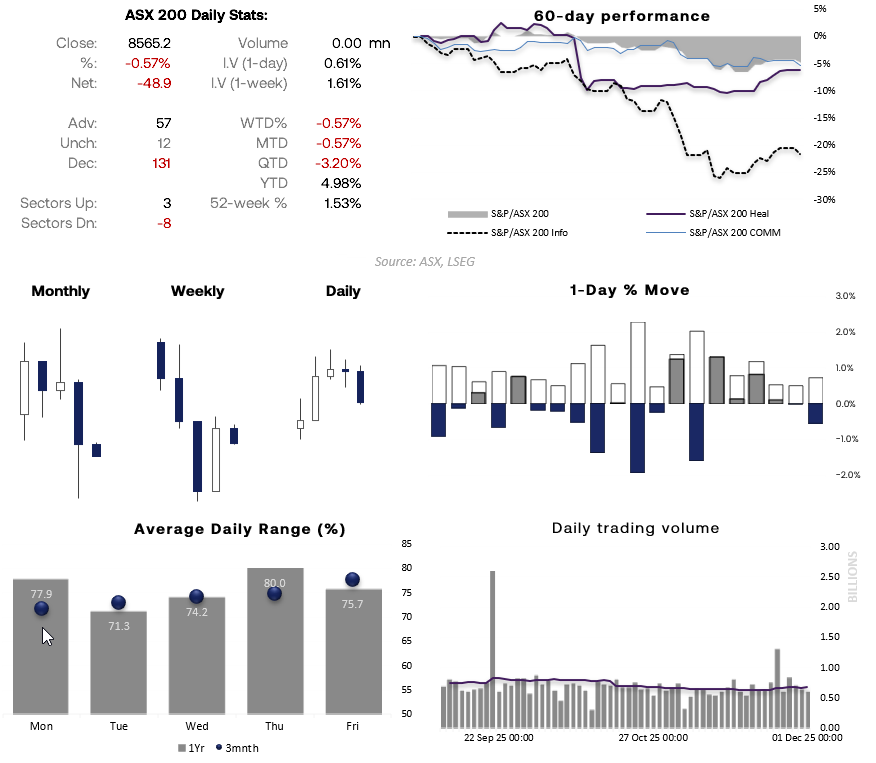
Chart analysis by Matt Simpson - source: ASX, LSEG

ASX 200 Seasonality
December is typically associated with equity gains thanks to positive leads from Wall Street. Interestingly, the ASX 200 has actually outperformed the Nasdaq 100 during this period.
- The ASX 200 has delivered an average December return of 1.86%, with a 1.8% median, showing the gains are consistent rather than skewed by outliers.
- December also boasts the highest win rate of the year at 72.7%.
- However, the average high-to-low monthly volatility is relatively modest at 5.7%.
- Volatility lifts to 6.1% in January, but both average and median returns drop to 0.25% and 0.7% respectively.
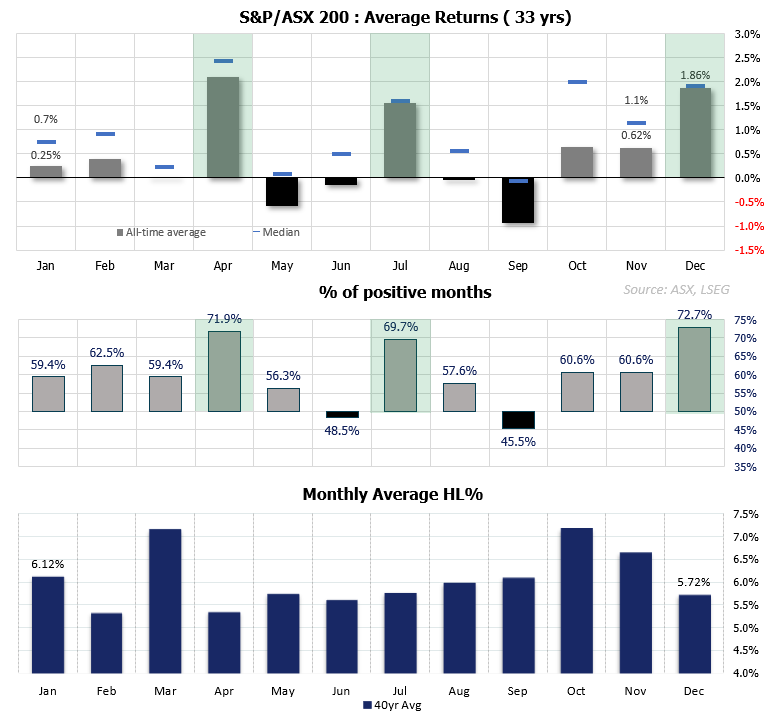
Chart analysis by Matt Simpson - source: ASX, LSEG
ASX 200 December Seasonality
We can take a closer look at how the ASX performs within December by analysing daily average returns for the month. While such a close look is prone to noise, a couple of interesting patterns emerge.
- The ASX 200 consistently shows a bullish bias from 16–24 December.
- This is backed by a positive win rate from 17–24 December.
- The positive return and win rate on 25 December is an artefact of pre-2000 data rather than actual trading, as the ASX is closed on Christmas Day.
- Overall, traders tend to be most bullish in the two weeks leading into Christmas Eve.
- The final trading day of the month is negative around 60% of the time, though the average decline is small.
- Near-term behaviour also aligns with the data: 2–3 December show bullish tendencies, while 4 December and 10 December lean negative.
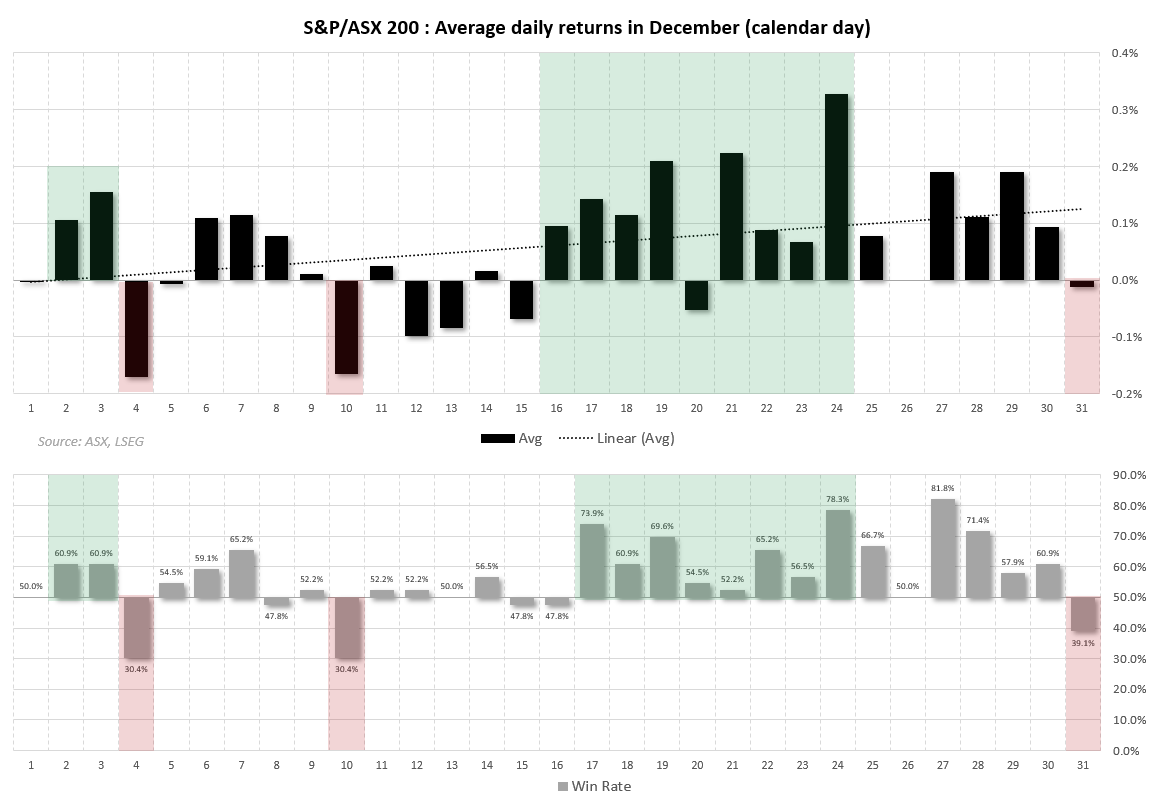
Chart analysis by Matt Simpson - source: ASX, LSEG

ASX 200 Futures (SPI 200) Technical Analysis
The weekly chart shows a bullish piercing pattern after a four-week selloff found support at the long-term 38.2% Fibonacci retracement. This keeps the 8400 region pivotal for sentiment: a break below it would imply a far deeper correction for the Australian share market.
Seasonality does lean supportive into mid-December, but traders should remain flexible.
On the daily chart, momentum has rolled over again, and the 200-day EMA has capped recent upside attempts. Prices are trying to stabilise above the August low, with the 200-day SMA nearby at 8457 to offer potential support.
I suspect bears will continue probing the downside, but may find it difficult to force a clean break below 8500 in the near term. If the ASX can stay supported into 16 December, the odds of a pre-Christmas Santa rally increase, opening scope for a move towards 8750–8800.
However, the seasonal tailwind fades quickly if momentum turns sharply lower again and the index breaks beneath 8400, which would align with the broader decline from its record high.
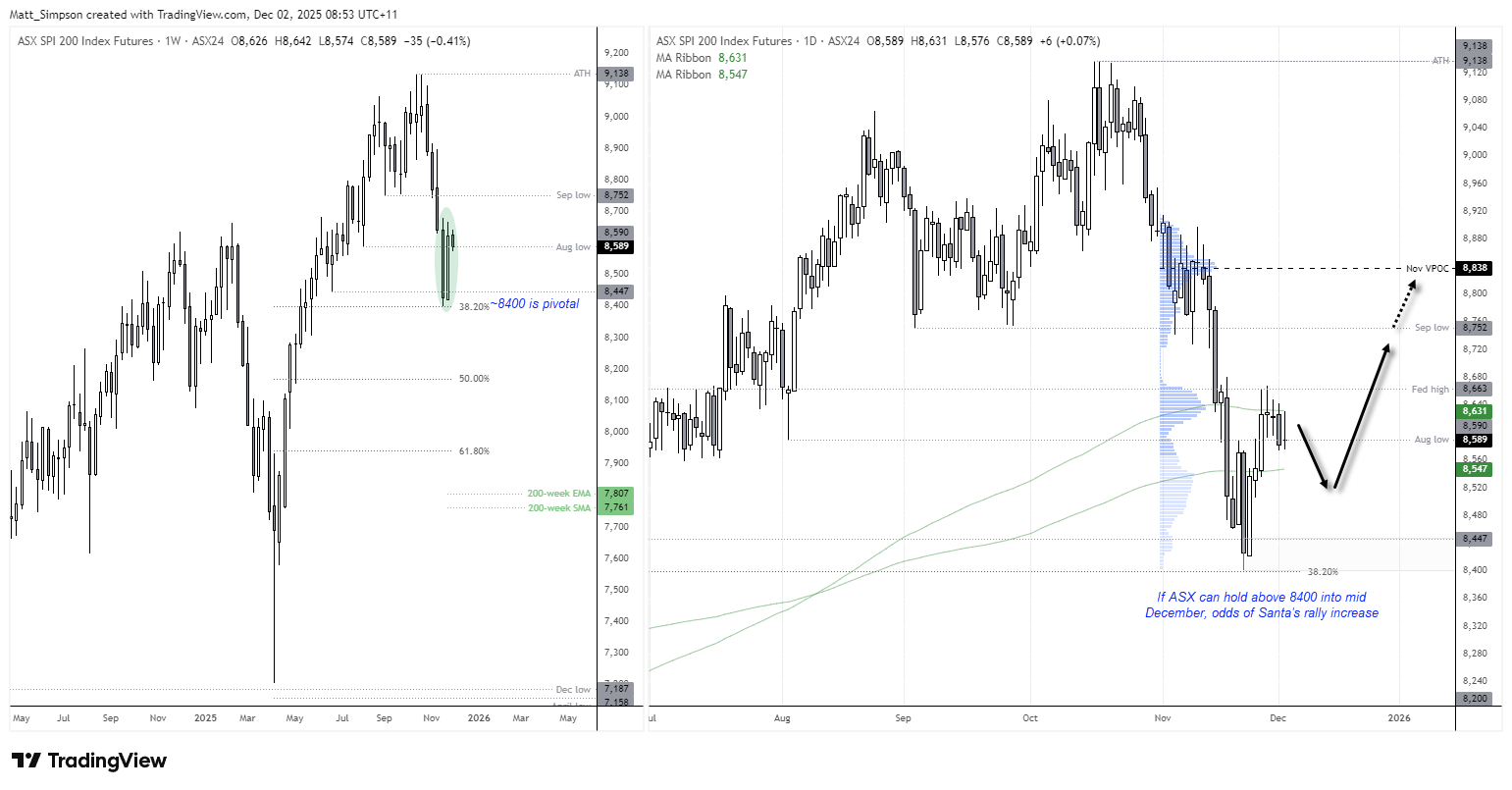
Chart analysis by Matt Simpson - Source: TradingView, ASX SPI 200 Index Futures
View the full economic calendar
-- Written by Matt Simpson
Follow Matt on Twitter @cLeverEdge
How to trade with City Index
You can trade with City Index by following these four easy steps:
- Open an account, or log in if you’re already a customer
• Open an account in the UK
• Open an account in Australia
• Open an account in Singapore
- Search for the market you want to trade in our award-winning platform
- Choose your position and size, and your stop and limit levels
- Place the trade