



The ASX 200 suffered its sharpest fall in eight weeks after hotter-than-expected CPI data killed hopes of another RBA rate cut this year. The index broke lower from a coiling pattern near record highs in a clear bearish range expansion day, with volatility spiking to a two-week high. Financials, Industrials, and Health Care led the declines, while Energy and Materials helped cushion the selloff.
View related analysis:
- ASX 200 Morning Market Outlook: CSL Plunge Drags ASX lower
- ASX 200 Morning Market Outlook: Bulls Lack Wall Street's Pace
- Bitcoin Bounce Fails to Shake Bearish Outlook
- Australian Dollar Outlook: AUD/USD Eyes Volatility Ahead of Fed, AU CPI
CPI Shock Sends ASX 200 and Big 4 Banks Lower
ASX 200 Market Snapshot
- The ASX 200 suffered its worst day in eight weeks following a hot CPI report, which killed any hope of another RBA rate cut this year.
- This marked a clear bearish range expansion day from a coiling pattern near its record high, following a weekly spinning top doji and shooting star candle at the same level.
- Its 1.1% high-to-low range made it the most volatile session in two weeks.
- In sector breadth, 72 ASX 200 stocks advanced, 114 declined, and 14 were unchanged.
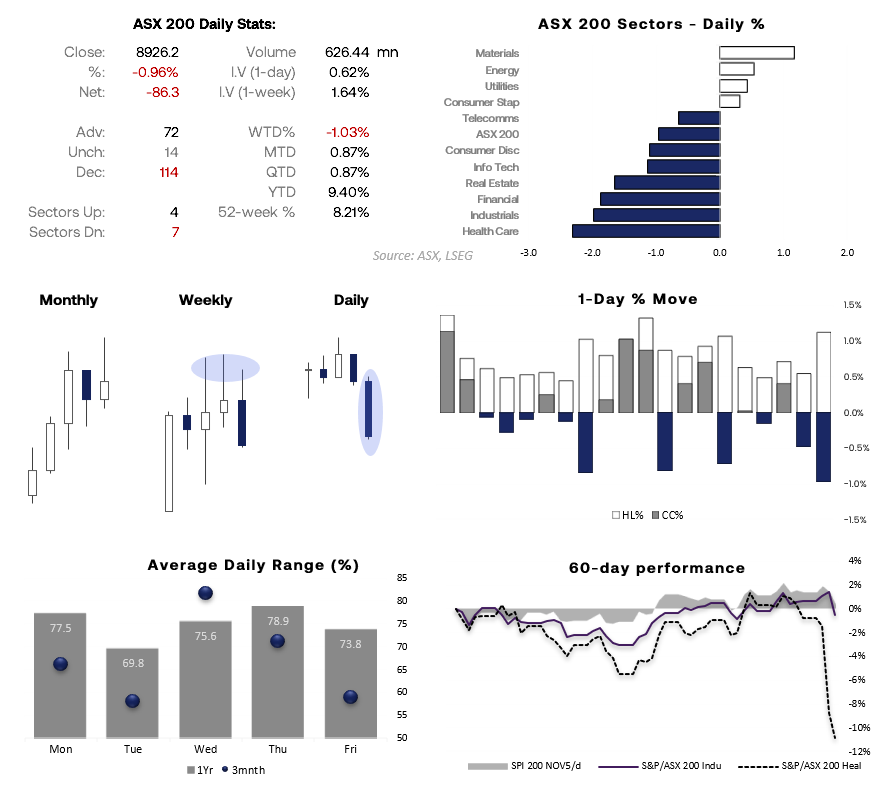
Credit: Chart analysis by Matt Simpson – Source: ASX, LSEG
ASX 200 Sector Analysis
- Seven of the eleven ASX 200 sectors declined, led by Health Care (XHJ), Industrials (XNJ), and Financials (XFJ).
- A bearish engulfing day formed in the Financials (XFJ) sector, with its -1.9% decline marking the worst session in eight weeks, as all four major banks closed lower.
- Industrials (XNJ) fell 2%, its worst day in 18 months, with Transurban (TCL) and Brambles (BXB) both down by a similar amount. Qantas (QAN) dropped 3.2% to a three-month low, also marking its worst day since June.
- Utilities (XUJ) reached a record high for a second consecutive session, with Origin Energy (ORG) climbing to a four-week high and APA Group (APA) to an eight-month high.
- Materials (XMJ) and Energy (XEJ) helped mitigate losses as two of the four sectors to advance on the day.
- Real Estate (XRE) fell 1.65%, its worst performance in eight weeks. Stockland Group (SGP) slumped 3.9% from its record high — also its worst day in 18 months — while Goodman Group (GMG) declined 1.4%, extending its losses for a second session.
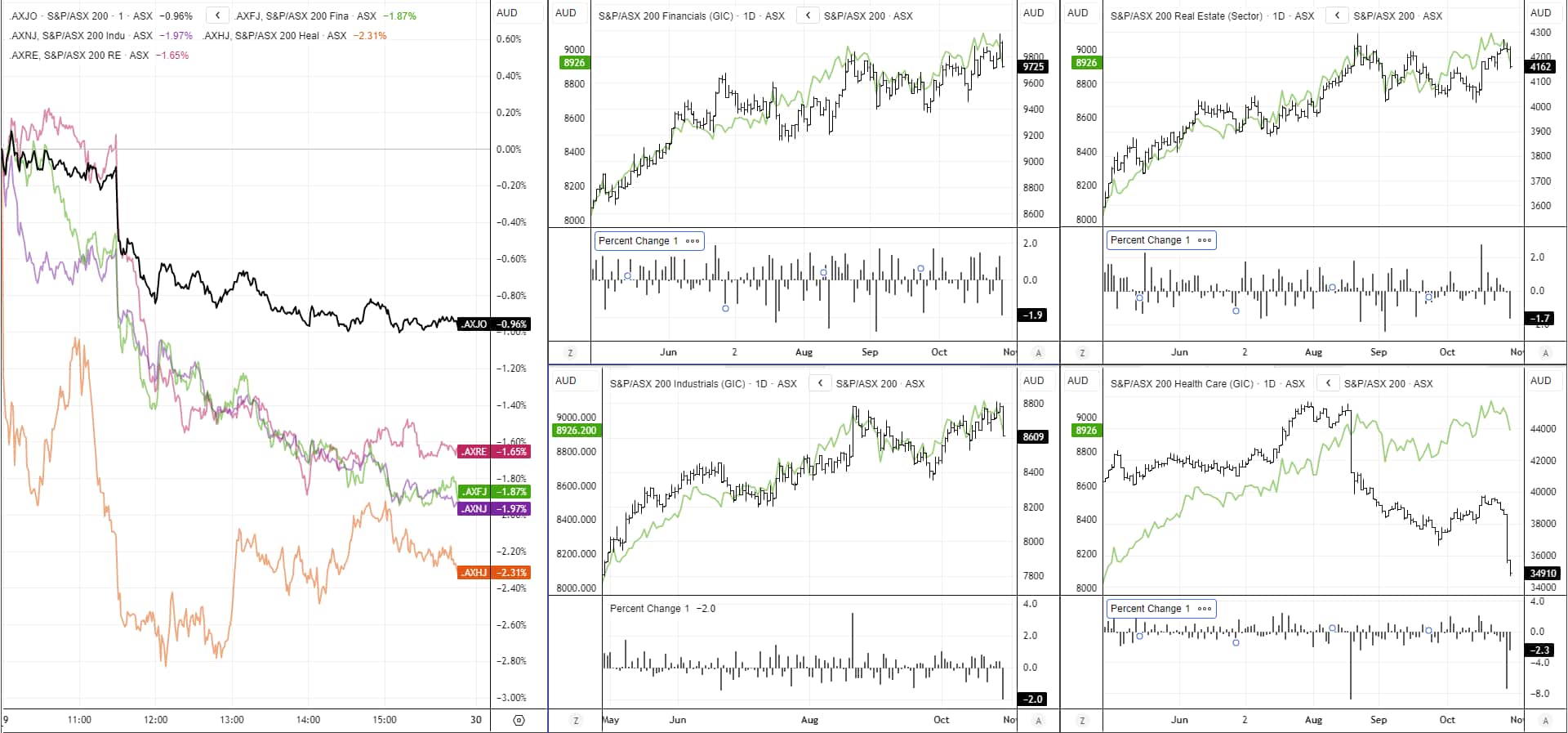
Chart analysis by Matt Simpson - source: ASX, LSEG

Westpac (WBC) Leads Financials Lower
All of the big four ASX banks declined on Wednesday as traders bet that the end of the RBA’s cutting cycle could eat into banking profits.
Westpac (WBC) fell 3% in its worst session in seven weeks, after a second shooting star candle below $40 signalled bulls may have run out of steam. It was the weakest performer of the big four, posting the largest negative delta volume, showing bears were firmly in control. The Westpac/Financials ratio also turned lower, forming a bearish divergence ahead of a potential double top below $40. This could suggest the best of Westpac’s rally is behind it, with a break below the September low potentially next in line.
National Australia Bank (NAB) was the second-weakest performer, down 2.6% by the close. A double top has formed just below $45, and the NAB/Financials ratio has also produced a bearish divergence, hinting at further downside potential.
Commonwealth Bank (CBA) has underperformed the financial sector since June, but the CBA/XFJ ratio has made a higher low while prices have hit new cycle highs. I retain a bullish medium-term bias, expecting dips to remain favourable for buyers.
ANZ Group (ANZ) remains the sector outperformer, showing the most bullish trend structure on both its stock price and ANZ/XFJ ratio. Dips are expected to be shallow and could remain attractive for bulls.
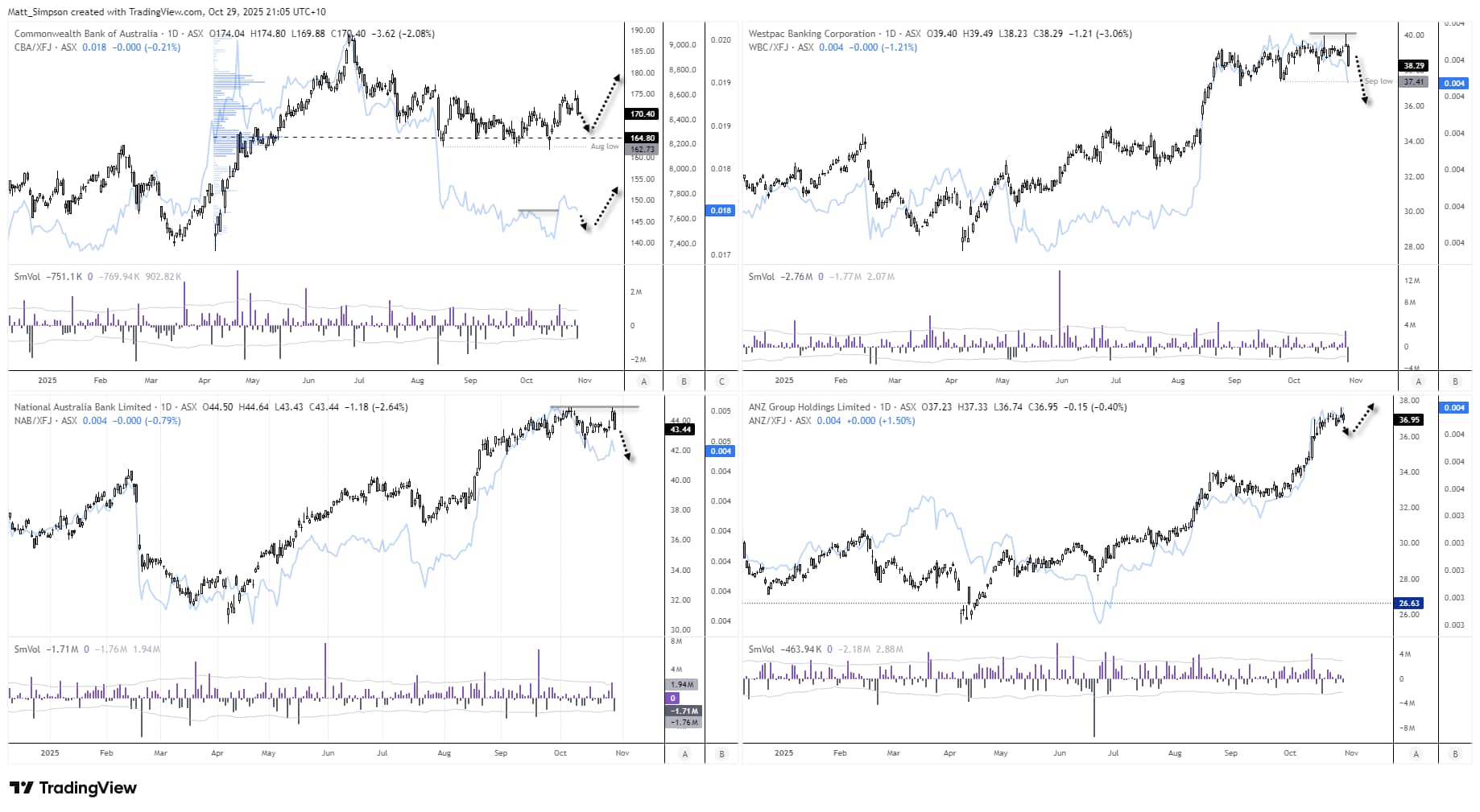
Chart analysis by Matt Simpson - source: TradingView
ASX 200 Futures (SPI 200) Technical Analysis
The market has clearly tipped its hand, with the ASX 200 falling to a 12-day low overnight. Given the bearish signals on weekly candles, the range expansion from the daily coiling pattern near record highs, and continued sectoral weakness, bears may have more to say in the coming weeks.
However, the selloff is already showing early signs of stabilisation above the September VPOC (Volume Point of Control) and October 14 low, while the daily RSI(2) has dipped into oversold territory. Bullish divergences are also forming on the 1-hour RSI(14) and RSI(2). While a dip towards the September VPOC is possible after the open, traders may want to watch for signs of a false break and a countertrend rebound towards the weekly S1 (8945) or 9,000 handle before the next leg lower for the ASX.
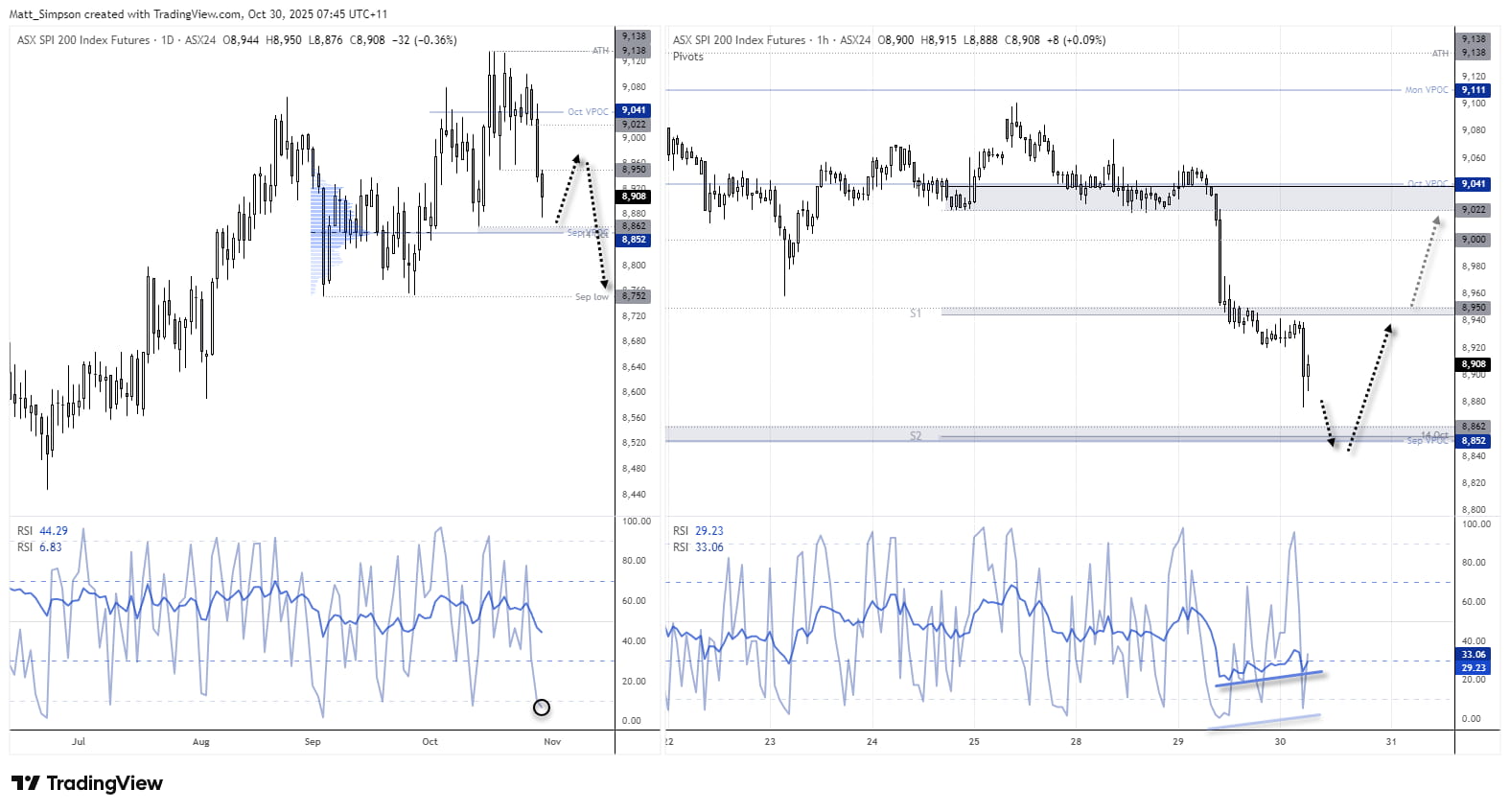
Chart analysis by Matt Simpson - Source: TradingView, ASX SPI 200 Index Futures
View the full economic calendar
-- Written by Matt Simpson
Follow Matt on Twitter @cLeverEdge
How to trade with City Index
You can trade with City Index by following these four easy steps:
- Open an account, or log in if you’re already a customer
• Open an account in the UK
• Open an account in Australia
• Open an account in Singapore
- Search for the market you want to trade in our award-winning platform
- Choose your position and size, and your stop and limit levels
- Place the trade