



- Yuan hits strongest since early 2023, largely ignored
- China relatively insulated from Hormuz disruption
- AUD/USD, NZD/USD break bearish trends
- Correlations show yuan strength feeding through
China’s Relative Insulation Showing Up in FX
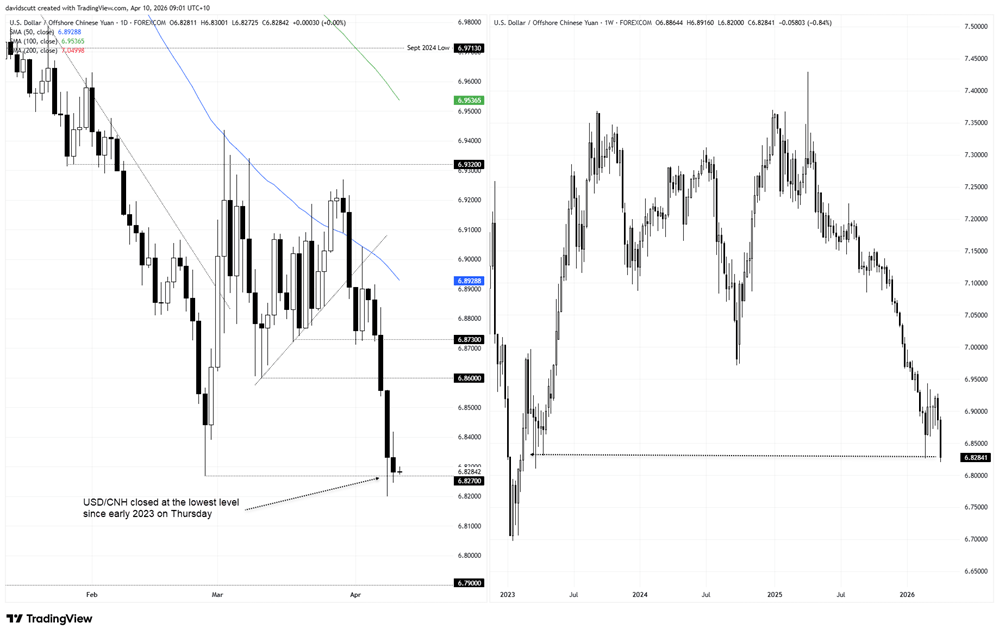
The Chinese yuan is now the strongest it’s been against the US dollar since early 2023, a stealth move that’s got little attention given what’s going on elsewhere in the world.
But step back and it makes sense from a fundamental perspective.
Source: TradingView
China has been one of the few relative beneficiaries from Iran effectively shuttering the Strait of Hormuz. It’s still able to receive energy exports from the Gulf via its relationship with Iran, and it’s built massive energy stockpiles over recent years. While others are dealing with disruption, China isn’t under the same pressure.
That goes some way to explaining the yuan’s recent gains, but it’s not all peaches and cream for the industrial giant. Second derivative effects from the war, especially weaker external demand for Chinese manufactured goods, are clearly not beneficial. But that’s not what’s influencing its performance right now.
Instead, USD/CNH is moving with broader USD direction and energy prices, which remain the chief determinant of broader risk sentiment, with its historic link to yield differentials breaking down. The move lower has been steady and controlled, hinting at heavy involvement from the PBoC to limit fluctuations seen in other currencies against the USD lately.
As two currencies often traded purely as China proxies, the strengthening has likely contributed to the relatively resilient performance of the Australian and New Zealand dollars. Over the past month, the relationship has been clear with correlation coefficients between USD/CNH with AUD/USD and NZD/USD sitting at -0.87 and -0.86 respectively. That means as the yuan has strengthened against the USD, both have tended to move higher alongside it.
Given the linkages, if China is holding up better than others, it helps explain why the Aussie and Kiwi are hanging tough. Add a softer USD and optimism around a US-Iran peace deal ahead of talks in Islamabad starting Friday, and both have broken bearish trends established early in the war over the past week.
While the chief focus for markets will be the peace negotiations over the weekend in Pakistan between the US and Iran, which will be the chief determinant of market performance early next week, before that attention will turn to the inflationary impact of the conflict in both China and the US.
CPI in Focus as Markets Assess War Spillover
Source: TradingView (US Eastern Time)
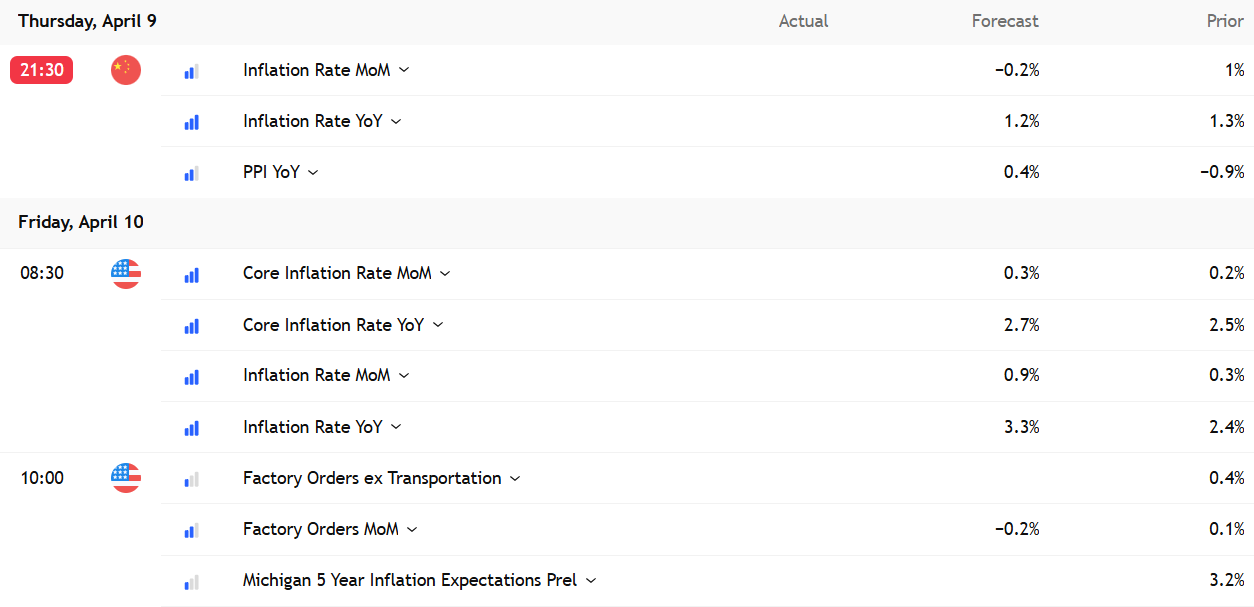
China’s inflation report lands first with the year-ended CPI rate expected to slow a tenth to 1.2%.
The bigger story may sit upstream. The year-ended PPI rate is tipped to turn positive for the first time since September 2022, driven by stronger energy prices. Any evidence that this is spilling over into broader pricing pressures would likely be well received by markets, given the positive implications for industrial margins and downstream inflation and could help bolster the yuan.
The opposite applies if price pressures remain narrowly concentrated in energy, or broader weakness persists elsewhere.
Attention then shifts to the US where March CPI is expected to show a firm lift in the headline driven by energy. The key question is whether that starts to bleed into broader prices.
If the core reading prints above the 0.3% pace expected, it risks reviving pricing for Fed tightening this year, pushing yields higher. If core remains contained, it may feed the backdrop that’s been supporting the move in USD/CNH and the resilience in the antipodeans.
AUD/USD Breakout Clears 50DMA, .7100 in Focus
Source: TradingView
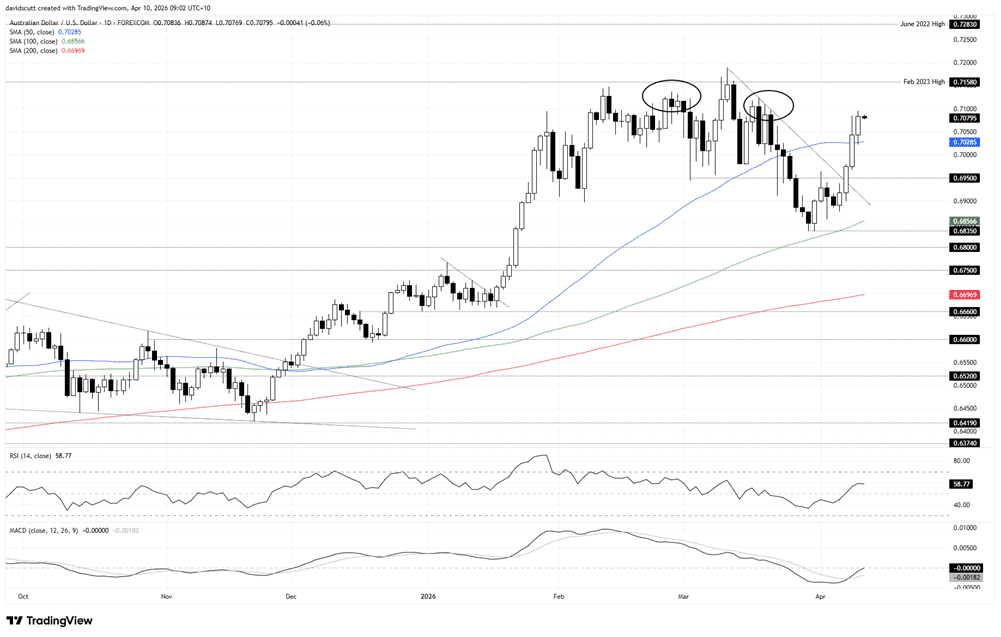
AUD/USD staged a bullish breakout from the intersection of the March downtrend and horizontal resistance at .6950 earlier this week, resulting in a powerful move that lifted the pair above the 50DMA.
The 50DMA was tested for extended periods yesterday and held, making it the first notable level underneath where the price now trades and a reference point for trade setups.
Overhead, the price action in March was messy given the macro backdrop, but it’s notable how AUD/USD struggled above .7100 during that period, making it the zone to watch when considering setups. It hasn’t been tested yet, but keep a close eye on the price action if and when it gets there.
To get excited about a resumption of the prior bullish trend, the price would need to test and break the highs set in early March, with .7283 the next notable level above.
Beneath the 50DMA, .6950 may provide support in the event of a pullback.
The oscillators are providing a mildly bullish signal, marginally favouring upside over downside.
NZD/USD Breaks February Downtrend, MAs in Focus
Source: TradingView
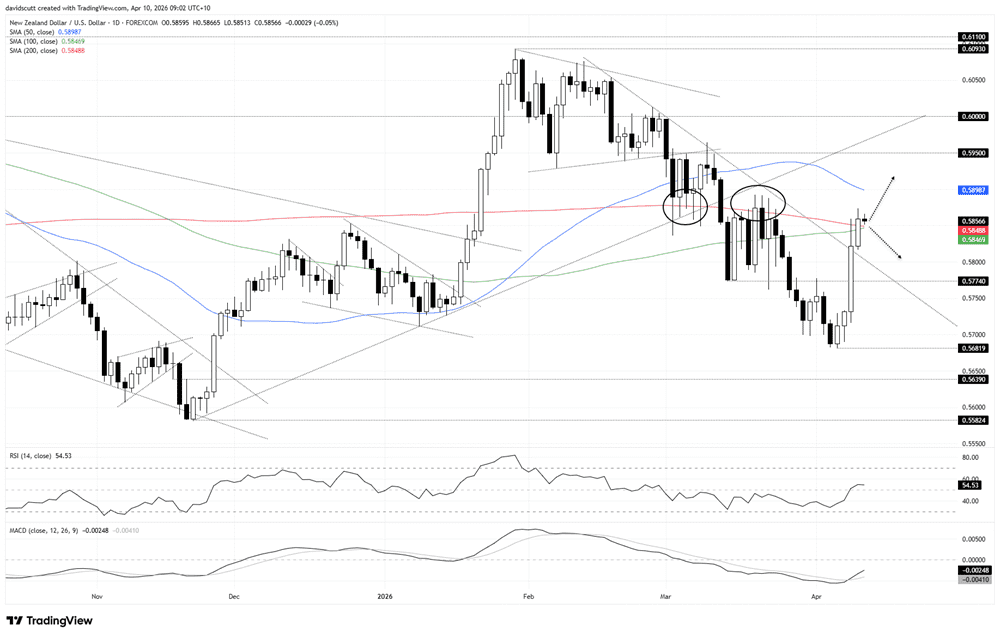
The powerful move sparked on Wednesday from the ceasefire announcement from the US and Iran, alongside a hawkish pivot from the RBNZ, saw NZD/USD break the bearish trend that had been in place since mid-February.
The price held the break through Thursday’s session, allowing the pair to push above the cluster of 100 and 200 day moving averages, providing a handy zone underneath where the price now trades for setup construction. The 200DMA, in particular, should be watched closely if tested.
Overhead, the 50DMA is curling lower, although the price has not been overly observant of it lately. Above that, .5950 and .6000 loom as potential targets for bulls.
If the price cannot hold above the moving average cluster, the February downtrend and .5774 are both obvious downside targets.
The message from the oscillators is more neutral than anything, pointing to the need to keep an open mind on whether to play the kiwi from the long or short side.