



- AUD/USD jumps as Trump signals war exit without reopening Hormuz
- Iran’s demands remain unchanged
- Energy flows still constrained, risk premium likely to persist
- Rally driven by headlines, vulnerable to reversal
Headline relief, unresolved risks
The Aussie dollar ripped higher overnight, driven first by the WSJ report that Trump is willing to end the Iran war without reopening the Strait of Hormuz, then reinforced by his Truth Social post and remarks from the Iranian President about looking to end the conflict.
Understandably, the hint that both sides may be seeking an off ramp has been taken as positive for risk, and that’s been enough to drive a sharp squeeze higher. But has the fundamental backdrop really changed, or was this just a quarter-end risk ramp manufactured by recycled headlines?
No one knows the answer for sure, but Iran has been very clear on the five demands it needs to end the war, at least based on public statements in recent weeks. All of which, unless you’re Donald Trump when it comes to Hormuz it seems, remain totally unacceptable.
So has the Iranian position really shifted? It doesn’t seem so.
Then there’s Trump telling the rest of the world to get their own oil from the Gulf. It’s difficult to square the reaction in stocks and other high beta risk assets with what that actually implies. Iran having effective control of Hormuz, charging tolls and retaining the ability to shut it whenever it chooses, is the kind of risk premium that doesn’t disappear quickly. If anything, it’s something that could be embedded in energy prices for years without a lasting solution that allows for free, unimpeded passage.
The other big sticking point is Israel, and whether it’s willing to deescalate while leaving the same regime in place it’s been trying to remove for decades.
There are still so many unanswered questions, which raises doubts about whether we’ve already seen the worst of the geopolitical shock.
Source: TradingView
Risk will likely rip in Asia on the coattails of the moves overnight, supporting further Aussie strength against the big dollar, but with quarter-end window dressing now done, it still feels like we’re only a headline away from the risk revival unravelling. On that front, the sweet spot for market moving headlines has been shortly after the Japan market open in each of the past two days, making that a key window for traders to stay alert today.
Given the environment, economic data continues to take a back seat, with price action instead dictated by shifts in sentiment and geopolitics.
Aussie behaving like high-beta risk play
Unlike other markets, AUD/USD has not demonstrated a strong direct linkage to energy prices recently.
Using correlation coefficients, which measure how closely two assets move together on a scale from -1 to +1, the relationship with Brent over the past week has been weak and slightly negative at -0.22, telling you energy isn’t directly driving AUD/USD moves.
Instead, the Aussie is behaving more like a speculative asset at the outer edges of the risk spectrum.
Correlations with gold and silver have been far stronger over the same period at 0.85 and 0.95 respectively, while the relationship with S&P 500 futures is positive but less dominant at 0.72, and the inverse link with the VIX sits at -0.69.
Then there’s offshore-traded Chinese yuan, or CNH. The correlation with USD/CNH has been extremely tight at -0.96, pointing squarely to China and geopolitics as the primary drivers.
Put simply, it’s not about Australian data right now, it’s about positioning and geopolitics.
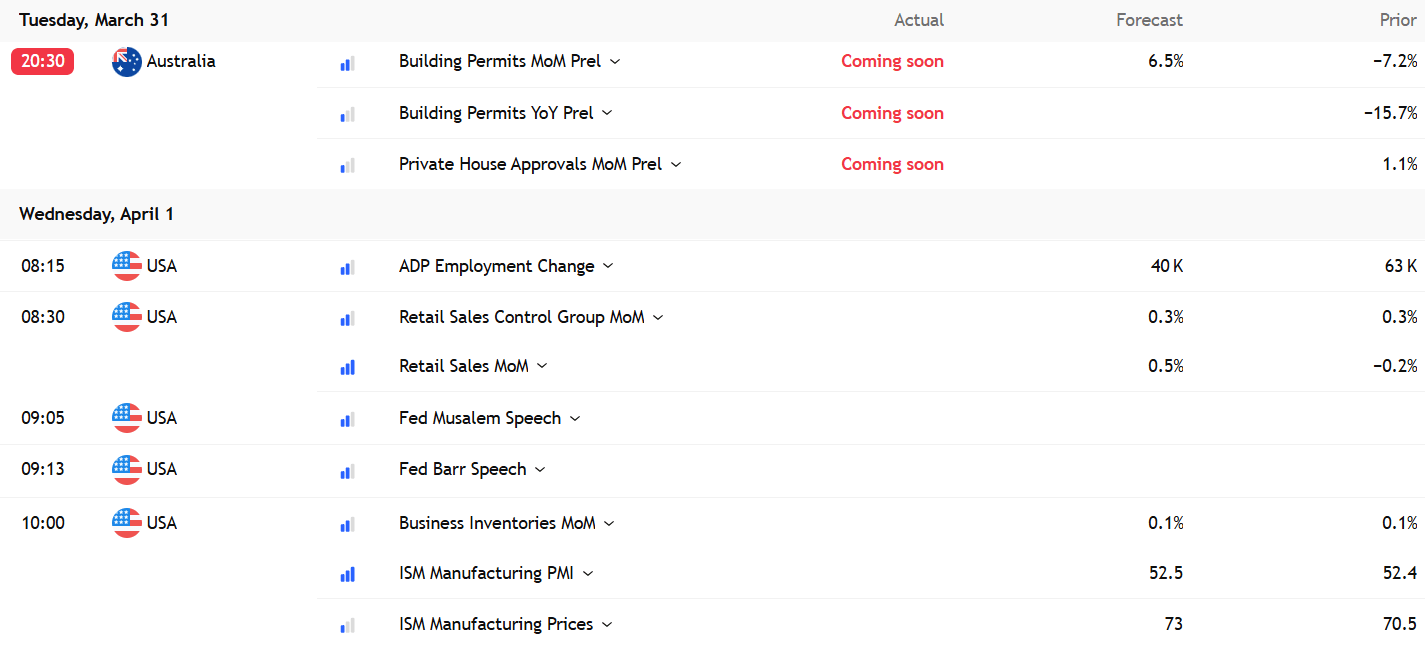
That said, given a strong inverse relationship with the broader DXY of -0.85, incoming US data could still matter at the margin, with ISM manufacturing and retail sales on Wednesday the releases to watch.
Source: TradingView (US EDT)
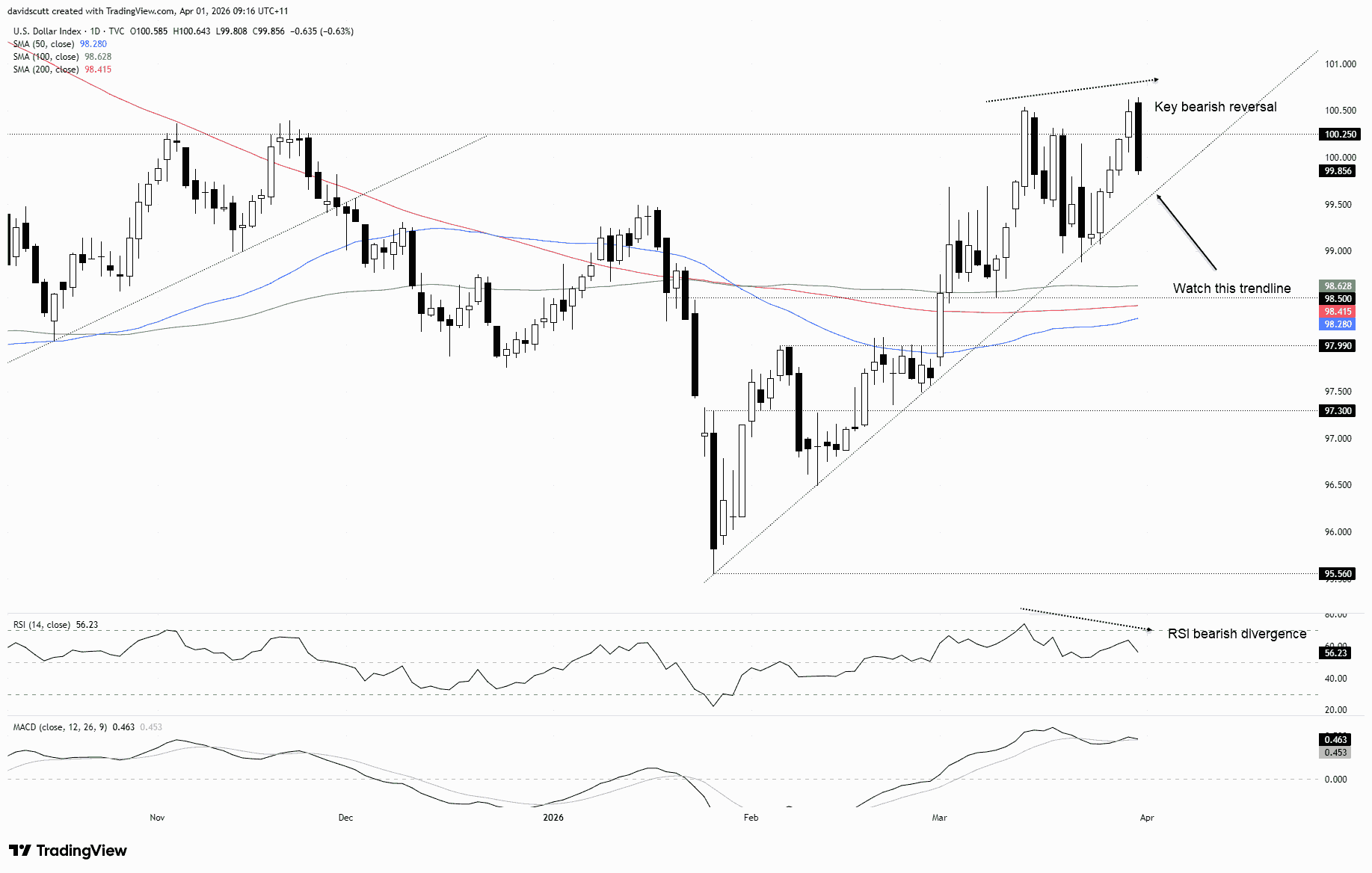
From a technical perspective, the DXY delivered a key reversal candle on Wednesday, signalling the risk of further downside, reinforced by divergence with RSI (14) on the daily and MACD rolling over.
However, before calling the death knell for the big dollar, it still remains in a strong uptrend and above the 50, 100 and 200-day moving averages. Right now, the move looks more like a corrective pullback than the start of a broader bearish trend, something that likely requires a genuine de-escalation backdrop, and we’re not there yet.
AUD/USD bounce with hurdles overhead
Source: TradingView
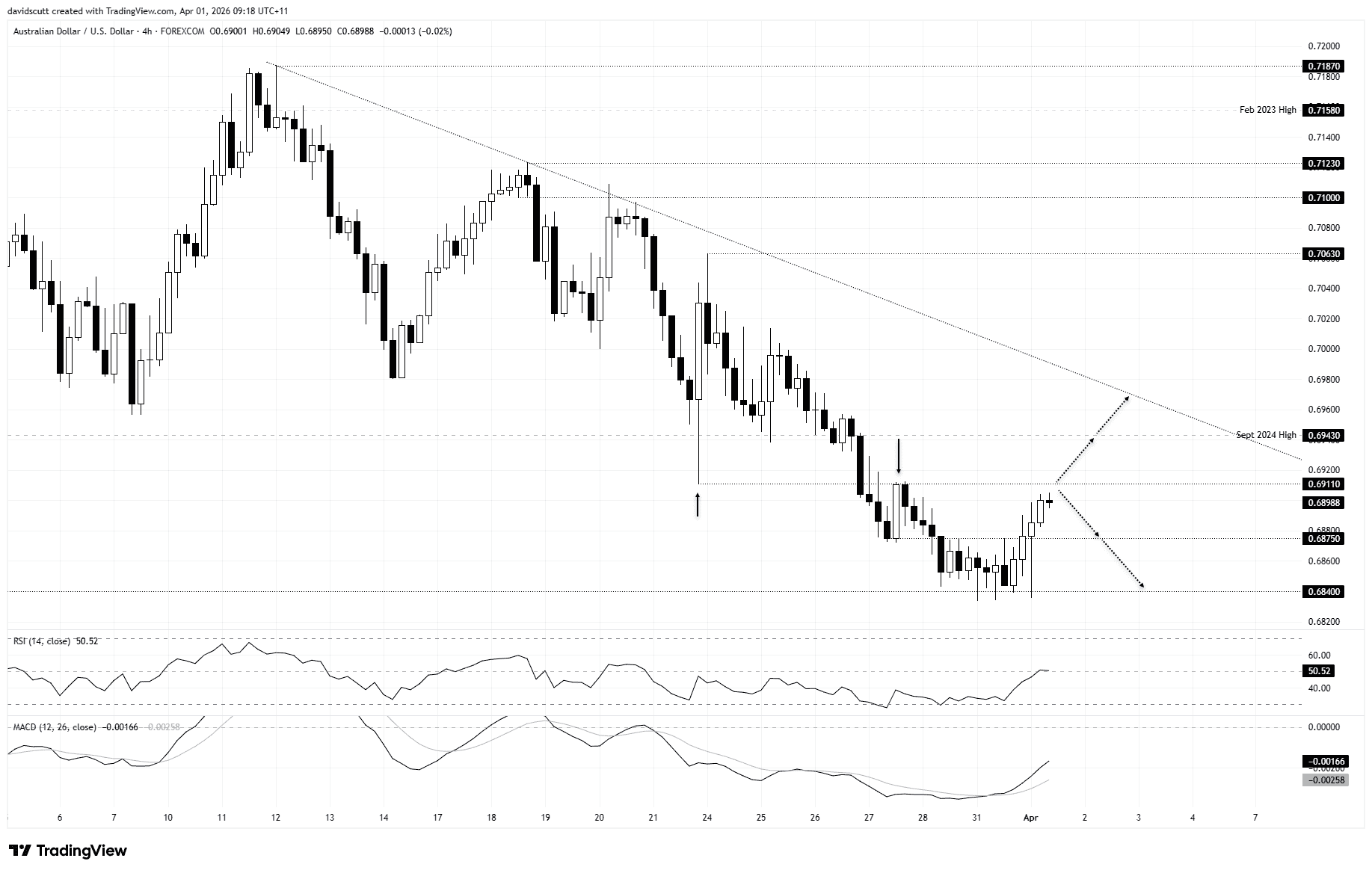
After multiple failed probes beneath .6840 earlier this week, the latest raft of headlines has seen AUD/USD climb away from the level, pushing above minor resistance at .6875 to sit just beneath .6911, the low set on March 21 that capped gains late last week.
That’s the reference point for traders to watch today, not only providing a level for trades to be established but also an opportunity for bulls to weaken the bearish structure that remains in place by setting a higher high for the first time in weeks.
The message from RSI (14) and MACD is neutral when it comes to directional risks, with the former sitting around the 50 level while MACD remains negative despite crossing the signal line from below.
A failure to break .6911 would allow for shorts to be set with a stop above for protection, targeting .6875 initially and .6840 beyond that.
If the price were to break and hold above .6911, longs could be set with a stop beneath for protection, targeting a retest of the September 2024 high at .6943 initially. That’s where accelerated selling kicked in when it gave way last week.
Overhead, the March downtrend, the psychologically important .7000 level and the March 24 high at .7063 are the levels to watch.