


AUD/USD faces a pivotal week as traders weigh the Jackson Hole symposium and the Reserve Bank of New Zealand’s expected rate cut. With downside risks building, the Australian dollar could struggle if the Federal Reserve resists Trump’s calls for aggressive easing.
View related analysis:
- AUD/JPY Dips to Support, Australian Full-Time Jobs Bounce
- AUD/USD, EUR/AUD Technical Outlook: Australian Dollar Under Pressure
- AUD/USD Softens, ASX Hits Record as RBA Cuts and Lowers Cash Rate Projection
AUD/USD Outlook: Jackson Hole and RBNZ in Focus for Australian Dollar
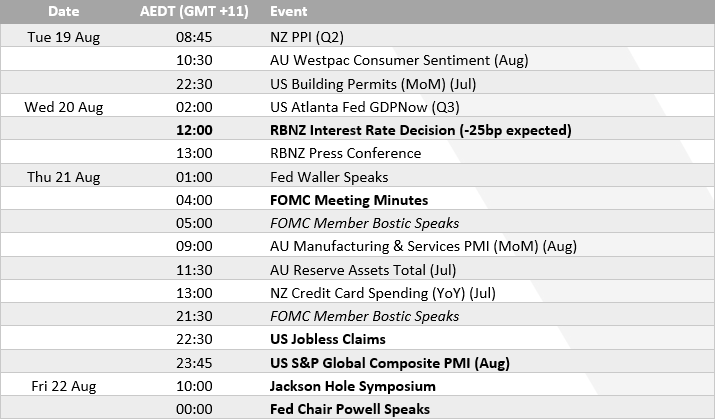
There is a lot of excitement surrounding this year’s Jackson Hole symposium. Not only has it historically served as a platform for the Federal Reserve to shape longer-term monetary policy expectations, but it also arrives at a time when the Fed faces immense pressure from the Trump administration to cut rates. According to Bloomberg, demand is so high that there aren’t enough rooms at the Jackson Lake Lodge to accommodate all the journalists wanting to attend.
This won’t be an easy event for the Fed to navigate, as it weighs the notably weaker Nonfarm Payrolls (NFP) report against rising inflation. To recap: only 73k jobs were added in July versus the 106k expected, while June’s figure was revised sharply lower to just 14k from 147k — a downgrade that resulted in the head of the Bureau of Labor Statistics being fired by Trump. On the inflation side, core CPI rose 3.1% y/y, a five-month high, while the 0.2% m/m gain marked a 34-month high. Producer prices also surged, with headline PPI up 0.8% m/m and core PPI rising 0.6% m/m.
With Trump set to nominate the next Fed chair, I suspect the Fed won’t deliver the dovish speech that some are hoping for. That could support a stronger US dollar. Of course, the reverse is also true — and arguably the more exciting scenario. If the Fed were to lay out a path of multiple cuts, the US dollar could find itself in real trouble.
US employment and PMI data also in focus
Traders will take any scraps of info heading into the Jackson Hole symposium in hope of getting any shred of policy clues. That elevates the importance of the weekly job claims figures, where USD bears may jump onto the back of any weakness in the data in light of weak NFP figures. They will also scrutinise the S&P Global flash PMI report, particularly the new orders, export orders, employment and ‘prices paid‘ components.
RBNZ to cut by 25bp
Meanwhile, the RBNZ is widely expected to cut its overnight cash rate by 25bp to 3% on Wednesday, with 28 of 30 economists polled by Reuters backing the move. AUD/NZD is flirting with a breakout above 1.10, though for rallies to be sustained the RBNZ may need to maintain a clear easing bias.
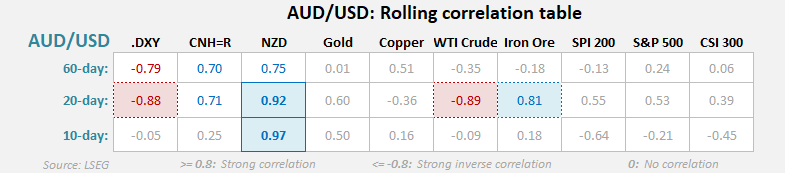
AUD/USD Correlations: NZD Strength, Weak Links to Risk and Commodities
- The Australian and New Zealand dollar relationship remains the strongest, with AUD/USD showing a tighter link to NZD than to the US dollar index or Chinese yuan.
- Over the past 10 days, correlations with Wall Street indices (S&P 500, SPI 200, CSI 300) have turned negative, signalling that risk sentiment is not driving AUD/USD direction.
- Crude oil also shows a weak and inconsistent relationship, while the once solid link between gold and AUD/USD has faded.
AUD/USD Futures Positioning: Net-Short Exposure Climbs as Open Interest Rises
- Bearish exposure increased last week, with net-shorts climbing to a 16-month high among large speculators and a 14-month high among asset managers.
- In both cases, a rise in gross-short positions drove the increase in net-shorts.
- Open interest is also trending higher, signalling fresh bearish initiation behind the move lower.
- This reinforces the view that the bearish engulfing candle two weeks ago was significant, and that last week’s minor bounce was likely a retracement before another leg lower.
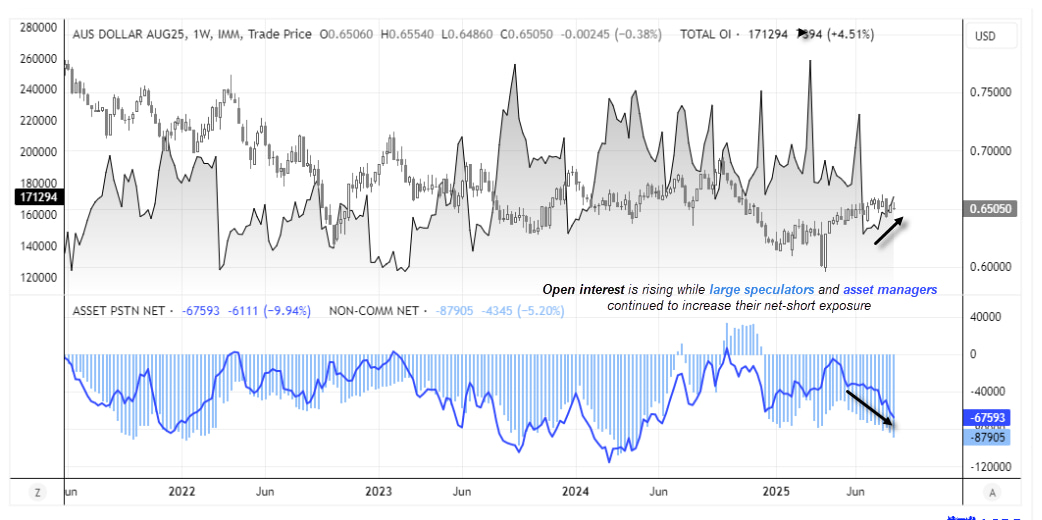
Chart prepared by Matt Simpson - data source: CME, LSEG
AUD/USD Technical Analysis: Australian Dollar vs US Dollar
I find it quite satisfying to see that the high of Thursday’s bearish engulfing candle perfectly respected the July VPOC (volume point of control) as resistance. And inverted hammer formed on Friday above the monthly pivot point and prices are trying to drift higher. Given we now have a bearish engulfing candle on the weekly and daily timeframes (and the pattern is a lower high) my bias is for another leg lower towards 0.6400.
Note the wide range of the 1-week implied volatility band due to Jerome Powell’s speech at Jackson Hole on Friday. We could find that prices action is fickle and therefore tricky to trade heading into the event, which may not be suitable for some. But if we see clear reversal signals around key resistance levels, my bias bearish becomes reinforced.
And if the price action clues are correct, the Fed may not be as dovish as the Trump administration hopes, and that could boost the US dollar and weigh on the Australian dollar.
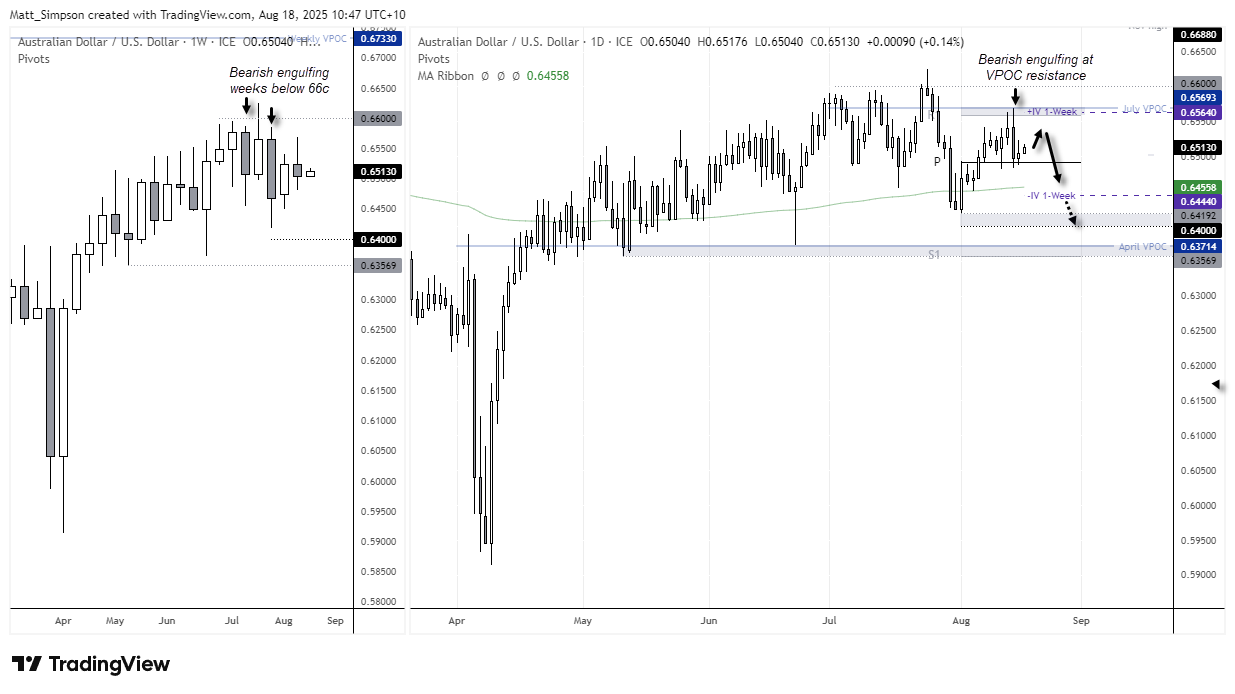
Chart analysis by Matt Simpson - data source: TradingView AUD/USD
-- Written by Matt Simpson
Follow Matt on Twitter @cLeverEdge
How to trade with City Index
You can trade with City Index by following these four easy steps:
- Open an account, or log in if you’re already a customer
• Open an account in the UK
• Open an account in Australia
• Open an account in Singapore
- Search for the market you want to trade in our award-winning platform
- Choose your position and size, and your stop and limit levels
- Place the trade