



The Australian dollar remains stuck in neutral, with AUD/USD unable to break free from its recent range. Volatility is compressed, correlations are fading, and price action suggests markets are waiting for an external catalyst rather than trading domestic fundamentals.
Geopolitical risks and key US data releases dominate the near-term outlook, skewing risks modestly lower for AUD/USD. While Australian yields remain elevated and Reserve Bank of Australia (RBA) hike speculation lingers, these factors have so far failed to generate sustained upside.
Until a clearer driver emerges, AUD/USD looks set to remain rangebound, with traders focused on geopolitics, US data surprises and shifts in broader risk sentiment.
View related analysis:
- ASX 200 Market Outlook: Materials Surge, CBA Support Defies Bears
- Australian Dollar Price Action Setups: AUD/USD, AUD/JPY, EUR/AUD
- FX Futures Positioning: EUR/USD, USD/CHF, USD/CAD, USD/JPY | COT Report
- Australian Dollar Outlook: AUD/USD Momentum Falters Near Highs
Australian Dollar Snapshot: Mixed Signals Across FX Crosses
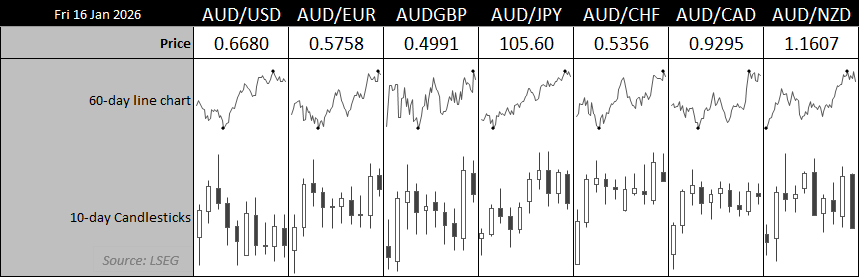
The Australian dollar continues to trade without a clear directional bias, with mixed signals across major FX crosses and volatility remaining compressed.
- NZD/USD was the strongest major FX pair last week, supported by business confidence rising to a 12-year high and firmer manufacturing PMI. This added a modest lift to Reserve Bank of New Zealand (RBNZ) hike expectations following a prolonged easing cycle.
- AUD/NZD formed a bearish inside day on Friday, alongside a two-week bearish reversal pattern (dark cloud cover), warning of potential weakness after its strong rally from the 2025 low.
- AUD/USD was flat for a second consecutive week, with realised volatility at its lowest in 12 weeks and a weekly high-to-low range below 1%.
- The Australian dollar pushed higher against the euro, sending EUR/AUD to its most bearish weekly close in 42 weeks.
- A shooting-star week formed on AUD/JPY, warning of exhaustion following its 24% rally from the April low.
Data source: CME, LSEG

Geopolitical Risks and US Data Keep AUD/USD Capped
Geopolitical risks continue to build, with President Trump threatening tariffs on countries opposing a US hostile takeover of Greenland — a stance that naturally places Denmark in the firing line. Whether this is a serious policy threat or just another throwaway comment remains to be seen. But given the US kicked off the year with a hostile takeover of Venezuela, nothing can be ruled out for now.
Geopolitics aside, key US data this week includes GDP and PCE inflation. Neither is likely to be a major market mover, but both arguably carry more upside risk for the US dollar than downside. That dynamic could cap near-term upside for AUD/USD.
December Employment: Seasonal Boost or False Signal?
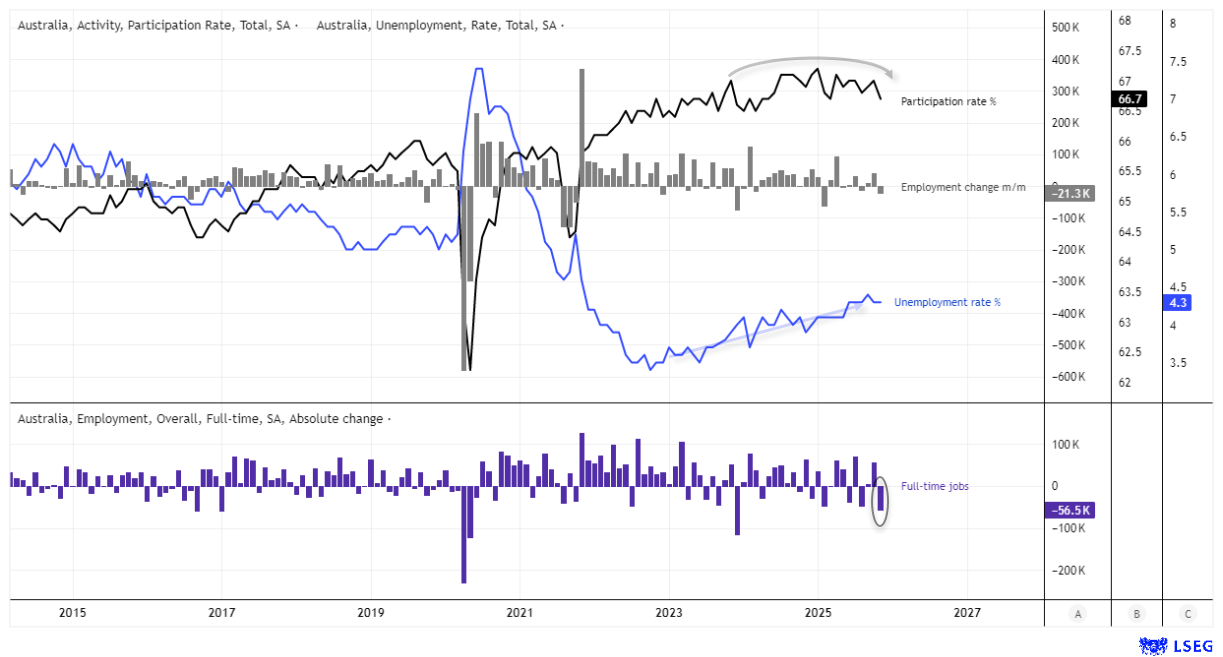
December employment figures are released on Thursday and could recoup some of the softness seen in November’s data. Headline employment fell by 21.3k, with full-time jobs down 56.5k. The participation rate slipped to 66.7%, while unemployment remained steady at 4.3%. With seasonality potentially boosting the December print, a stronger result could reignite speculation around a Reserve Bank of Australia (RBA) hike.
Data source: ABS, LSEG
However, December labour data is notoriously noisy. Students enter the workforce during the long summer break, while hiring in hospitality, retail and tourism often spikes. Beyond these temporary boosts, productivity arguably softens.
For those outside Australia, school holidays can run for around two months, it is the hottest time of the year, and “holiday mode” is deeply ingrained in the culture. As a result, it is difficult to read too much into December employment figures from a fundamental perspective — even if markets still react to the headline.
|
Date |
AEDT (GMT +11) |
Event |
|
Mon 19 Jan |
10:00 |
AU MI Inflation Gauge |
|
|
12:00 |
CN GDP, Industrial Production, Retail Sales, |
|
Tue 20 Jan |
12:15 |
CN PBoC Loan Prime Rate |
|
|
12:30 |
CN House Prices (Sep) |
|
|
13:00 |
CN GDP (Q3), Industrial Production, Retail Sales (Sep) |
|
Wed 21 Jan |
11:30 |
AU Building Activity, Engineering Construction Activity |
|
|
13:00 |
NZ Credit Card Spending (Sep) |
|
Thu 22 Jan |
08:45 |
NZ Electronic Card Retail Sales (MoM) (Dec) |
|
|
11:30 |
AU Labour Force Report (Dec) |
|
|
23:30 |
US Preliminary GDP (Q3), Jobless Claims, |
|
Fri 23 Jan |
02:00 |
US Core PCE Price Index, Income, Consumption (Nov) |
|
|
08:45 |
NZ CPI (Q4) |
|
|
09:00 |
AU PMI |
|
|
11:30 |
AU Employee Earnings and Hours, Australia |
AUD/USD Futures Positioning – COT Report
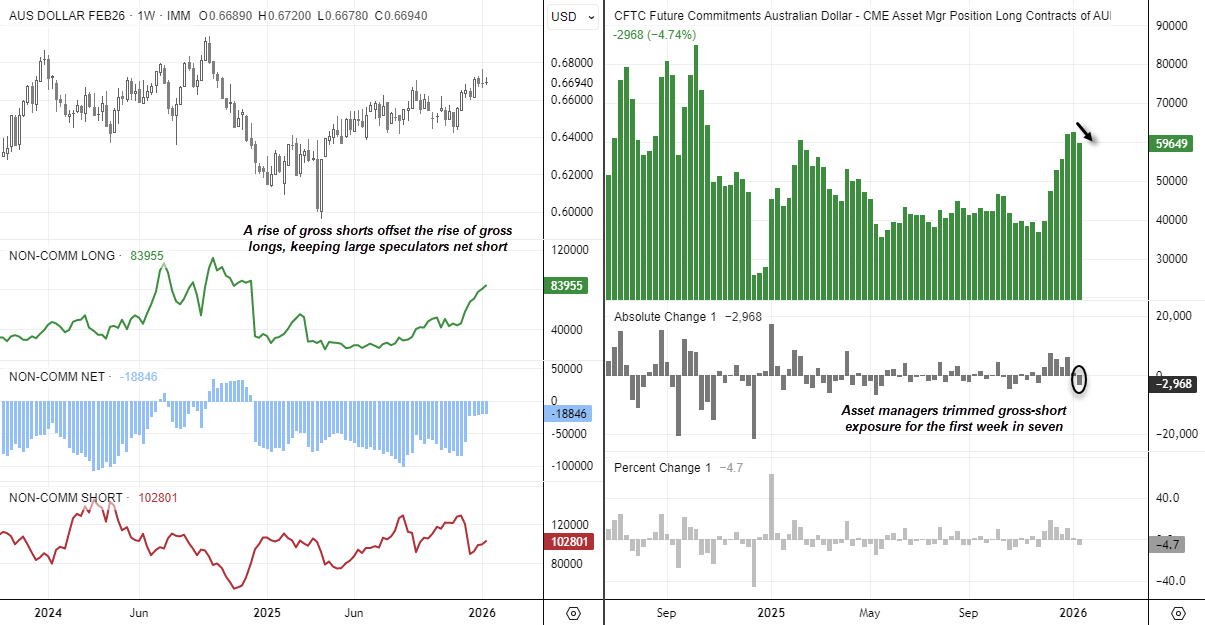
Net short exposure among large speculators was effectively flat, as a 3.5k rise in gross shorts offset a similar increase in gross longs, which rose for a sixth consecutive week. Asset managers trimmed gross-long exposure by around 3k contracts — their first reduction in seven weeks.
These are marginal changes at best and suggest the recent reduction in net-short exposure is losing momentum rather than reversing outright.
Data source: CME, LSEG

Divergent AUD/USD Signals Between Options and Bonds
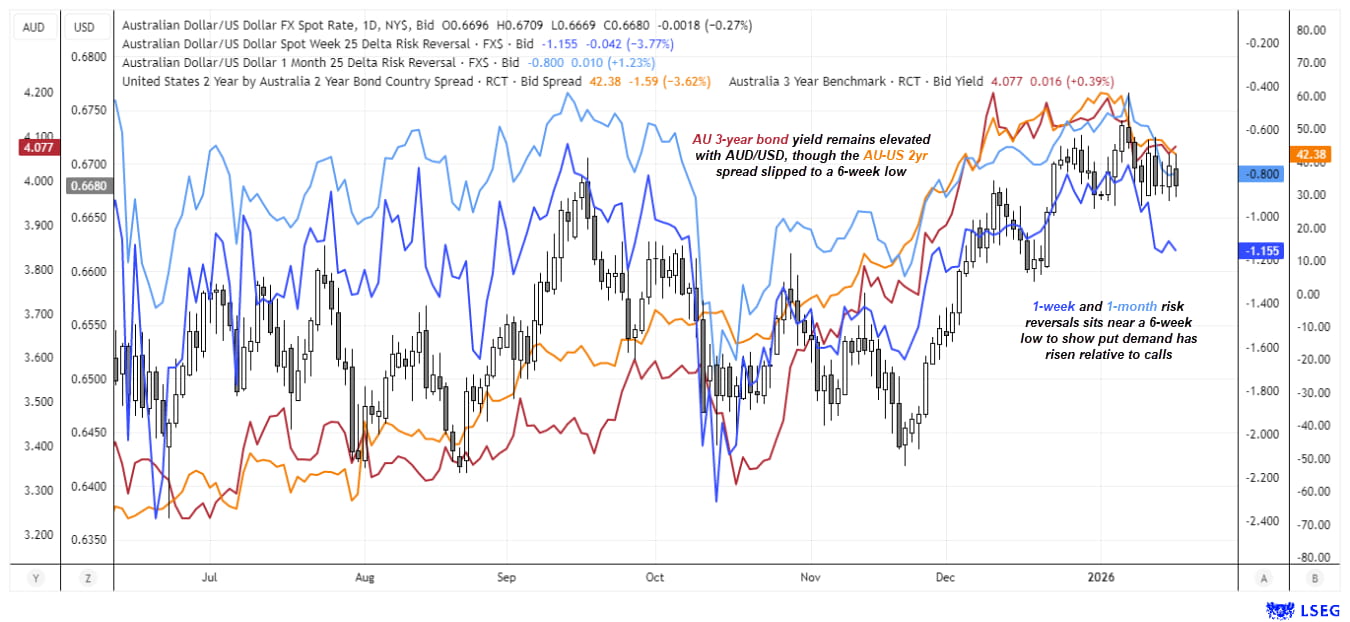
Options markets and yield differentials point to a mild downside bias for the Australian dollar, even as the closely watched 3-year bond yield remains elevated. Reserve Bank of Australia (RBA) hike risks remain on the radar — albeit low — helping keep the 3-year yield above recent lows alongside the Aussie.
However, the AU–US 2-year yield spread has fallen to a six-week low, in line with softer 1-week and 1-month risk reversals. That signals rising put demand relative to calls. The implication is a modest downside bias for AUD/USD, which would likely deepen if geopolitical risks escalate or tech earnings weigh on broader risk sentiment.
Data source: LSEG
AUD/USD Correlations Fade as Market Awaits a Catalyst
Traditional correlations with AUD/USD continue to break down. Last week, NZD/USD was the only pair showing a strong relationship, and even that has now faded. The simple explanation is that the Australian dollar remains rangebound.
Markets appear to be waiting for a fresh catalyst — either confirmation that the Reserve Bank of Australia (RBA) will hike, or a sufficiently bearish shock to overwhelm monetary policy expectations.
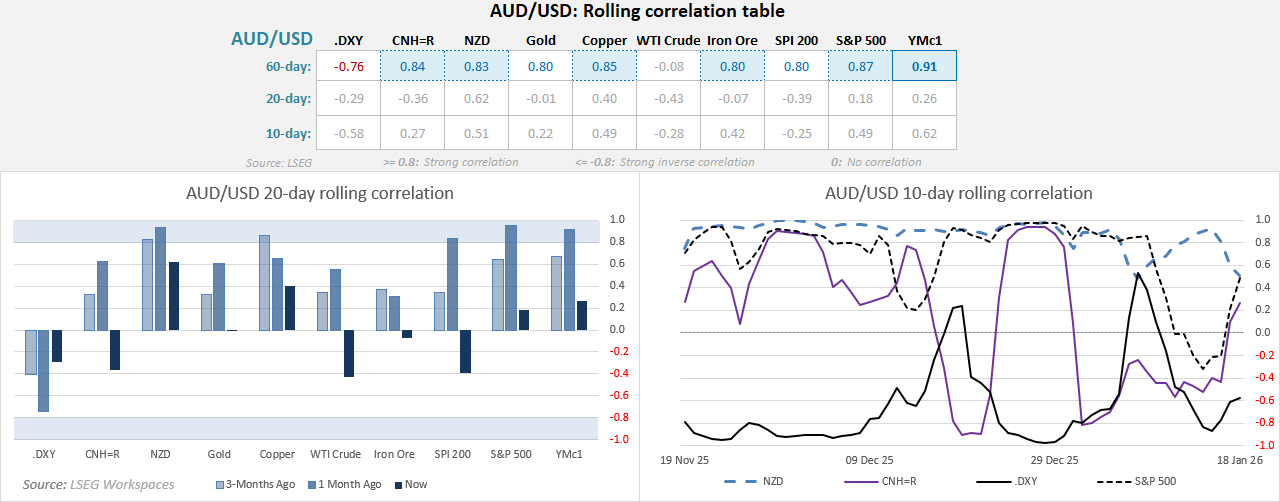
Chart analysis by Matt Simpson – Data source: LSEG

AUD/USD Technical Analysis
There is little to update from last week, aside from another shooting-star candle on the weekly chart, reinforcing signs of trend exhaustion. Last week’s high met resistance around 0.67, yet there has still been no meaningful bearish follow-through.
While risk reversals warn of a pullback, any retracement may prove shallow, with buyers likely lurking around the 0.6640 and 0.6600 support zones.

Source: LSEG
View the full economic calendar
-- Written by Matt Simpson
Follow Matt on Twitter @cLeverEdge
How to trade with City Index
You can trade with City Index by following these four easy steps:
- Open an account, or log in if you’re already a customer
• Open an account in the UK
• Open an account in Australia
• Open an account in Singapore
- Search for the market you want to trade in our award-winning platform
- Choose your position and size, and your stop and limit levels
- Place the trade