



Although recent BTC price action has started to show a mild bullish bias in the short term, with a streak of three consecutive positive sessions and gains of more than 4.00%, this move is still not strong enough to establish a clearly dominant bullish trend. This is partly because, despite the gradual recovery in overall market confidence, network activity in BTC does not yet reflect a fully stabilized demand.
It is possible that, despite the recent price recovery, as long as on-chain activity does not show more solid figures, the current move could continue to stall within a neutral range or a relevant phase of indecision in the coming trading sessions.

Improving tensions fail to stabilize demand
Recent trading sessions have been particularly relevant for market risk sentiment, as comments from President Trump have started to point toward a potential de-escalation of the conflict in the Middle East. Although no concrete progress has been made in peace negotiations, there have been mentions of reducing U.S. military presence in the region, which could eventually lead to a withdrawal and a moderation of the tensions seen in recent weeks.
This has started to impact financial markets, generating increased appetite for risk assets such as U.S. equities. However, although Bitcoin can also be considered a risk asset, the temporary improvement in confidence has not been enough to sustain consistent demand.
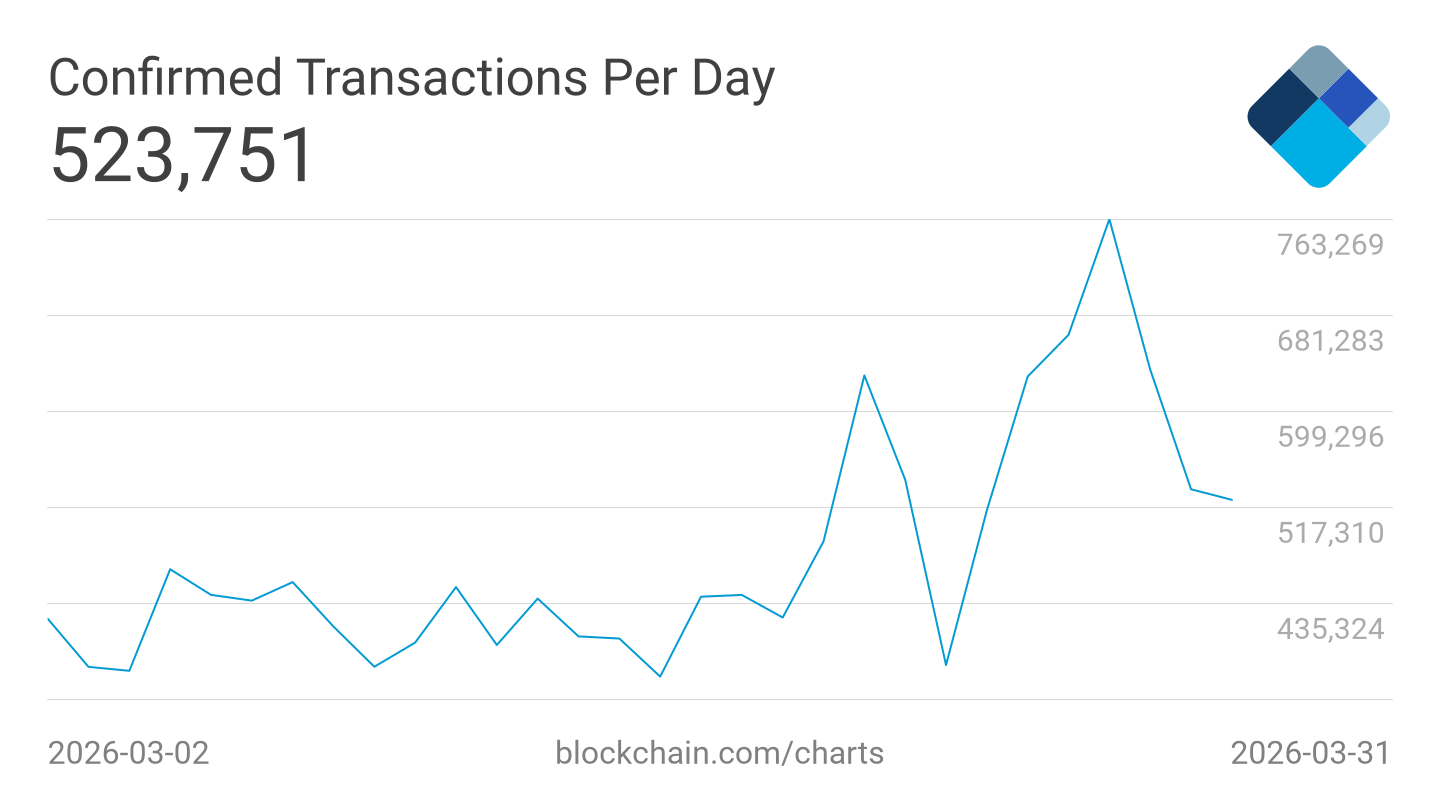
This can be observed in the confirmed transactions indicator within the BTC network, which has shown a gradual decline in activity, dropping from more than 700,000 transactions on March 27 to just above 500,000 currently. This suggests that, although price has recovered, network participation is not keeping pace, limiting the sustainability of the current demand.
Source: Blockchain.com
This behavior, rather than positioning Bitcoin as a preferred market asset, reflects that its current relationship with traditional risk or safe-haven assets is relatively limited. While other markets have shown more defined movements in recent weeks, BTC has stood out for its persistent neutrality, suggesting that capital flows are being directed toward other assets.
Taking all this into account, Bitcoin may not be attracting enough interest to rebuild strong demand in the short term. Even if de-escalation in the Middle East is confirmed, this may not translate into a strong bullish bias, but rather into the continuation of an indecisive market phase in the near term.
The recovery in confidence fails to stabilize
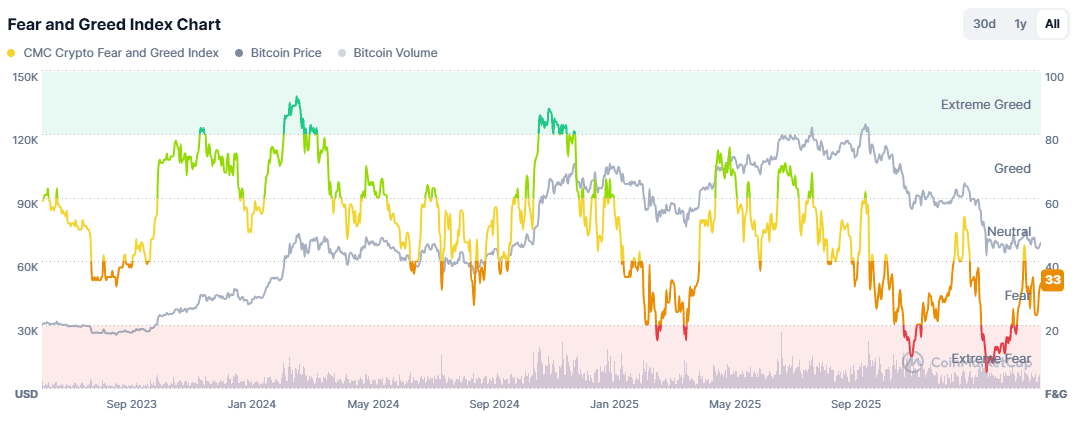
Recent movements in the crypto Fear and Greed Index show a decline from the “neutral” zone, now hovering around 33 points, back in “fear” territory. This reflects that the recovery in market confidence has not been sustained, keeping risk perception elevated within the crypto market.
Source: Coinmarketcap
This is particularly relevant because weak confidence levels do not create the conditions needed for consistent demand in cryptocurrencies. In part, this explains the recent bullish moves in BTC, which, although present, remain limited in scope. As long as confidence indicators do not show a more structural recovery, the market is likely to continue reflecting a dynamic of uncertainty and sideways movement in the short term.
Bitcoin Technical Outlook
Source: StoneX, Tradingview
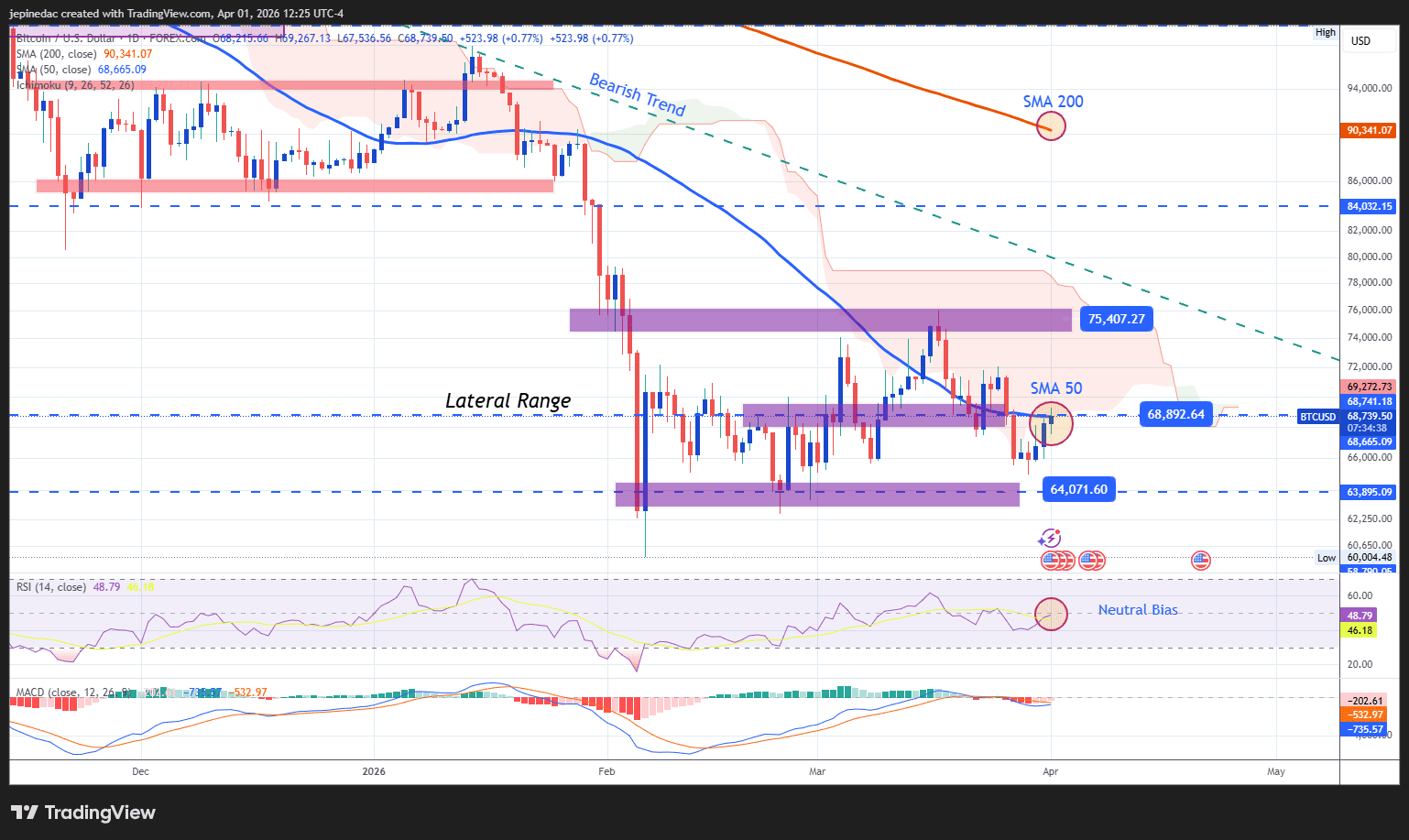
- Range-bound structure gaining relevance: BTC price action in recent weeks has not shown a clear directional phase, and the market is now facing a potential sideways range between the $75,000 resistance and the $64,000 support. As long as price remains within these levels, neutral conditions are likely to dominate, keeping indecision as the main short-term pattern on the daily chart.
- RSI: The indicator remains close to the 50 neutral level, suggesting a balance between buying and selling momentum in the short term. If this continues, the neutral phase is likely to remain relevant in price action.
- MACD: The indicator shows a similar picture, with the histogram hovering around the zero line, reflecting a balance in short-term moving average strength. This reinforces the idea that indecision remains a key component of the current market structure.
Key levels:
- 75,000 – Key resistance: This level represents the upper boundary of the current range. A breakout above this zone could trigger a new bullish bias, potentially challenging the longer-term downtrend line.
- 69,000 – Near-term barrier: A neutral level aligned with the 50-period simple moving average. Price action around this level could continue to reinforce a sideways trading environment in the near term.
- 64,900 – Key support: A recent low and the main downside barrier on the chart. A consistent break below this level could reactivate a dominant bearish bias and extend the current downtrend in the short and medium term.
Written by Julian Pineda, CFA, CMT – Market Analyst
Follow him on: @julianpineda25