



Recent sessions have been challenging for the Canadian dollar in the short term, as USD/CAD has extended a streak of six consecutive bullish sessions, with gains of around 1.5% in favor of the U.S. dollar. This move is beginning to establish a solid bullish bias in the short term.
For now, buying pressure remains consistent, driven by the interest rate differential and the role of the U.S. dollar as a safe-haven asset amid ongoing tensions in the Middle East. As long as these factors persist, buying pressure could remain relevant in the coming sessions.

Are central banks still driving the move?
One of the most relevant dynamics in recent weeks has been the stance of the Federal Reserve, which continues to maintain a more aggressive approach in the short term. In recent remarks, Fed Chair Jerome Powell emphasized that inflation remains a key concern and that there is no urgency to cut interest rates, reinforcing a stable policy outlook.
On the other hand, the Bank of Canada is following a similar path, maintaining a hold stance despite recent inflation data (1.8% in February) coming in below the 2.00% target. In theory, this could provide room for adjustments, but for now both central banks are prioritizing policy stability through much of 2026.
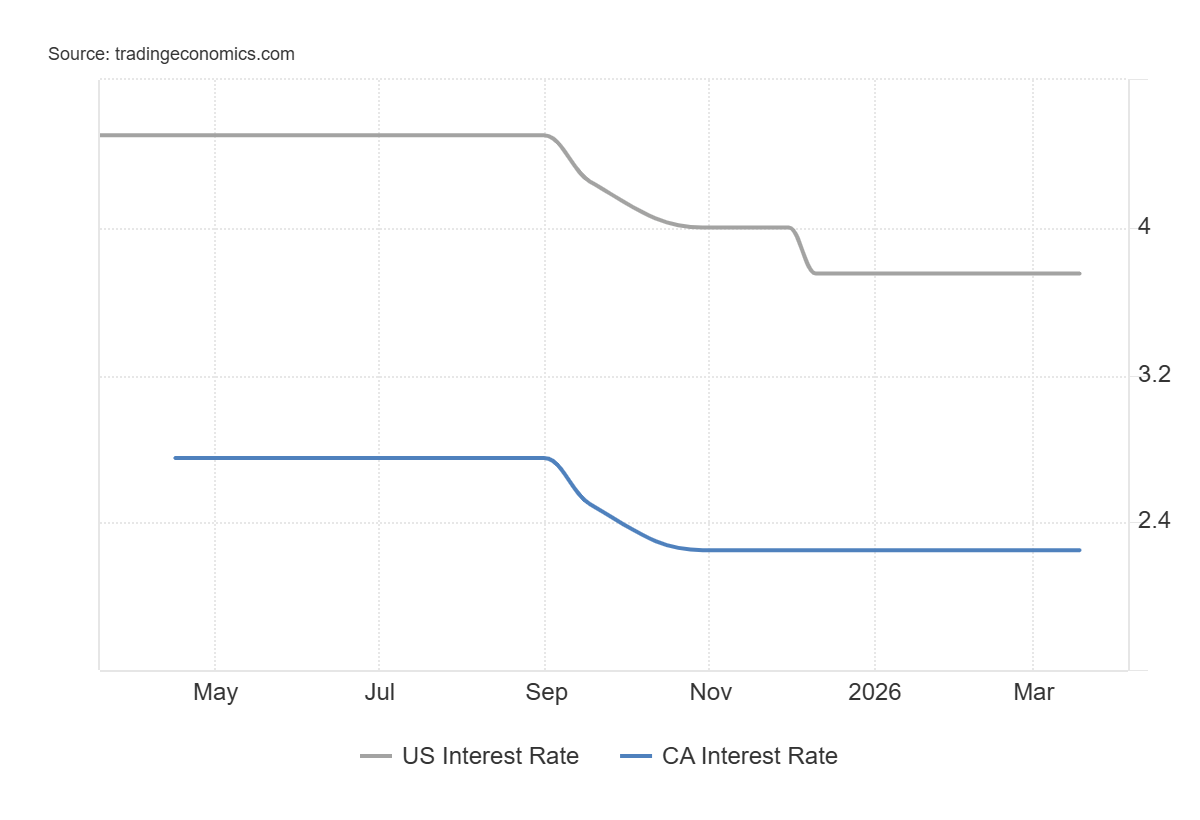
What stands out in this environment is that the rate differential continues to favor the United States. Currently, the U.S. policy rate stands at 3.75%, while Canada remains at 2.25%, which continues to support the attractiveness of U.S. dollar–denominated investments over Canadian dollar assets.
Source: TradingEconomics
In this context, as long as the market expects this differential to remain in place, demand for the U.S. dollar is likely to stay stronger than for the Canadian dollar. If no signs of narrowing emerge, this could continue to support sustained buying pressure in USD/CAD.
Is the dollar still acting as a safe haven?
As the conflict in the Middle East continues and the prospect of a short-term resolution fades, tensions between the United States and Iran keep escalating. Meanwhile, WTI crude oil remains above the $100 per barrel level, reflecting ongoing uncertainty in the market.
In this environment, the U.S. dollar continues to stand out as a safe-haven asset, as markets seek liquidity during periods of elevated risk. Recent statements from former President Trump regarding potential actions targeting energy infrastructure have further reinforced this perception.
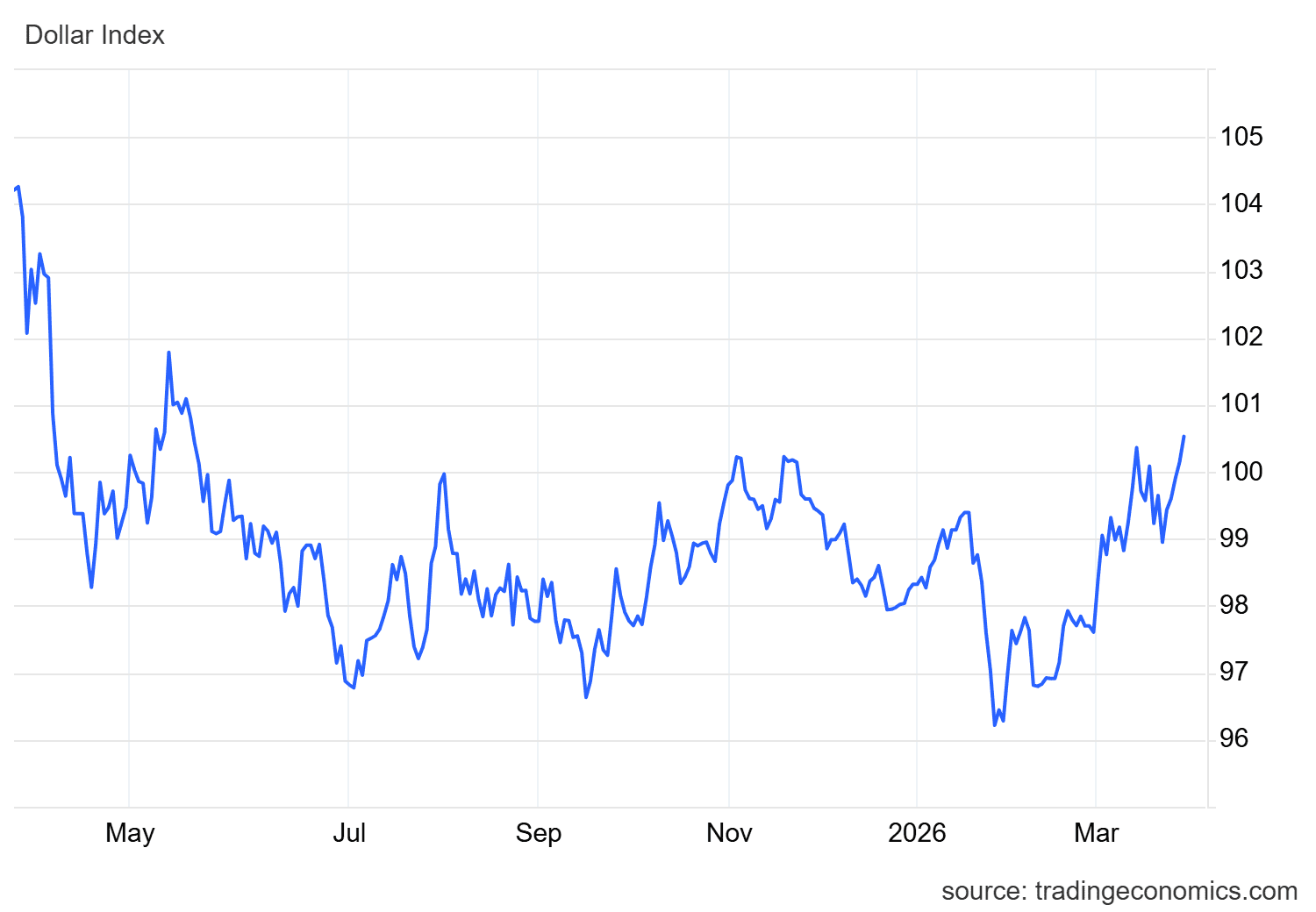
This is reflected in the DXY index, which measures the strength of the dollar against its main peers, and has once again moved above the 100 level, showing a renewed bullish momentum.
Source: TradingEconomics
This factor remains critical, as stronger demand for the dollar could continue to weigh on currencies such as the Canadian dollar. If the DXY continues to push higher, it could translate into more consistent buying pressure in USD/CAD in the short term.
USD/CAD Technical Outlook
Source: StoneX, Tradingview
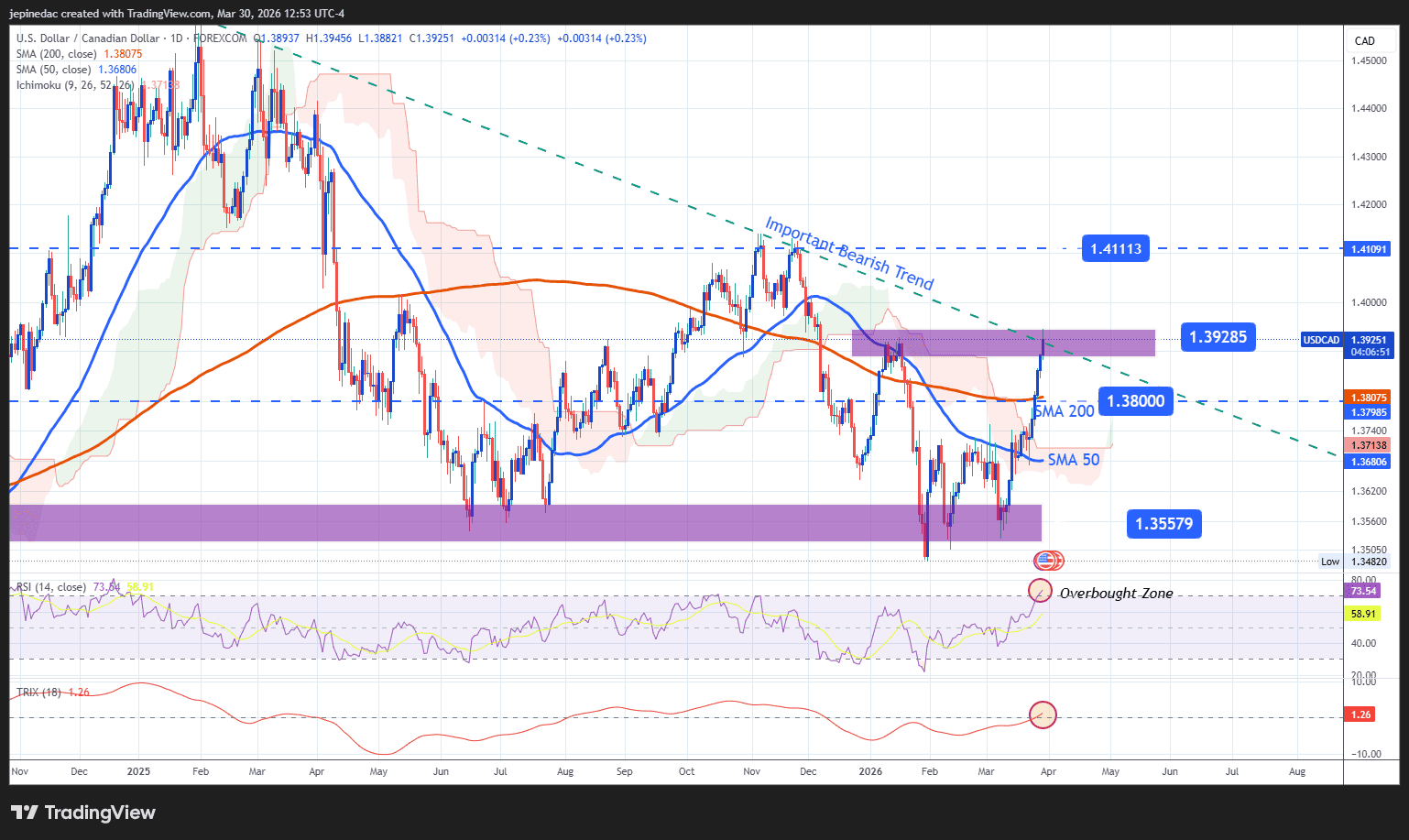
- The long-term trendline enters a key test zone: Since late November 2025, USD/CAD has maintained a consistent downward structure, forming a descending trendline on the daily chart, which has been the dominant pattern in recent months. However, the recent strength in the U.S. dollar has pushed price to test this trendline. If the current bullish momentum holds, this could lead to a break of the dominant bearish structure, opening the door to a potential trend shift. At the same time, it is important to note that short-term pullbacks remain possible after the strong recent rally.
- RSI: The RSI is currently above the 70 level, indicating that the market has entered overbought territory. This suggests that recent bullish momentum may be overstretched, increasing the likelihood of short-term corrective moves.
- TRIX: The TRIX indicator has moved above the zero line, signaling that long-term exponential moving average momentum has shifted into a bullish bias, reinforcing the relevance of buying pressure in the medium term.
Key levels:
- 1.41113 – Key resistance: A level aligned with recent highs and positioned above the descending trendline. Moves toward this area could confirm bullish dominance and open the door to a new upward trend.
- 1.39285 – Key barrier: A level aligned with the descending trendline. Sustained moves above this zone could invalidate the bearish structure and reinforce the bullish bias in the coming sessions.
- 1.38000 – Key support: A nearby level aligned with the 200-period moving average, which could act as a key reference point in the event of short-term corrections.
Written by Julian Pineda, CFA, CMT – Market Analyst
Follow him on: @julianpineda25