


Oil markets were jolted at the open after U.S. airstrikes on Iran's nuclear sites reignited fears of a broader conflict in the Middle East. The Strait of Hormuz—a vital artery for global energy flows—has now become the focal point for traders, with Iranian lawmakers voting symbolically to shut it in retaliation. While the Supreme National Security Council must approve the decision, even the possibility of a closure could send oil prices soaring beyond $100 per barrel. For now, markets remain in limbo, caught between escalation risk and hope for de-escalation.
View related analysis:
- Crude Oil Outlook: Will WTI Extend Gains or Fade as Middle East Tensions Peak?
- Gold Outlook: Seasonal Weakness and Fading Momentum Hint at June Pullback
- Gold Price Outlook: Can Bearish Technical Setup and June Weakness Align?
- Australian Dollar Outlook: Will AUD/USD Follow NZD/USD Lower?
TACO Turns to Tension as Iran Threatens Strait Closure
On Friday, I hypothesized that Trump’s two-week deliberation over whether the U.S. would get directly involved in the Israel–Iran conflict could turn into his latest TACO trade. But that view was quickly annulled by weekend headlines confirming that the U.S. had struck three of Iran’s nuclear facilities.
TACO — Wall Street shorthand for “Trump Always Chickens Out” — emerged during past trade negotiations, where his tough talk was often followed by watered-down deals that boosted risk assets. So it came as a genuine surprise when reports surfaced that the U.S. had launched direct attacks on Iran’s military sites. Trump announced via Truth Social: “We have completed our very successful attack on the three Nuclear sites in Iran, including Fordow, Natanz, and Esfahan.” He later addressed the nation, warning that “future attacks will be far greater and easier” unless Iran agrees to peace.
Strait of Hormuz in Focus as Iran Weighs Retaliation
The ball is now firmly in Iran’s court. And Iran’s parliament has already voted to retaliate by shutting down the Strait of Hormuz in response to the U.S. strikes. While the vote is symbolic for now—pending approval from the Supreme National Security Council—it’s a move that could have serious implications for the conflict, oil markets, and global economic growth.
The Strait of Hormuz is one of the world’s most strategically important waterways, particularly for energy trade. Roughly 20% of global oil supply (~17 million barrels per day) passes through it daily, along with about 25% of the world’s liquefied natural gas (LNG). Any disruption to this chokepoint—or even credible fears of one—could send energy prices sharply higher. A return to $100+ oil is not out of the question.
• WTI crude oil gapped higher by $4.16 ($5.63) at the open, briefly trading at a 20-month high of $78
• Brent crude oil rose $3.28 ($4.26) to an 11-month high of $80.30
• Wall Street futures were lower, with S&P 500 opening –0.98% lower, Nasdaq futures down -0.9% and Dow Jones down -0.6% at the open
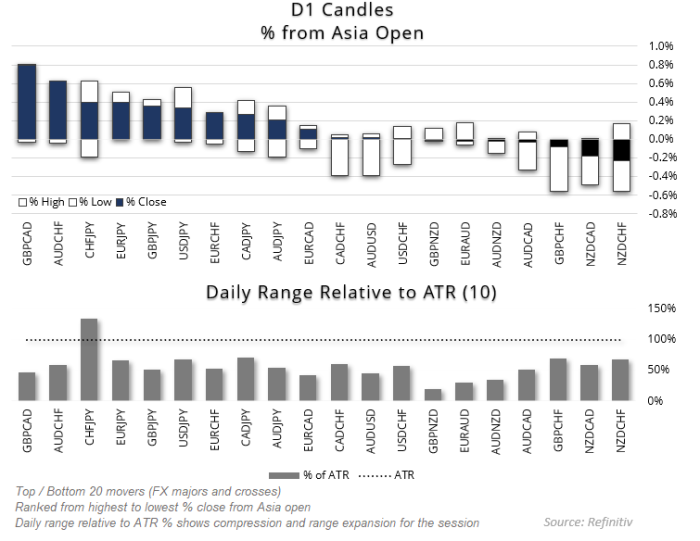
• The Australian dollar (AUD/USD) is down -0.42% at the time of writing, and trades just 24 pips above the 64c handle
• The New Zealand dollar (NZD/USD) is tracking the Aussie, with both sitting around 3-week lows
• The Swiss franc (CHF) continues to be favoured as the safe-haven currency of choice over the Japanese yen (JPY) with CHF/JPY rising to an 11-month high and breaching the 179 handle (a symmetrical triangle target sits around 180)

WTI Crude Oil Futures (CL) Technical Analysis
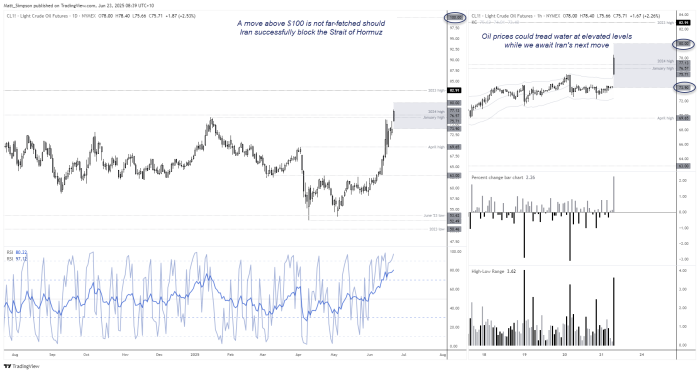
It was practically a given that crude oil prices would gap higher at today’s open. WTI briefly traded above $78 but has already closed around 50% of the opening gap. Whether we’ll see a bullish continuation or sharp reversal likely comes down to if — or how — Iran retaliates.
A sharp move to and beyond the 2023 high ($82.91) is on the cards should Iran strike the Strait of Hormuz. But until then, we may find ourselves in limbo. Oil prices could tread water at elevated levels without committing to further gains, whereas Iran’s surrender could spark a sharp fall in crude oil prices and prompt a risk-on rally.
For now, I suspect oil prices will remain above Friday’s close ($73.84) and the $70–$80 zone as we await Iran’s next move. In either case, Iran holds sentiment in its hands right now, and economic data is likely on the backburner.