


A consistent neutral bias has begun to consolidate in WTI crude price action, as recurring announcements related to geopolitical tensions have increased uncertainty in the energy market over the short term. For now, average price fluctuations over the past four sessions have been limited to around 3%, a move that remains insufficient to define a clear directional trend. This behavior reinforces the view that a phase of indecision has taken hold in the short term and, unless clear signals of renewed confidence or a de-escalation of tensions that directly affect production emerge, this neutral environment is likely to persist over the coming trading sessions.

What Could Happen with Production?
Several days after the capture of Venezuela’s president, speculation continues to build around the potential impact this event could have on Venezuelan crude production. In recent statements, the U.S. government has indicated that it is considering an ambitious strategy to leverage the country’s vast oil reserves with the aim of increasing global production and potentially generating a price-reducing effect that could ease energy costs for both companies and consumers.
There has also been discussion around the possibility of indefinitely controlling Venezuelan oil sales, alongside the imposition of additional sanctions in the event of a lack of short-term cooperation. Nevertheless, the primary objective of the United States appears to be encouraging the entry of U.S.-based companies to help increase Venezuelan oil output in the coming months.
At the same time, OPEC+, the world’s most influential oil-producing bloc, decided to keep production levels unchanged following its most recent meeting on January 4, ruling out supply adjustments for now despite heightened uncertainty in the energy market. The organization did not directly address the situation in Venezuela nor issue public comments, reflecting a cautious stance, while also refraining from signaling potential output cuts to stabilize crude prices in the short term.
Taking all of the above into account, the perception of a potential oversupply of crude has not faded. OPEC+ continues to operate at elevated production levels, in line with the increases recorded during the final months of 2025. Moreover, if U.S. intervention begins to translate into a reactivation of Venezuela’s oil industry, an additional increase in supply could materialize. This backdrop has contributed to a lack of clear direction in oil prices, even after the uncertainty generated by the military intervention days earlier.
As long as the market continues to perceive that oil production is not pointing toward near-term cuts, oversupply concerns may keep weighing on prices, favoring an environment of indecision or weakness in WTI crude over the coming sessions, with no clear directional signal at this stage.
What About Market Confidence?
At present, the MM User Sentiment Indicator shows that bullish sentiment toward oil stands at 15.56%, while neutral sentiment has increased to 44.44%, and bearish sentiment remains close to 40%. This distribution reflects a market clearly dominated by neutrality and caution, with limited short-term bullish conviction.
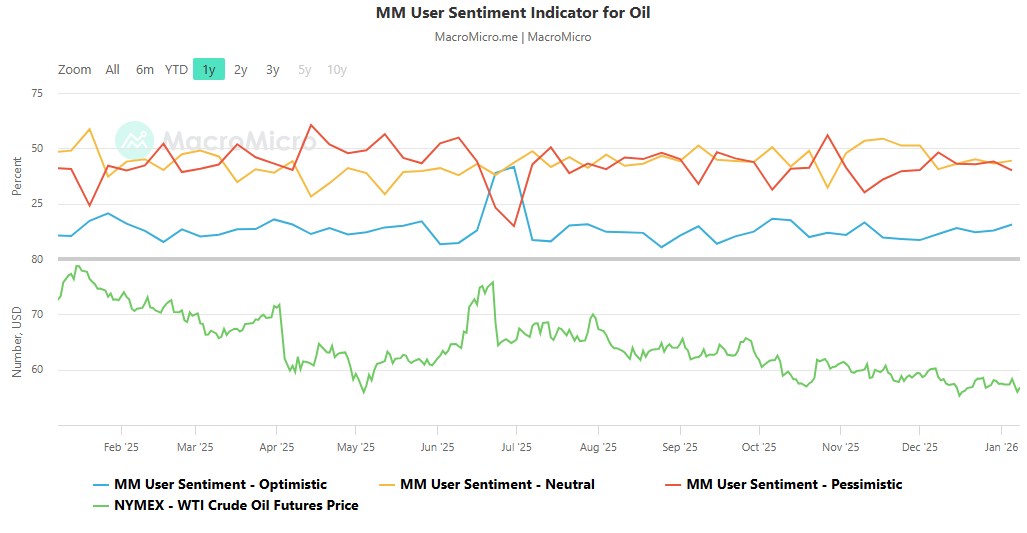
Source: Macromicro
This scenario suggests that market confidence is going through a prolonged period of uncertainty, with few signals pointing to solid demand capable of pushing prices higher. As long as neutral and bearish sentiment levels remain elevated, WTI crude is likely to continue exhibiting an indecisive phase, a pattern that has characterized the market since the military intervention in Venezuela.
WTI Technical Outlook
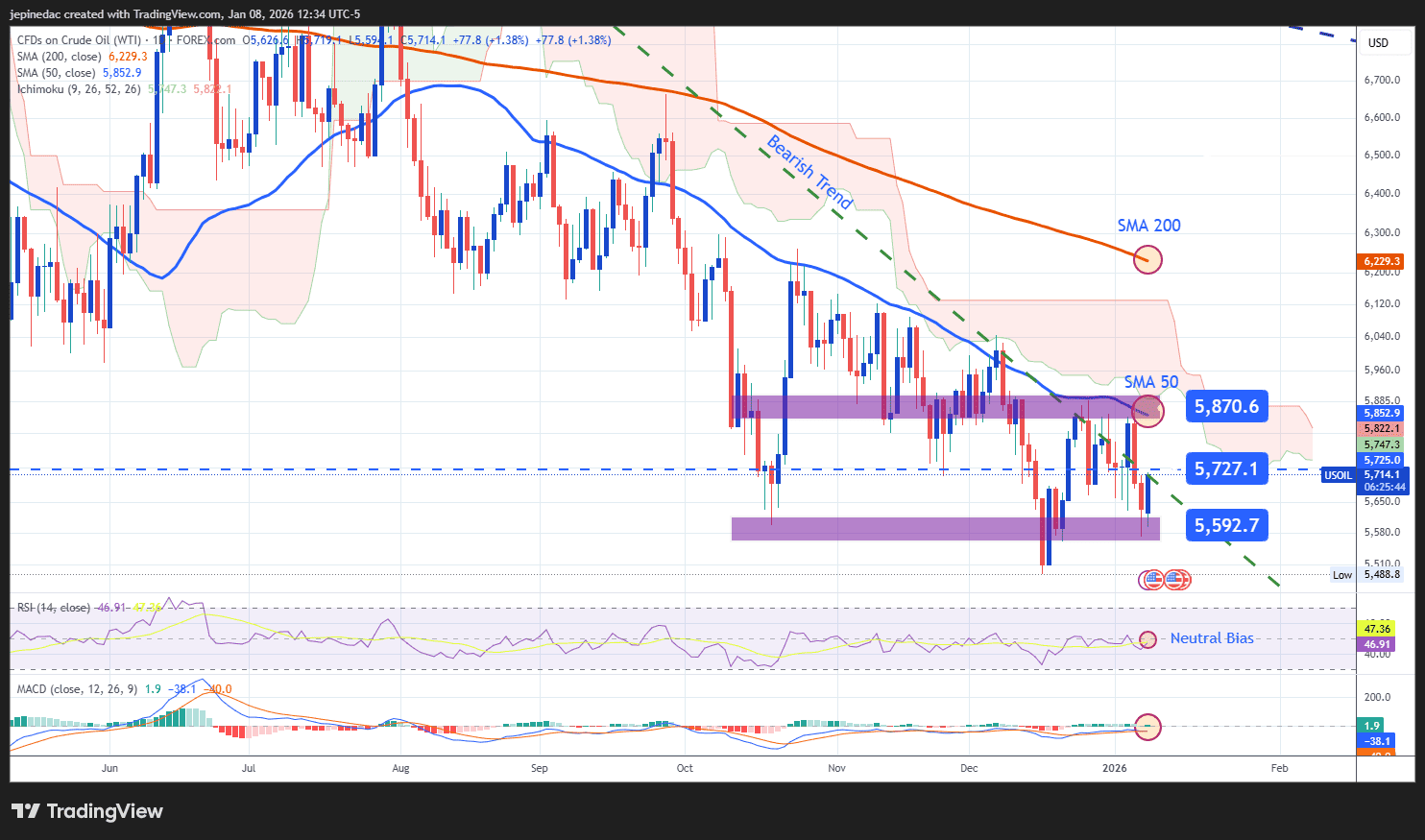
Source: StoneX, Tradingview
- An indecision phase is developing: In the short term, WTI has begun to respect a sideways range, capped near $58 per barrel and supported around $55 per barrel. Recent price swings have not been strong enough to break out of this range, leaving this neutral structure as the most relevant technical reference for the sessions ahead. Until a clear directional move emerges, the formation of a well-defined trend is likely to remain constrained.
- RSI: The RSI continues to oscillate around the neutral 50 level, indicating a balance between buying and selling momentum. This behavior reinforces the idea that indecision may continue to dominate the market in the short term.
- MACD: The MACD also keeps its histogram near the neutral zero line, reflecting persistent neutrality in short-term moving average momentum. As long as this pattern holds, the indecision phase is likely to continue for WTI.
Key Levels:
- $58 – Key resistance: The most important short-term resistance zone, aligned with the 50-period moving average. A sustained breakout above this level could pave the way for the formation of a new bullish trend in the sessions ahead.
- $57 – Nearby barrier: A recent neutrality level that has acted as a point of price indecision. Prolonged consolidation around this area could extend the current sideways range.
- $55 – Key support: A level marking the 2025 lows and standing out as the most relevant downside barrier. Sustained moves below this zone would reinforce a dominant bearish bias, extending the downside pressure observed in recent months.
Written by Julian Pineda, CFA, CMT – Market Analyst
Follow him on: @julianpineda25