


During today’s session, WTI crude oil posted a decline of more than 2%, moving once again toward the most relevant short-term support level near $62 per barrel.
The renewed selling pressure is partly driven by recent progress in negotiations between Iran and the United States, which reduces the immediate risk of disruptions to global oil supply. This development has revived concerns about a potential oversupply environment in the market. As long as this perception persists, it may continue to weigh on crude prices and generate more consistent selling pressure in the coming sessions.

Iran and the United States Meet Again
Both countries concluded a second round of nuclear negotiations today in Geneva, Switzerland. Although no final agreement has yet been reached to ease tensions, meaningful progress was reported. Iran’s Foreign Minister stated that an understanding was achieved on basic principles that could serve as the foundation for a potential nuclear agreement, and both parties agreed to prepare more detailed proposals. The atmosphere was described as more constructive compared to the first round of talks.
This development is relevant because it has partially reduced geopolitical uncertainty that had persisted in recent months. As a result, the oil risk premium has begun to decline, given the lower probability of military escalation and therefore reduced risk of supply disruptions in the Strait of Hormuz, through which more than 20% of global oil supply transits.
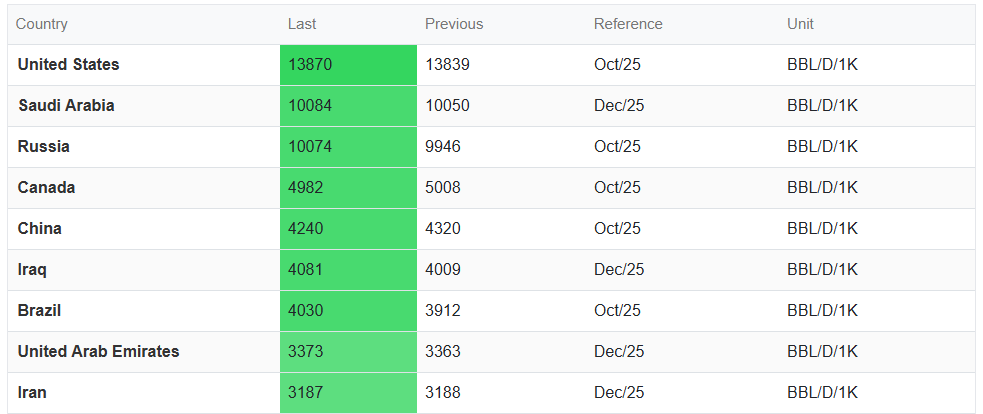
Under this scenario, and with lower immediate supply risks, concerns about oversupply have resurfaced. The absence of disruption allows previously agreed OPEC+ production increases to remain in effect. Furthermore, a potential agreement with Iran could ease economic sanctions that currently limit its exports, enabling greater participation in the global market. According to the latest data, Iran has a production capacity of approximately 3.1 million barrels per day, ranking it as the ninth most relevant oil producer globally.
Source: TradingEconomics
These factors become even more significant considering that last week the IEA lowered its forecast for global oil demand growth in 2026 from 930,000 barrels per day to 850,000 barrels per day. This adjustment points to a scenario where supply may remain solid, but without clear demand growth to absorb it.
As a result, the market could face a relative oversupply environment, which may pressure prices in the short term and sustain more consistent selling pressure in WTI in the coming sessions.
Is Lower Volatility Expected?
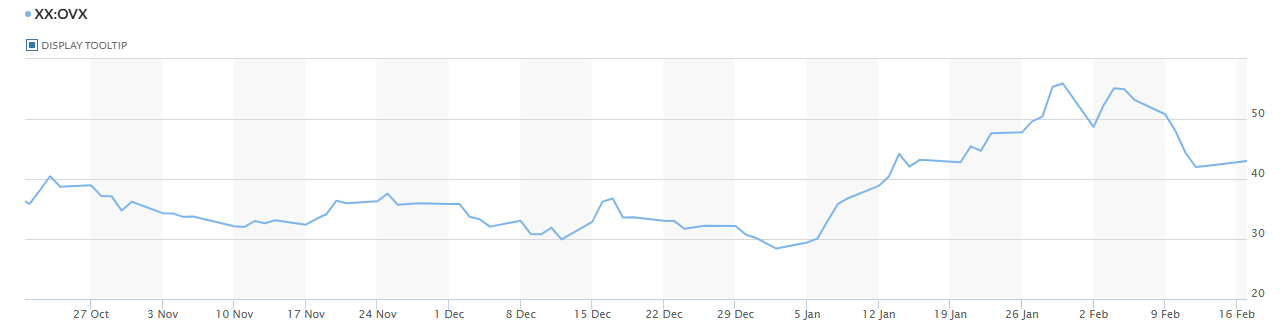
The OVX index, which measures implied volatility in oil ETF options, serves as a gauge of market expectations for price movement. Currently, the OVX has declined toward the 40-point area after having traded above 50 points in early February, reflecting a sustained reduction in implied volatility.
Source: MarketWatch
The drop in OVX suggests that the market is pricing in lower expected volatility for WTI over the next 30 days. This implies reduced immediate risk, a smaller geopolitical risk premium, and lower demand for hedging among institutional participants.
While this environment signals greater short-term stability, it also reduces the likelihood of a rapid and sustained recovery in crude prices. If the OVX continues to decline, a period of indecision may consolidate and potentially give way to more persistent weakness in the coming sessions.
WTI Technical Outlook
Source: StoneX, Tradingview
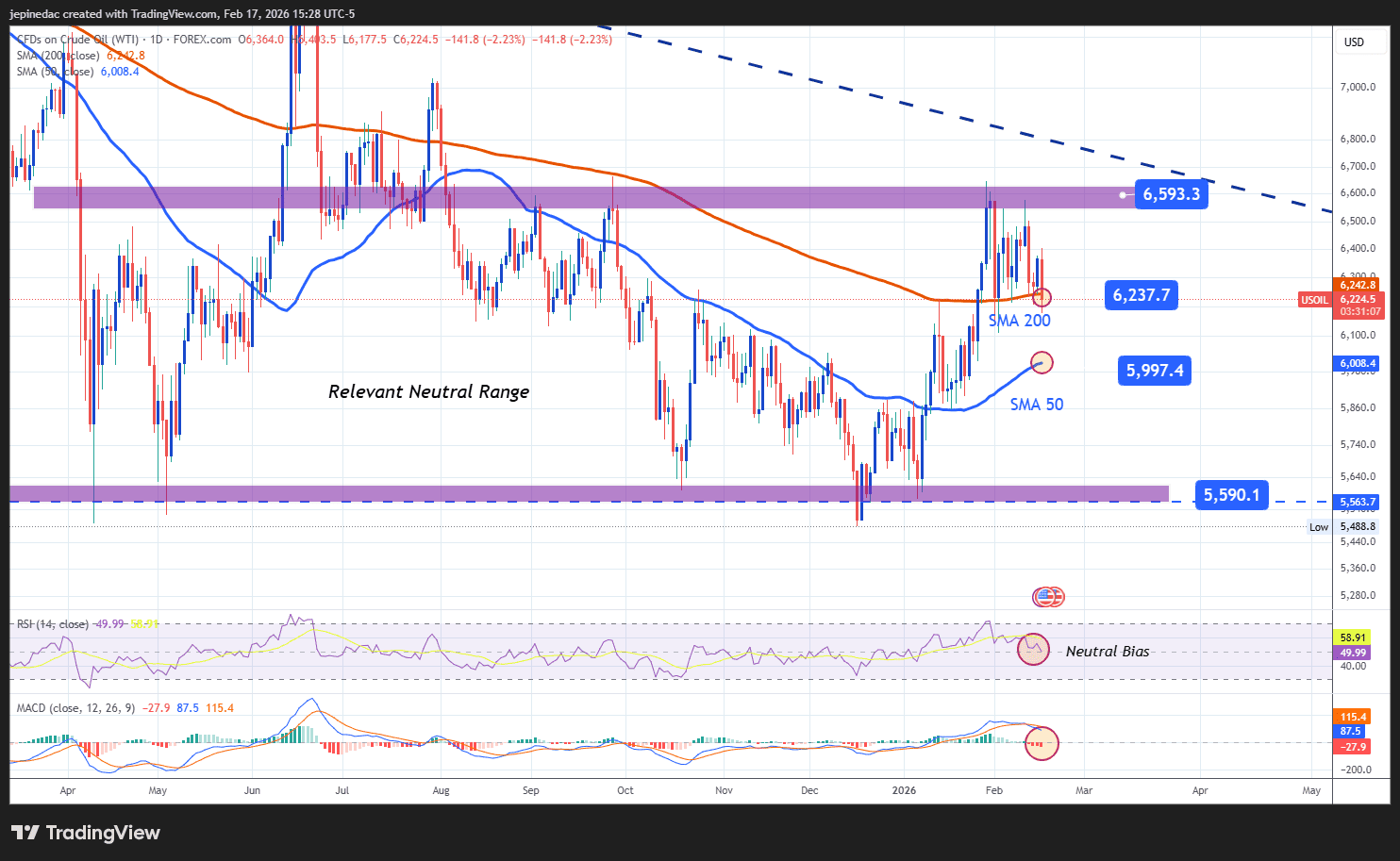
- The Sideways Range Gains Relevance: Over recent months, a consistent sideways range has become more evident between resistance near $65 per barrel and support around $55 per barrel. So far, recent price action has failed to break out of this range, keeping the dominant neutral scenario intact. Unless a clear directional breakout occurs, WTI is likely to continue trading within this structure, making it difficult to establish a more defined trend on the daily chart.
- RSI: The RSI remains oscillating around the neutral 50 level, indicating that short-term momentum is balanced, with no clear dominance by buyers or sellers. This reinforces the indecisive environment in crude price action.
- MACD: A similar pattern is observed in the MACD, with the histogram fluctuating around the zero level, signaling a lack of direction in short-term moving average momentum. This confirms the recent neutrality in WTI behavior.
Key Levels:
- $65 – Key resistance: A zone aligned with recent highs and near the prevailing downtrend line. A sustained move above this level could reinforce a more consistent bullish bias and potentially break the current sideways range.
- $62 – Near-term barrier: A neutrality level aligned with the 200-period moving average. A sustained bearish break below this zone could strengthen selling pressure, though not yet enough to confirm a structural downtrend.
- $60 – Key support: A significant psychological level that also coincides with the 50-period moving average. Sustained moves below this area could reinforce bearish dominance and open the door to a more consistent short-term downtrend.
Written by Julian Pineda, CFA, CMT – Market Analyst
Follow him on: @julianpineda25