


US futures
Dow futures 0.9%, S&P futures 0.8% & Nasdaq futures 0.95%
In Europe
FTSE 0.65% & DAX 2%
- US stocks rise, and oil falls on Iran peace hopes
- US proposes a 15-point plan for a month-long ceasefire
- Treasury yields fall even as Iran denies talks
- Oil falls 5% to $95 per barrel

US stocks rebound and oil falls on hopes of de-escalation
U.S. stocks are pointing to a solid start after media reports suggested the U.S. is pursuing a diplomatic path towards a month-long ceasefire in its conflict with Iran.
Reports that President Trump has sent a 15-point proposal to Iran to end the war are being interpreted as early signs of de-escalation. According to Reuters, Pakistan has reportedly delivered the proposal to Iran, and possible venues for discussions are being explored.
However, it is worth noting that Tehran has publicly denied negotiating with the Trump administration, suggesting that signals remain mixed for now.
Even so, oil prices are falling sharply as markets increasingly see a further escalation as less likely, unless Iran proves more resistant than expected.
With oil prices down around 5%, Treasury yields are also declining while risk sentiment improves.
Still, for the recovery to gain more meaningful traction, investors will want to see clearer signs of de-escalation, including the reopening of the Strait of Hormuz.
Markets are currently not pricing in either rate cuts or hikes from the Fed this year. Earlier this week, markets had priced in around a 70% chance of a rate hike by December, but this has now dropped to around 25%.
Corporate news
CF Industries, the fertiliser manufacturer and distributor, is falling around 4% as reports of negotiations between the U.S. and Iran suggest that commodity supply disruptions may begin to ease. Fertiliser prices had surged following the closure of the Strait of Hormuz, helping lift CF Industries by over 27% during March.
The chipmaker has jumped 13% in premarket trading after unveiling its first in-house chip and saying it expects to generate $15 billion in revenue over the next five years.
Dow Jones – technical analysis
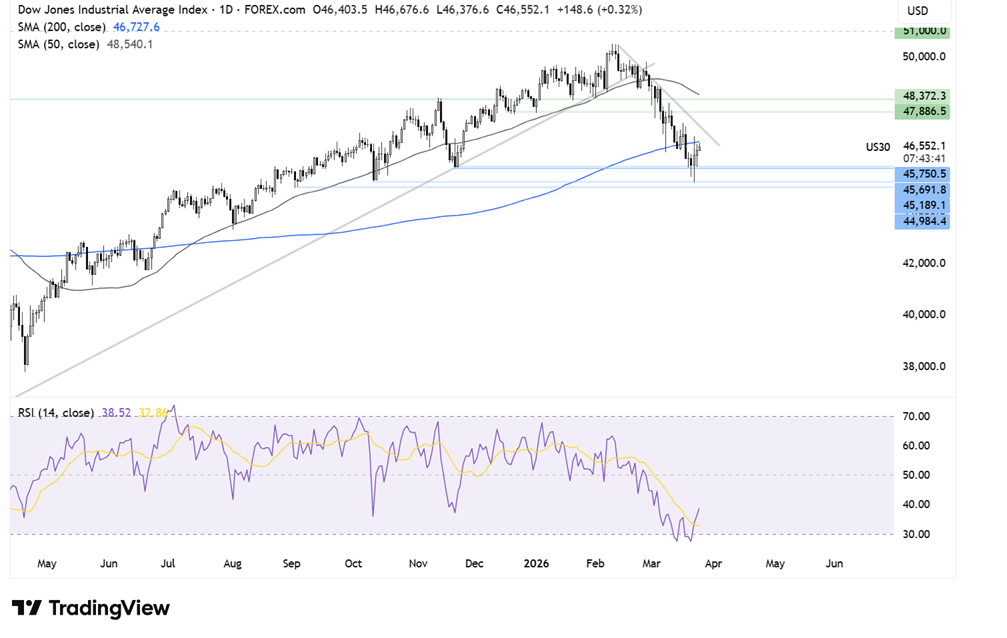
The Dow Jones has been trending lower from its 50,500 record high, breaking below both the 50-day and 200-day SMAs to a low of 45,165.
Although the index has recovered from that low, it remains below the 200-day SMA, with the broader downtrend still intact.
Any recovery would need to rise above the 200-day SMA at 46,690 and then clear 47,000, where falling trendline resistance comes into play.
Sellers will look for a break below 45,700 — the November low — which could open the door to 45,165, the 2026 low, and then 45,000.
FX markets – USD rises, GBP/USD steady
The U.S. dollar is moving modestly higher despite the improved risk mood and falling oil prices. FX markets remain notably muted compared with the larger moves seen in equities and commodities.
Markets are now pricing in only a 26% probability of the Fed hiking rates by December, down from 70% a week ago.
EUR/USD is little changed despite a slightly firmer dollar, suggesting FX traders are showing signs of headline fatigue and waiting for clearer signals either from the Middle East or upcoming data.
GBP/USD is also steady after UK inflation brought few surprises, holding at 3.0% year-on-year in February. However, core inflation — which excludes more volatile items such as food and fuel — came in slightly above expectations at 3.2%.
The data has had little impact on sterling, given that it is already somewhat outdated and does not reflect the sharp increase in energy prices seen since the start of the month.
Oil drop 5% on Middle East ceasefire hopes
Oil prices are falling more than 5% on Wednesday, with Brent dropping to around $95 a barrel and WTI to $87, as markets grow increasingly optimistic over U.S. diplomatic efforts to end the conflict with Iran.
These moves reflect a fading geopolitical risk premium around energy supply. However, there are still conflicting reports coming from Iran, and the Strait of Hormuz remains only partially open.
For oil prices to fall significantly further, markets will want to see more tangible signs of de-escalation and a resumption of oil and LNG shipments through the Strait.
Iran has reportedly told the International Maritime Organization that non-hostile vessels may be allowed to transit the Strait of Hormuz.