



EUR/USD rises amid a softer USD and ahead of Eurozone inflation data
EUR/USD is edging higher, snapping a five-day losing streak, helped by a softer US dollar following reports that President Trump may be open to ending the Iran conflict without first requiring the reopening of the Strait of Hormuz. The pair is also trading cautiously ahead of a busy session on the economic calendar.
The main focus will be on eurozone inflation, which is expected to rise sharply to 2.8% year-on-year from 1.9% in February. If confirmed, this would mark the highest inflation reading since summer 2024, with the rebound driven largely by a sharp increase in energy prices.
However, the more important signal for the ECB will be whether those higher energy costs are starting to feed into broader domestic inflation. So far, that pass-through still appears limited, with core CPI expected to remain broadly unchanged at around 2.4%.
That distinction matters. While the oil-driven shock is likely to push headline inflation higher in the near term, the ECB cannot do much to offset the initial rise in energy prices. The central bank is more likely to focus on whether inflation broadens into wages, services, and inflation expectations over the coming months.
Markets are currently pricing in around three ECB rate hikes by year-end, which may prove aggressive unless core inflation starts to move meaningfully higher. Still, if second-round inflation effects begin to emerge in the second half of the year, the ECB may come under increasing pressure to tighten policy.
The US dollar, meanwhile, is easing back from an 11-month high as broader risk sentiment improves modestly.
Attention will also turn to US JOLTS job openings data later today, which could provide further clues on the health of the US labour market.
EUR/USD forecast technical analysis
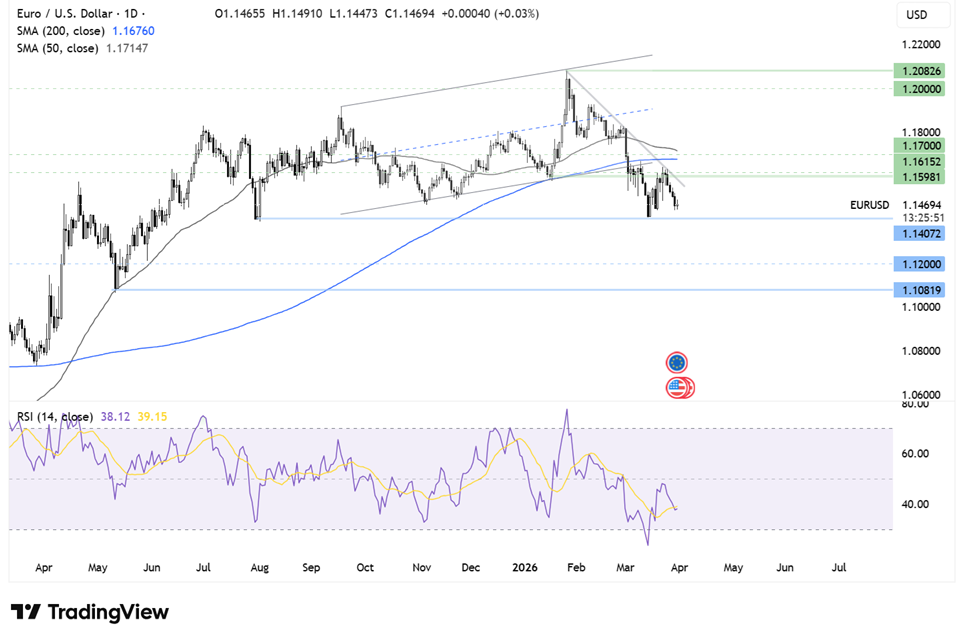
EUR/USD ran into resistance at 1.2080 and rebounded lower, breaking out of its rising channel and below the 200 SMA. The price found support at 1.1410, but the recovery higher faced rejection at the falling trendline and 1.16 resistance, reinforcing the bearish trend.
Sellers will look to break below 1.1410, the 2026 low and July low, to create a lower low and extend the bearish move towards 1.12, before bringing 1.1065, the May low into focus.
Any recovery would need to rise above 1.16, the January low and falling trendline resistance. A rise above here creates a higher high and exposes the 200 SMA at 1.1685.
USD/JPY weakens below 160 on Iran optimism
USD/JPY is edging lower on broader US dollar weakness as market sentiment improves, reflected in firmer US equity futures.
A report in the Wall Street Journal suggesting that President Trump may be willing to end the Iran conflict without first insisting on the reopening of the Strait of Hormuz has been interpreted as a possible shift towards de-escalation.
That said, continued US troop deployments to the region point to a more complicated picture, highlighting the mixed messaging that continues to drive market volatility and uncertainty around global energy supply.
From the US side, Federal Reserve Chair Jerome Powell said yesterday that long-term inflation expectations remain well anchored despite heightened uncertainty linked to the Iran conflict. However, he also stressed that it is still too early to fully assess the economic consequences of the war.
Similarly, New York Fed President John Williams said monetary policy remains well-positioned, but acknowledged that the labour market is sending more mixed signals.
That makes today’s JOLTS job openings data particularly relevant. The market expects job openings to fall slightly to 6.87 million from 6.94 million previously, ahead of a busy US data week that includes ISM manufacturing PMI tomorrow and nonfarm payrolls on Friday.
On the Japanese side, the yen is also finding support from renewed verbal intervention warnings from Japanese officials.
Japan’s top currency official, Atsushi Mimura, said yesterday that authorities would take decisive action if needed, echoing earlier comments from Finance Minister Satsuki.
Those comments come after USD/JPY moved back above the 160 level, a threshold that previously triggered official intervention in July 2024.
The yen has been under pressure in recent weeks due to Japan’s heavy dependence on imported energy and the stagflationary impact of higher oil prices. However, today’s modest pullback in oil is offering the currency some relief.
USD/JPY forecast – technical analysis
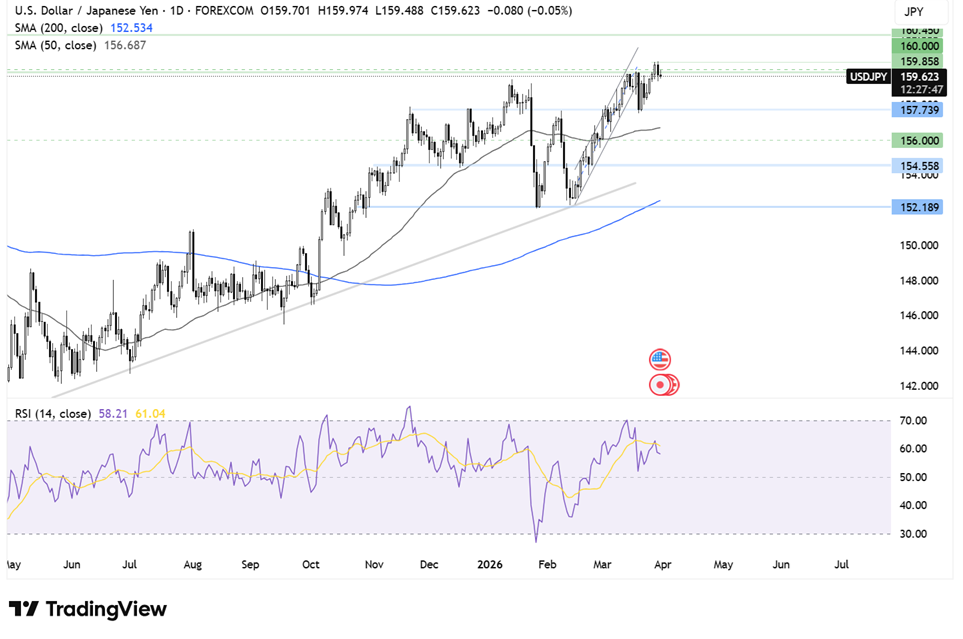
USD/JPY recovered from the 152.25 February low and rose to a high of 1.59.90. After pulling back to support at 157.80, the price rebounded back up to 160.45. Thhe price has just eased back to below 160.00 at the time of writing, although the uptrend remains intact and the RSI is above 50.
Buyers will look to rise above 160.45, the 2026 high, to extend gains towards 162.00, the 2024 high.
A meaningful break below 160.00 opens the door to 1.57.80. A break below here is needed to create a lower low.