


Key points for the Euro 2026 Q2 outlook
- EUR/USD rallied into resistance into the start of the year before reversing more than 5.5% off the highs. Focus is on a possible exhaustion low closer to uptrend support in Q2.
- Surge in oil prices caused by the war in Iran fuel concerns over the inflationary outlook.
- Federal Reserve interest rate expectations shift dramatically with the traders now expecting a potential rate hike to be on the table into the close of the year.
- ECB still likely to hold rates although probability of a potential hike has been building over the past few months.
- Broader Euro outlook constructive but the threat for a deeper correction within the multi-year uptrend remain.
Euro rallied into key technical resistance in January before reversing sharply lower with March marking the second consecutive monthly decline in EUR/USD. Rising inflation concerns, a war in Iran, and a major shift in interest rate expectations have continued to support the US Dollar. While the longer-term Euro outlook remains constructive, the threat remains for a deeper pullback towards uptrend support heading into Q2.
Federal Reserve in the Spotlight
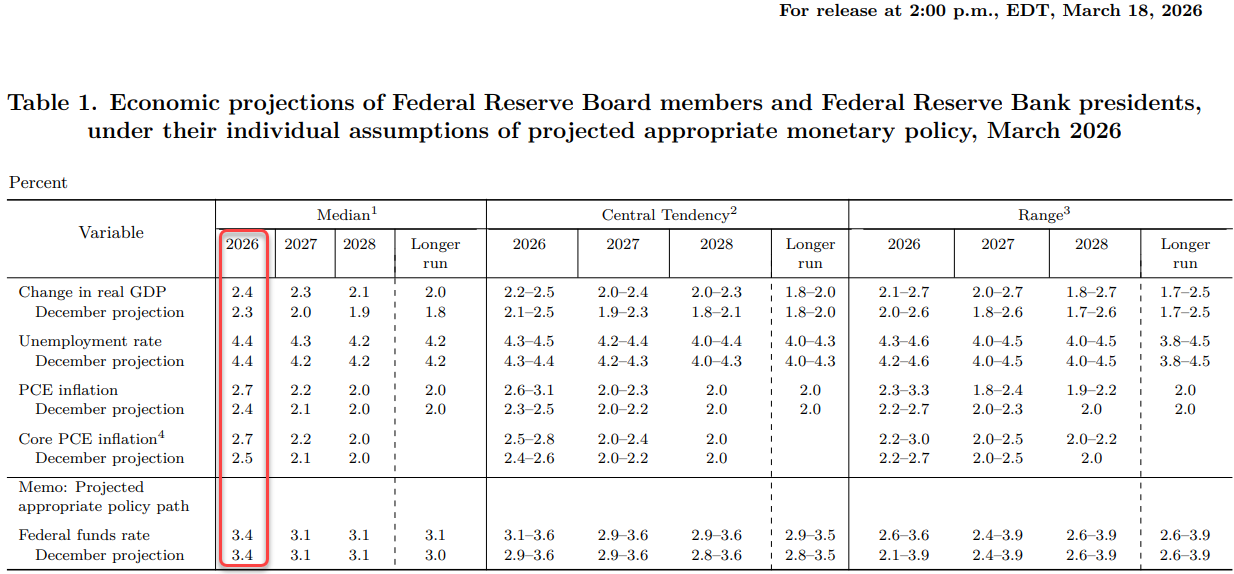
FOMC Summary of Economic Projections
Source: FOMC
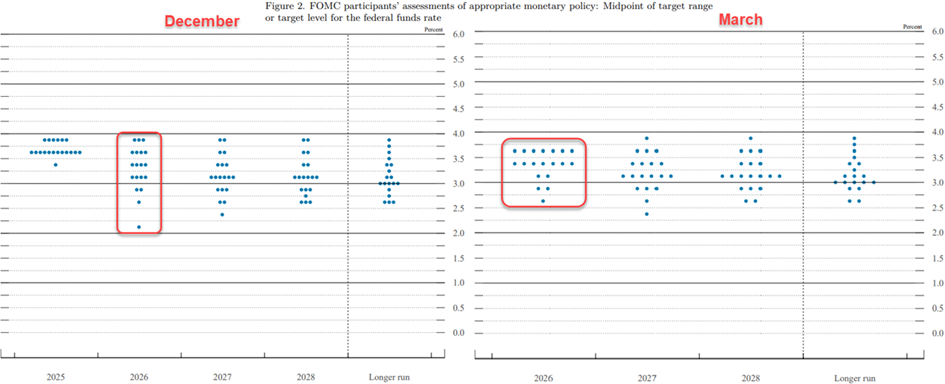
In March, the Federal Reserve decided to hold interest rates for a second consecutive meeting as concerns over the recent surge in energy prices cloud the inflation forecast. In the Fed’s latest Summary of Economic Projections, the central bank raised growth expectations with the GDP revision adding another 0.1% to 2.4% in 2026. The unemployment rate was left unchanged at 4.4% while the inflation outlook was revised higher to 2.7% on both the headline and core PCE (personal consumption expenditure). The revisions were accompanied by a shift in the interest rate dot plot with the average dot rising 5 basis points for the next three years as well as the terminal rate.
FOMC Interest Rate Dot Plot
Source: FOMC
The adjustments highlight a growing concern within the committee regarding the outlook for inflation and while Powell noted risks to both sides of the dual mandate, the pace of price growth will be the main driver in the months ahead. The Iran conflict has seen oil prices surge more than 77% off the yearly low (more than 110% at the peak) and although the Trump administration has pledged the conflict will be short-lived, negotiations with the Iranian government remain in limbo. From the market standpoint, the center of the conflict is squarely on the Strait of Hormuz where 20% of the world’s oil supply transits. The duration of the war will be critical in the weeks ahead as US forces look to secure the strait and the longer this key transit remains closed, the more uncertainty in the energy market will fuel concerns of rising energy prices.
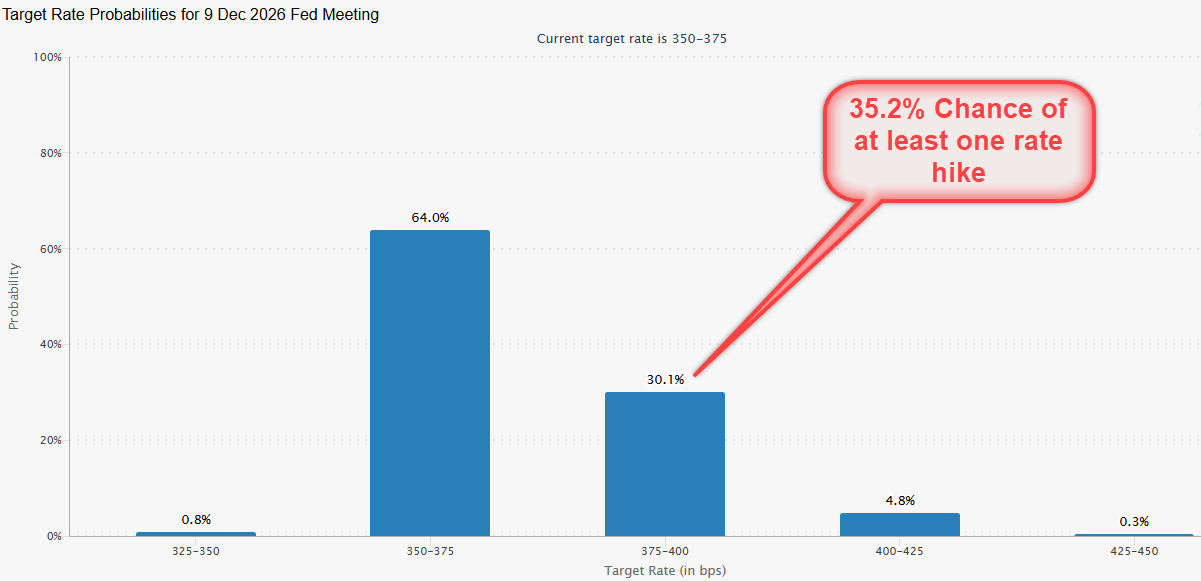
Fed Fund Futures- FedWatch Tool
Source: CME
Markets are pricing a 64% probability the Fed will remain on hold through December. This is a dramatic shift form the start of the year when Fed Fund Futures were pricing a 77% probability of at least two cuts in 2026. Expectations for a potential hike have also been on the rise with traders pricing a 35% chance the central bank will need to raise rates in response to higher energy prices. The shift in expectations has continued to benefit the Greenback with the US Dollar Index (DXY) up more than 4.5% off the January low. A faster resolution to the war could see markets quickly reprice the rate outlook but as it stands, traders are now expecting the Fed’s next move will be to tighten policy, with no easing seen until late 2027.
Although the ECB is widely expected to hold rates through 2026, concerns over rising prices have seen a slight uptick in interest rate expectations. The energy crisis is expected to hit Europe even harder as a larger portion of their oil imports rely on the Strait of Hormuz. If the conditions in Iran deteriorate or the conflict prolongs, expectations could shift for the ECB as well and may limit the decline in the Euro in the months ahead. Once again, the duration of the conflict will be critical.

Euro Technical Outlook: EUR/USD Correction Underway- Key Support Targets in View
Euro Price Chart – EUR/USD Monthly
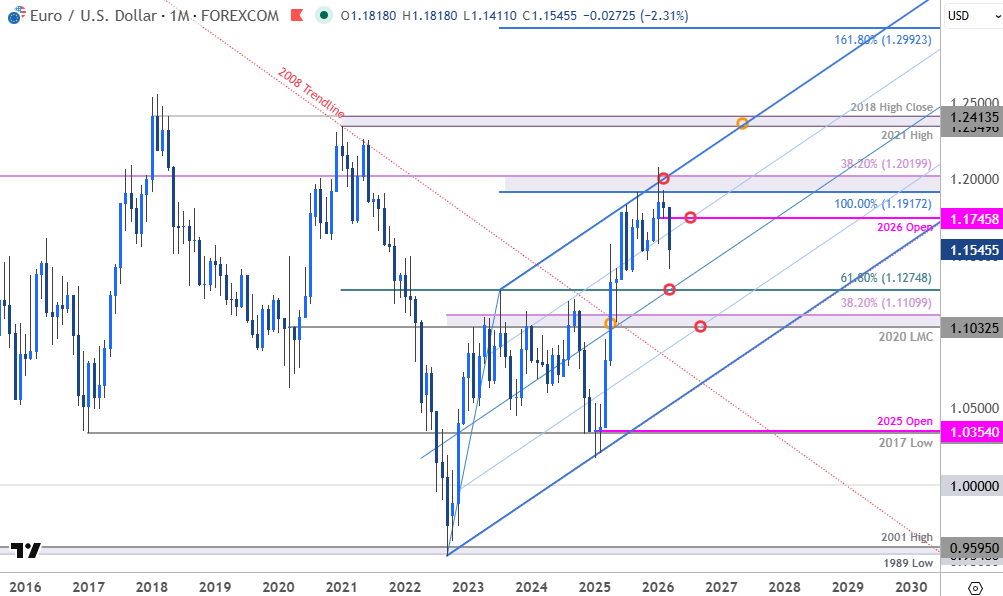
Chart Prepared by Michael Boutros, Sr. Technical Strategist; EUR/USD on TradingView
In our EUR/USD 2026 Yearly Outlook published in January, we noted that, “The broader EUR/USD outlook remains tilted to the topside into the yearly cross, but the advance may be vulnerable to a larger correction in the first half of the year. From a trading standpoint, losses should be limited to 1.1275 IF Euro is heading higher in 2026 with a close above 1.2020 needed to fuel the next major leg of the EUR/USD advance.” Euro plunged more than 5.5% off the January highs after turning from noted resistance at 1.1917-1.2020- a region defined by the 100% extension of the 2022 advance and the 38.2% retracement of the 2008 decline. A break below the 75% parallel in March exposes the threat for a deeper pullback within the broader 2022 uptrend. The focus is on this pullback in the months ahead with key support targets now in view heading into April.
Euro Price Chart – EUR/USD Weekly
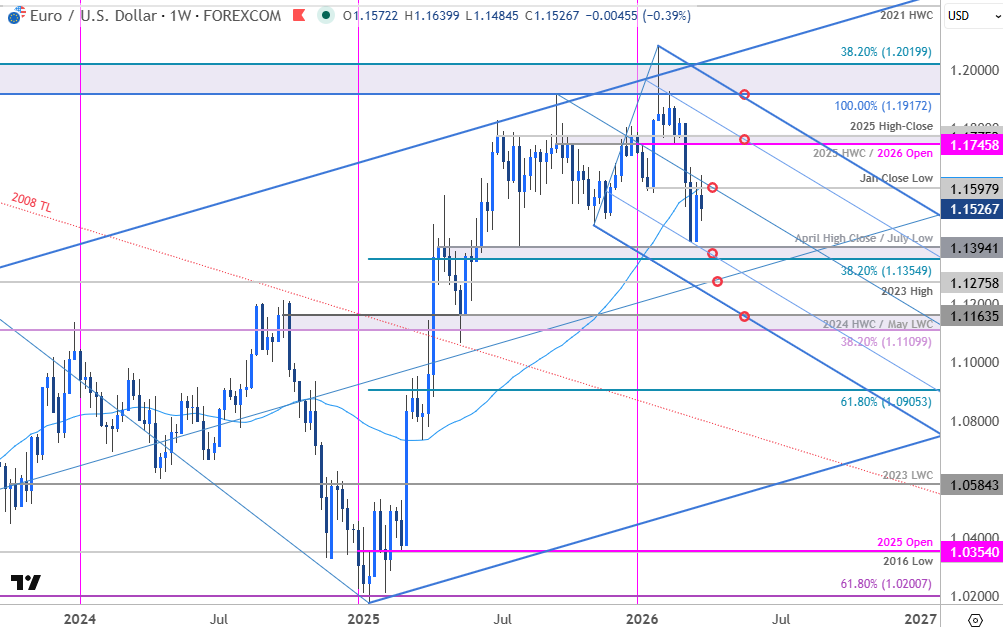
Chart Prepared by Michael Boutros, Sr. Technical Strategist; EUR/USD on TradingView
A closer look at the weekly chart shows EUR/USD trading within the confines of an embedded descending pitchfork extending off the yearly high. Initial support rests at 1.1355/94- a region defined by the 38.2% retracement of the 2025 advance, the April high-close, and the July low. Note that the 61.8% parallel converges on this threshold in April and further highlights the technical significance of this pivot zone in the weeks ahead.
A break / weekly close below this threshold would threaten further Euro losses with subsequent support objectives eyed at the 2023 high and the 61.8% retracement of the 2021 decline at 1.1275 and 1.1110/64- a region defined by the 38.2% retracement of the 2022 advance, the 2024 high-week close (HWC), and the May low-week close (LWC). Note that key slopes converge on these levels into May and both represent areas of interest for possible downside exhaustion / price inflection IF reached. Losses below this region would suggest a more significant trend reversal is underway and would threaten a much deeper correction in EUR/USD.
Initial weekly resistance is eyed with the January close low at 1.1598. The median-line converges on this level over the next few weeks and a breach / weekly close above would expose the potential for a larger recovery toward 1.1745/75- a region define by the objective yearly open, the 2025 high-week close (HWC), and the 2025 high-close. Gains beyond this threshold would suggest a more significant low is in place with a breach above 1.1917-1.2020 ultimately needed to mark the next major leg of the Euro uptrend. Subsequent resistance objectives are eyed at the 2021 high-week close (HWC) at 1.2217.
Bottom Line: Euro is in correction within the multi-year uptrend, and the outlook remains weighted to the downside heading into Q2. That said, the focus is on identifying a potential exhaustion low in the months ahead. From a trading standpoint, rallies should be limited to the 1.1775 IF price is heading lower on this stretch with a close below 1.1355 needed to fuel the next leg of the decline. 1.1275 & 1.1164 are areas of interest to reduce short-exposure / lower protective- look for larger reaction there IF reached.
--- Written by Michael Boutros, Senior Market Analyst
Follow Michael on X @MBForex