



EUR/USD is maintaining solid short-term strength and, over the past three trading sessions, has posted gains of more than 1.00%, reflecting a renewed bullish bias in recent price action. This upside pressure is partly driven by market expectations ahead of the upcoming U.S. Non-Farm Payrolls (NFP) report and the potential impact these data may have on monetary policy. At the same time, the neutral stance of the European Central Bank has helped keep confidence in the euro firm. If expectations for Federal Reserve rate cuts continue to build alongside a neutral ECB posture, buying pressure in EUR/USD could gain further relevance in the coming sessions.

NFP day approaches
During tomorrow’s session, February 11, the United States will release its NFP employment data. Forecasts point to the creation of 66,000 new jobs in January, up from the 50,000 reported in December. If confirmed, this would support a gradual recovery in employment following the sharp contraction seen at the end of 2025, when job losses exceeded 100,000.
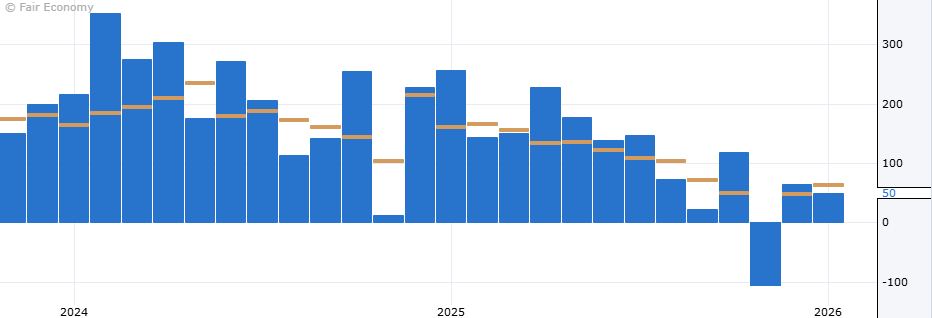
Source: ForexFactory
This release is particularly important for assessing U.S. dollar strength, as one of the factors that led the Federal Reserve to begin cutting interest rates was the weakness observed in the labor market toward the end of 2025, which ultimately weighed on the dollar. If the NFP data fail to come in above—or at least in line with—expectations, it could reinforce the perception that the slowdown in U.S. employment remains in place, potentially prompting the Fed to reassess a more neutral interest rate policy in upcoming decisions.
This scenario is already being reflected in market-implied probabilities. While there is currently a 78.4% probability that rates will remain unchanged at the March 18 meeting, expectations for the April 29 decision have begun to shift. The probability of a neutral stance now stands at 57.3%, down from 70% just a week ago, highlighting growing market indecision and opening the door to a potential lower-rate scenario, depending on how upcoming employment data evolve.
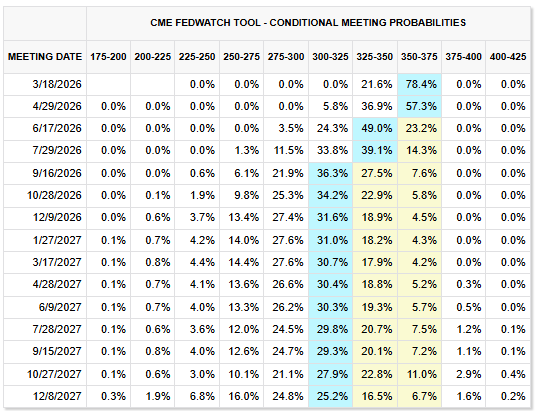
Source: CMEGROUP
In this context, a potential lower-rate environment could further reduce the attractiveness of dollar-denominated investments, continuing to weigh on the U.S. dollar in the short term. If this dynamic persists, the euro could continue to recover ground in a more sustained manner, fueling consistent buying pressure in EUR/USD.
European Central Bank maintains neutrality
Beyond developments in the United States, market-implied probabilities for the European Central Bank indicate an 83.6% chance that interest rates will remain unchanged at 2.00% at the March 17 meeting. In addition, probabilities for rates to remain in neutral territory stay above 50% through October 2026, suggesting that the ECB does not currently envision an aggressive rate-cutting cycle, in contrast to what could unfold in the United States.
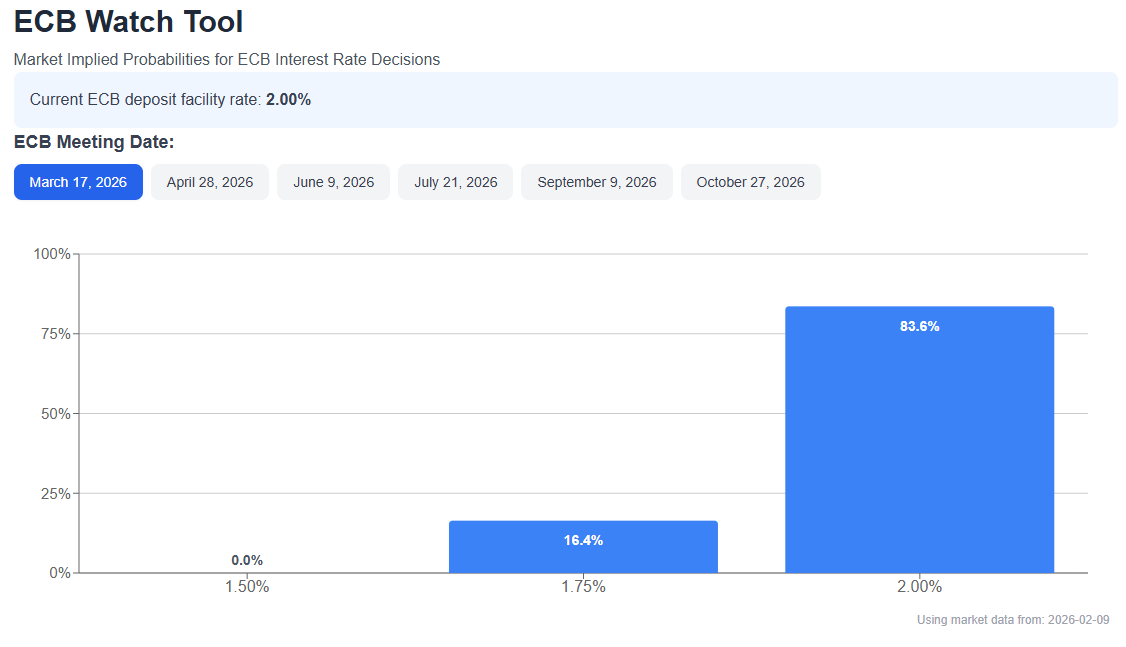
Fuente: ECBWATCH
This outlook of prolonged policy neutrality has contributed to greater stability in European fixed-income markets and has helped keep confidence in the euro relatively firm. As long as the ECB avoids meaningful surprises, this stance could continue to support stable demand for the euro in the short term.
EUR/USD technical Outlook
Source: StoneX, Tradingview
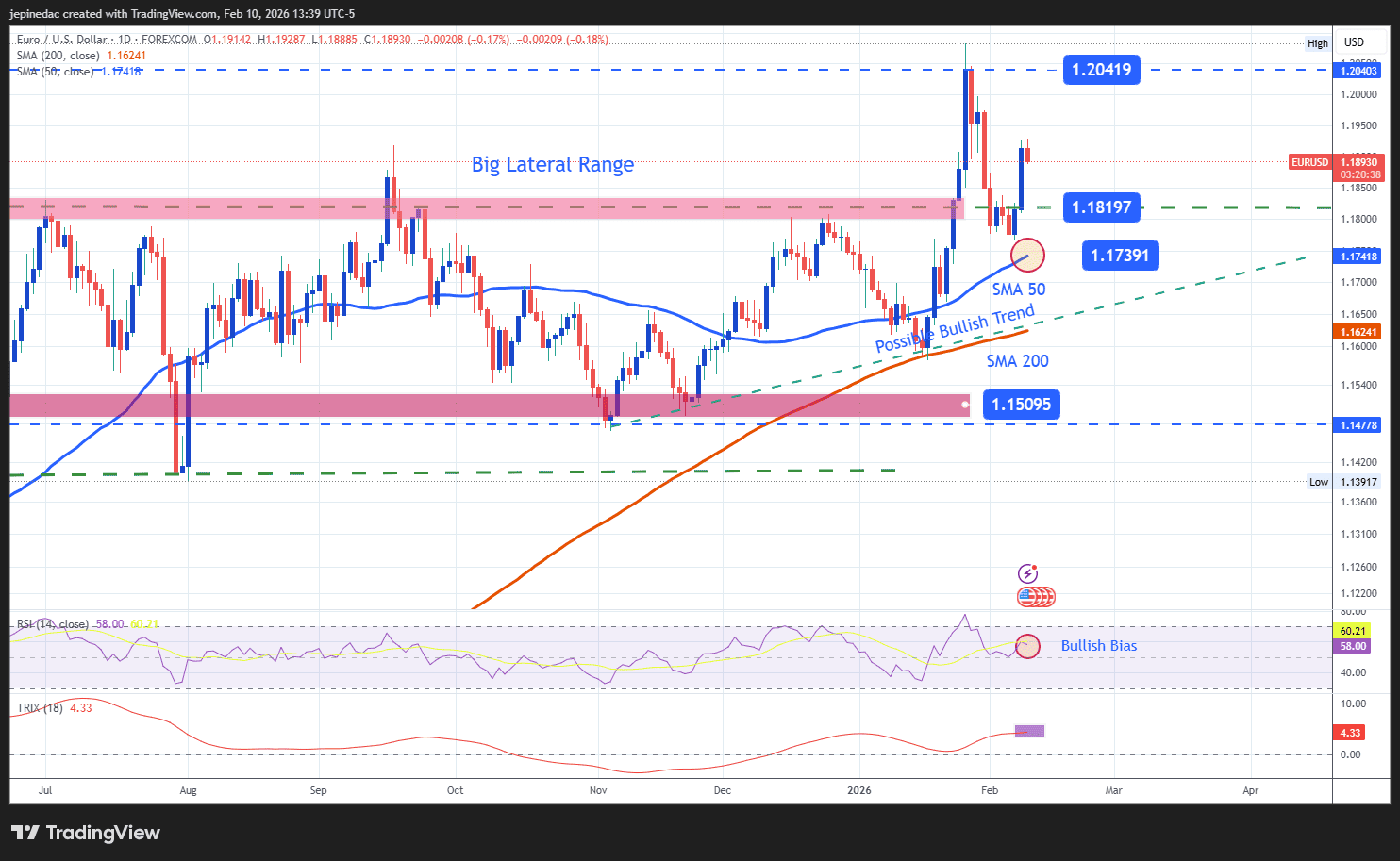
- A potential bullish trend begins to re-emerge: Despite the aggressive nature of recent EUR/USD price swings, the pair has managed to sustain consistent buying pressure. This behavior reinforces the potential formation of a new upward trendline, particularly following the break above the broad sideways channel that dominated price action for several months. If the bullish bias holds, a more solid bullish structure could develop in the coming sessions.
- RSI: The RSI line remains consistently above the neutral 50 level, indicating that the bullish bias continues to dominate the average momentum of the past 14 sessions. As long as this dynamic persists, buying pressure is likely to remain relevant on the chart.
- TRIX: A similar scenario is observed in the TRIX indicator, with the line holding above the zero level, signaling that bullish momentum is embedded in the exponential moving averages. This reinforces the view that the dominant bullish bias remains present across medium- and longer-term oscillations.
Key levels:
- 1.20419 – Key resistance: This level aligns with the recent high and represents the main upside barrier. A sustained move back toward this area could reactivate bullish momentum and open the door to a more defined upward trend in the coming sessions.
- 1.18197 – Near-term barrier: A neutrality zone corresponding to the upper boundary of the broader sideways range. Sustained moves below this level could shift focus back toward a consolidation scenario in the short term.
- 1.17391 – Key support: A level aligned with the 50-period simple moving average, acting as the main downside barrier. A sustained break below this area could enable a more dominant bearish bias, relevant over the coming weeks.
Written by Julian Pineda, CFA, CMT – Market Analyst
Follow him on: @julianpineda25