



The week has started with notable neutrality in EUR/USD price action in the short term, as the pair has not been able to establish a consistent direction, with average movements over the last two sessions hovering around just 0.24%. For now, market indecision remains present, largely because ongoing updates around the Middle East conflict have failed to provide a clear outlook, leading to a decline in consistent demand for both the dollar and the euro.
If this uncertainty surrounding the conflict persists, it is likely that neutral conditions will continue to dominate EUR/USD movements, limiting the emergence of a clear directional bias in the coming sessions.

Middle East conflict still lacks a clear Outlook
Recent sessions have been particularly relevant in the context of the Middle East conflict. Since last week, there have been attempts to maintain a tone of potential negotiations, and President Trump had even suggested that he did not expect the conflict with Iran to last much longer, indicating that efforts were being made toward concrete progress.
However, this week, while the narrative of possible de-escalation remains in place, new comments have emerged in which Trump issued a direct ultimatum to Iran, stating that if the Strait of Hormuz is not reopened soon, they could face attacks on key infrastructure. This has once again increased uncertainty in the market, although not to the extent of triggering sustained demand for safe-haven assets.
What is currently being observed is a cautious market stance, driven by mixed signals between potential agreements and renewed threats, making it difficult to establish a clear bias in major currencies.
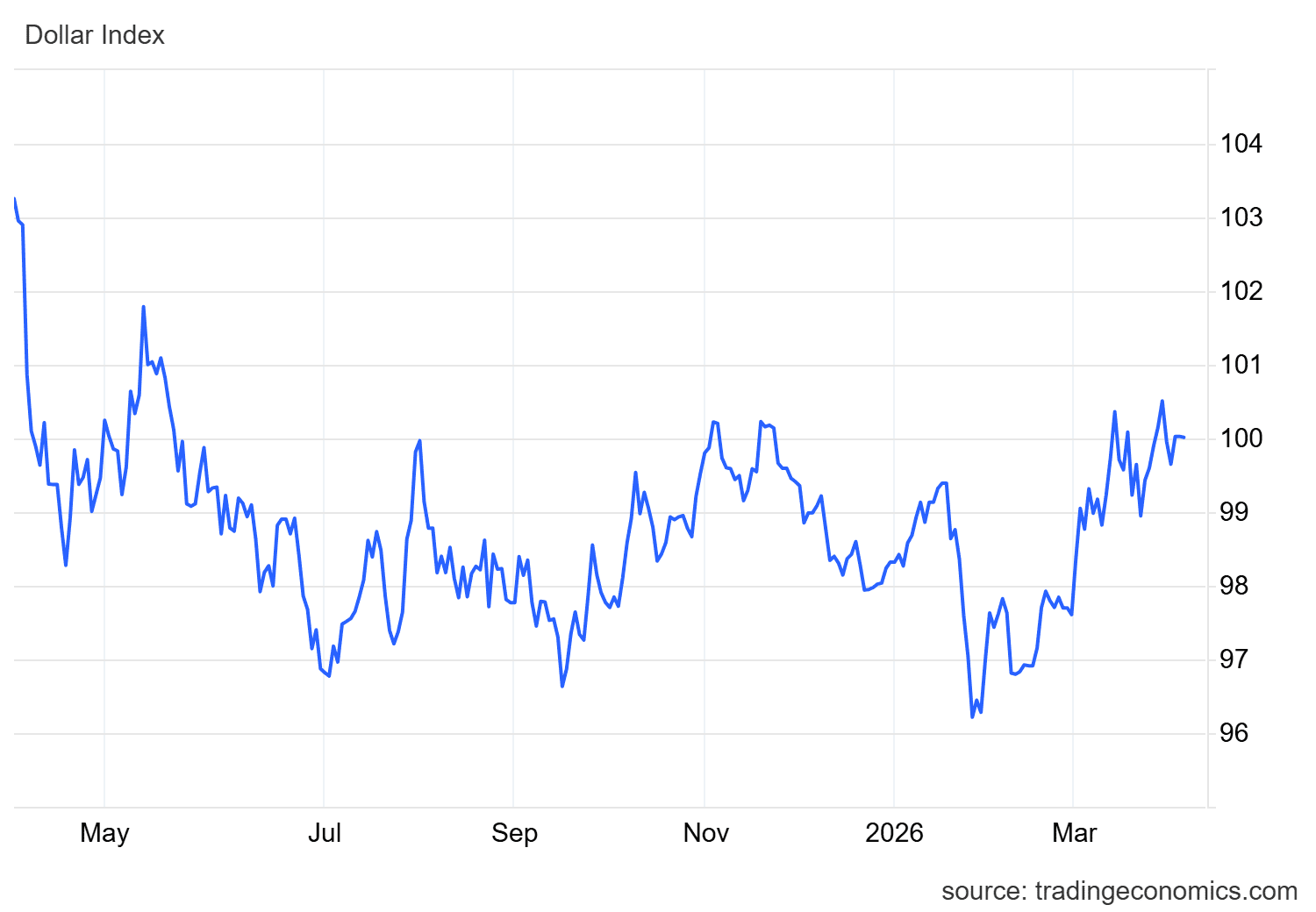
This dynamic is also reflected in the behavior of the U.S. dollar. While it had been the most demanded currency in recent weeks, the latest confusion has led the DXY index to show neutral price action around the 100 level, with a relatively flat slope. This suggests that, although the dollar remains relatively strong, demand has slowed, giving way to a phase of indecision in the short term.
Source: TradingEconomics
In this context, as long as there is no greater clarity around the conflict, market caution is likely to continue limiting strong demand for the dollar, which in turn could maintain a bias of indecision in EUR/USD in the coming sessions. However, a renewed escalation in the conflict could once again favor the dollar, as seen in previous weeks.
Do interest rates still matter?
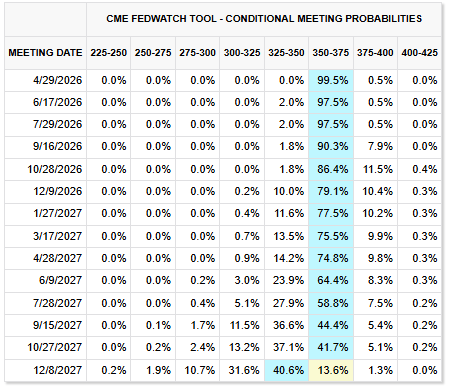
At present, there remains a significant interest rate differential between the United States and the eurozone. The U.S. reference rate stands around 3.75%, while the European Central Bank rate is near 2.15%, continuing to favor dollar-denominated assets over euro-denominated ones.
Although this differential is not currently the main driver of EUR/USD movements in the short term, it represents an important structural factor in the long term, which could continue to limit the euro’s ability to stage a sustained recovery.
In addition, current expectations suggest that the Federal Reserve could keep rates unchanged for an extended period, potentially stretching into 2027. This reinforces the idea that the rate differential may persist longer than expected, consolidating the dollar’s relative advantage.
Source: CMEGROUP
Taking all this into account, as long as U.S. interest rates remain more attractive, the euro may face difficulties in achieving a sustained recovery, which could continue to generate structural weakness in EUR/USD over the long term.
EUR/USD Technical Outlook
Source: StoneX, Tradingview
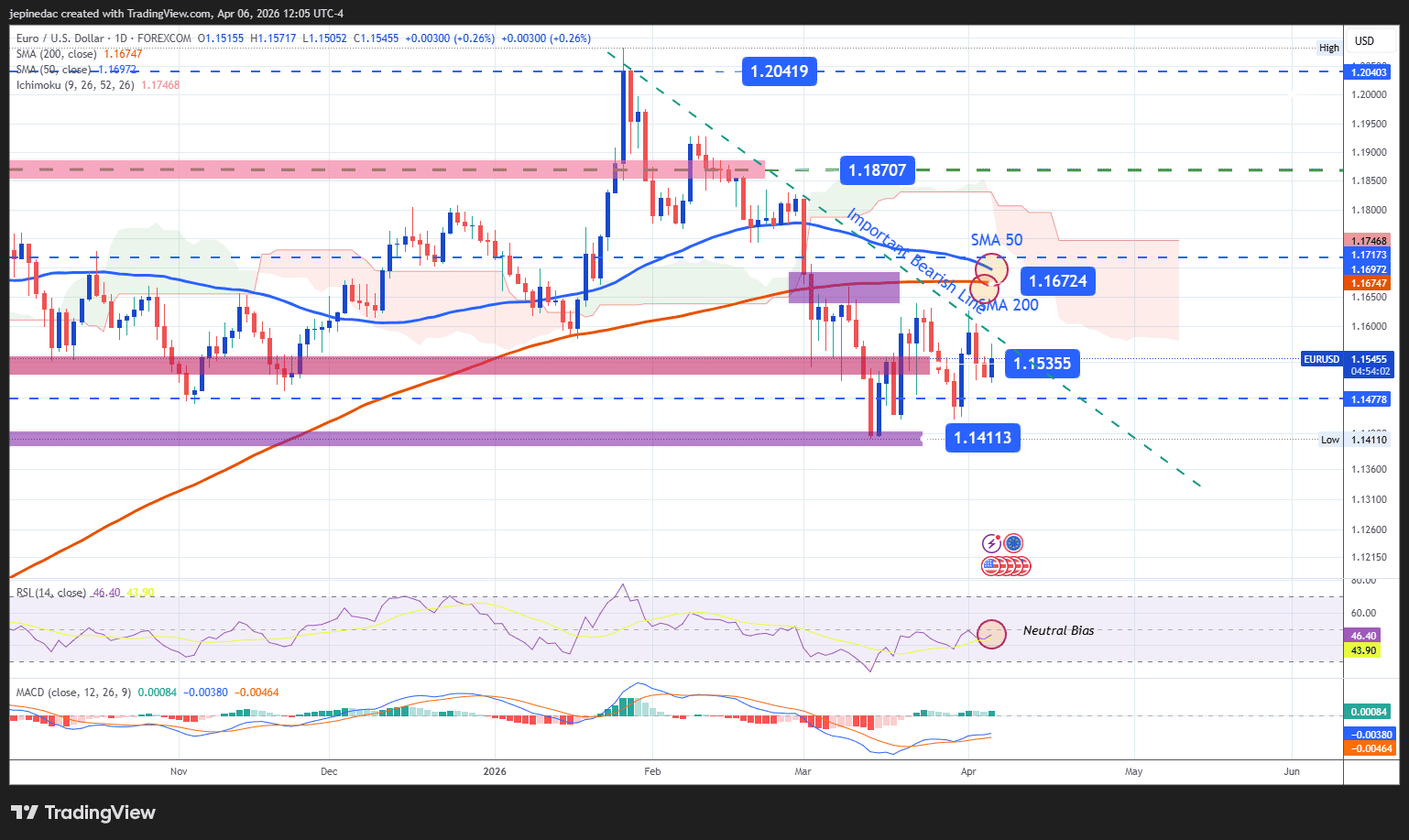
- Downtrend remains firmly in place: Since January, EUR/USD has been respecting a consistent downward trendline, which remains the most relevant technical structure in the short term. So far, there has not been a strong enough bullish move to challenge this trend, meaning that if selling pressure returns, the bearish structure could continue to dominate price action in the coming weeks.
- RSI: The indicator remains close to the 50 neutral level, reflecting a balance between buying and selling momentum over the last 14 sessions. As long as this behavior persists, indecision is likely to remain a key factor in price dynamics.
- MACD: The histogram continues to fluctuate around the zero line, confirming a neutral momentum environment, reinforcing the lack of clear direction in the market.
Key levels:
- 1.16724 – Key resistance: This level aligns with recent highs and the confluence of key moving averages. A move toward this zone could challenge the current downtrend and open the door to a more consistent bullish bias.
- 1.15355 – Near-term barrier: A relevant neutral level. Price action around this area could continue to reinforce a sideways or indecisive environment in the short term.
- 1.14113 – Key support: A level not seen since August 2025. A break below this zone could reinforce the bearish bias and extend the current downtrend in the coming sessions.
Written by Julian Pineda, CFA, CMT – Market Analyst
Follow him on: @julianpineda25