



The latest Commitment of Traders (COT) report reveals mixed positioning across currencies and commodities, with the US dollar still in a downtrend, yen longs climbing, and commodity FX showing contrasting trends. AUD/USD is supported by renewed bullish conviction, CAD bears have grown more aggressive, and NZD remains the laggard despite light net-short exposure. These shifts come as traders balance Fed cut expectations against domestic central bank outlooks.
View related analysis:
- AUD/USD Weekly Outlook: Odds of a Bullish Breakout on the Rise
- EUR/USD and GBP/USD Outlook: Bullish Patterns Form as Dollar Wavers
- Gold Outlook: Triangle Patterns Face Resistance, Positioning Softens
- GBP/USD, EUR/GBP: COT Data Appears Favourable to British Pound Bulls
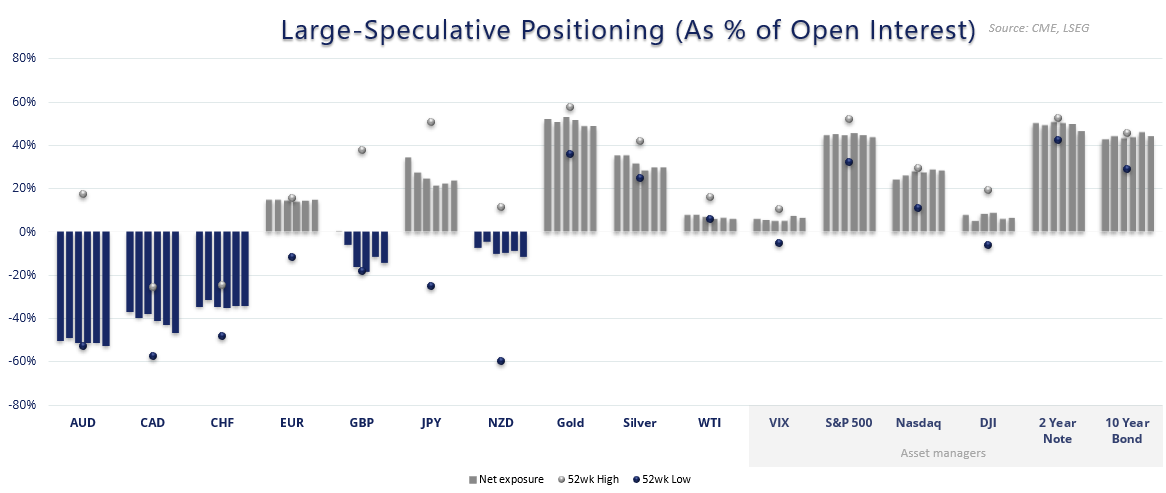
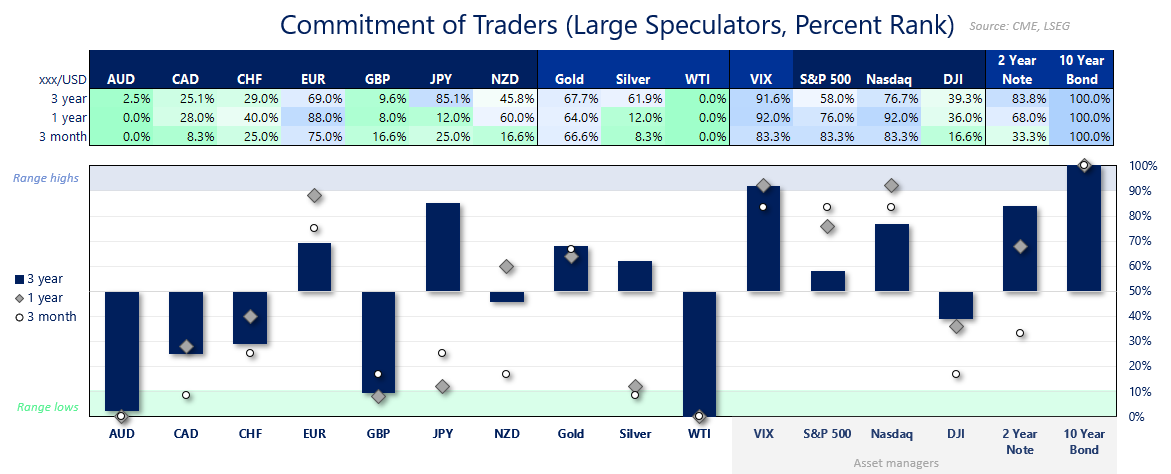
Chart analysis by Matt Simpson - data source: CME, LSEG
Weekly COT Report Highlights:
- US Dollar (USD): Traders were net-short the US dollar by -6.1 billion (-0.5b w/w)
- European dollar (EUR): Asset managers increased net-long exposure to a 19-month high
- British pound (GBP): Large speculators increased net-short exposure by 6.2k contracts
- Japanese yen (JPY): Net-long exposure rose 12.5k contracts combined across large specs and asset managers
- Australian dollar (AUD): Traders most bearish in 16 months
- Canadian dollar (CAD): Net-short exposure increased by 12k contracts
- Crude Oil (WTI): Managed funds cut net-long exposure by -10.7k contracts, a 15-year low
US Dollar Positioning (IMM Data): Weekly COT Report Analysis
The US dollar index remains in a broader downtrend and for a second week printed an inverted hammer candle. For now, this suggests bears have been unable to extend gains, though a weekly close above last week’s high could confirm a swing low. Until then, the preference is to fade into rallies.
Traders were net-short the US dollar by -6.1k contracts, while asset managers held net-short exposure of -5,712 contracts. Neither reading points to a bearish sentiment extreme, leaving scope for positioning to extend further if dollar weakness persists.
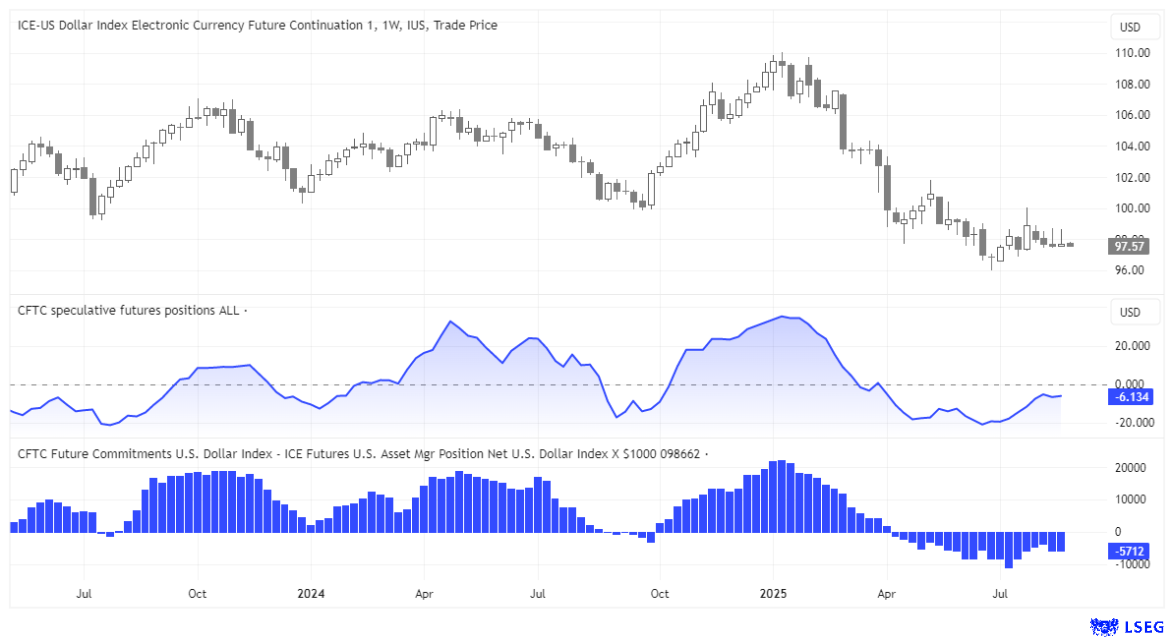
Chart prepared by Matt Simpson - data source: CME, IMM, LSEG
JPY/USD Positioning: Japanese Yen Futures – Weekly COT Report Analysis
Net-long exposure to Japanese yen futures continued to edge higher, with asset managers adding for a third straight week and large speculators for a second. Both groups increased gross-longs and trimmed shorts, lifting overall net-long exposure.
Since net-longs have been trending lower from their May peak, this renewed pickup suggests a trough may now be in place. If so, it implies that a swing high has already formed on USD/JPY, reinforcing downside risks for the dollar against the yen.
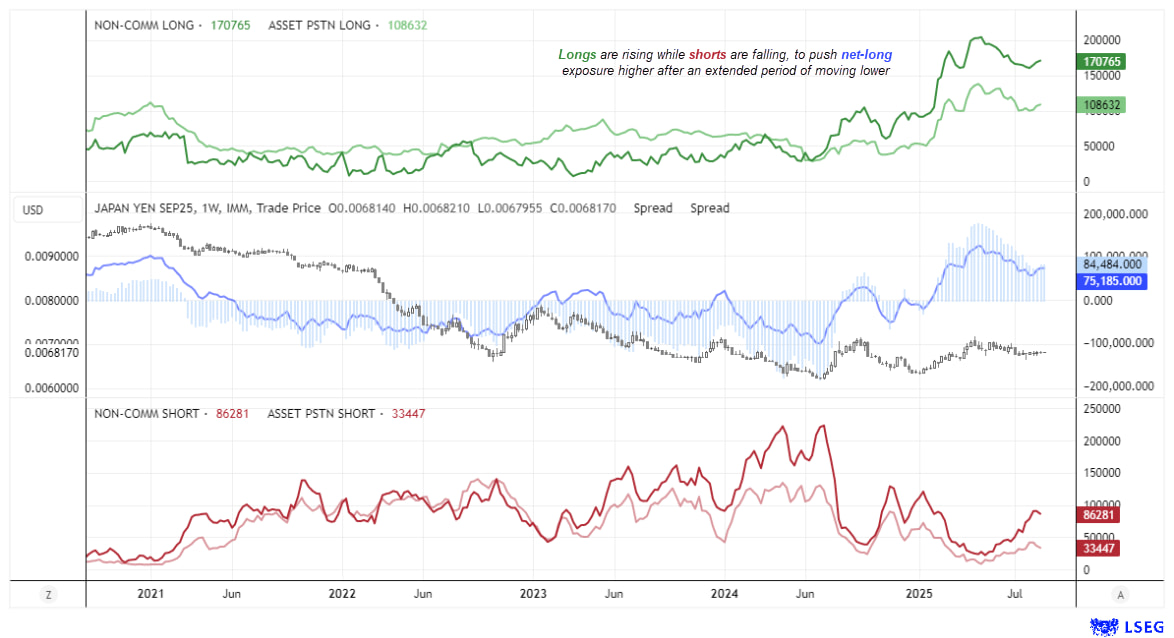
Chart analysis by Matt Simpson - data source: CME, LSEG
Commodity FX Positioning (AUD, CAD, NZD): Weekly COT Report Analysis
Traders remain net-short on the major commodity-FX futures, though last week’s price action suggests bears could face challenges if the US dollar continues to weaken. With that said, the Australian and Canadian dollars show the most potential to perform a rebound compared to the lagging New Zealand dollar.
AUD/USD Positioning: Australian Dollar Futures – Weekly COT Report Analysis
Net-long exposure to AUD/USD futures climbed to a 16-month high among both asset managers and large speculators. Gross-longs rose while gross-shorts declined last week, showing renewed bullish conviction.
This suggests traders are betting that the Reserve Bank of Australia (RBA) will be forced to cut rates sooner than its guidance implies. Even so, I maintain my view that a 25bp cut in Q4 remains a finely balanced decision. And with odds of a Fed cut rising, AUD/USD should remain supported, forcing some of these bears to cover shorts against the Australian dollar.
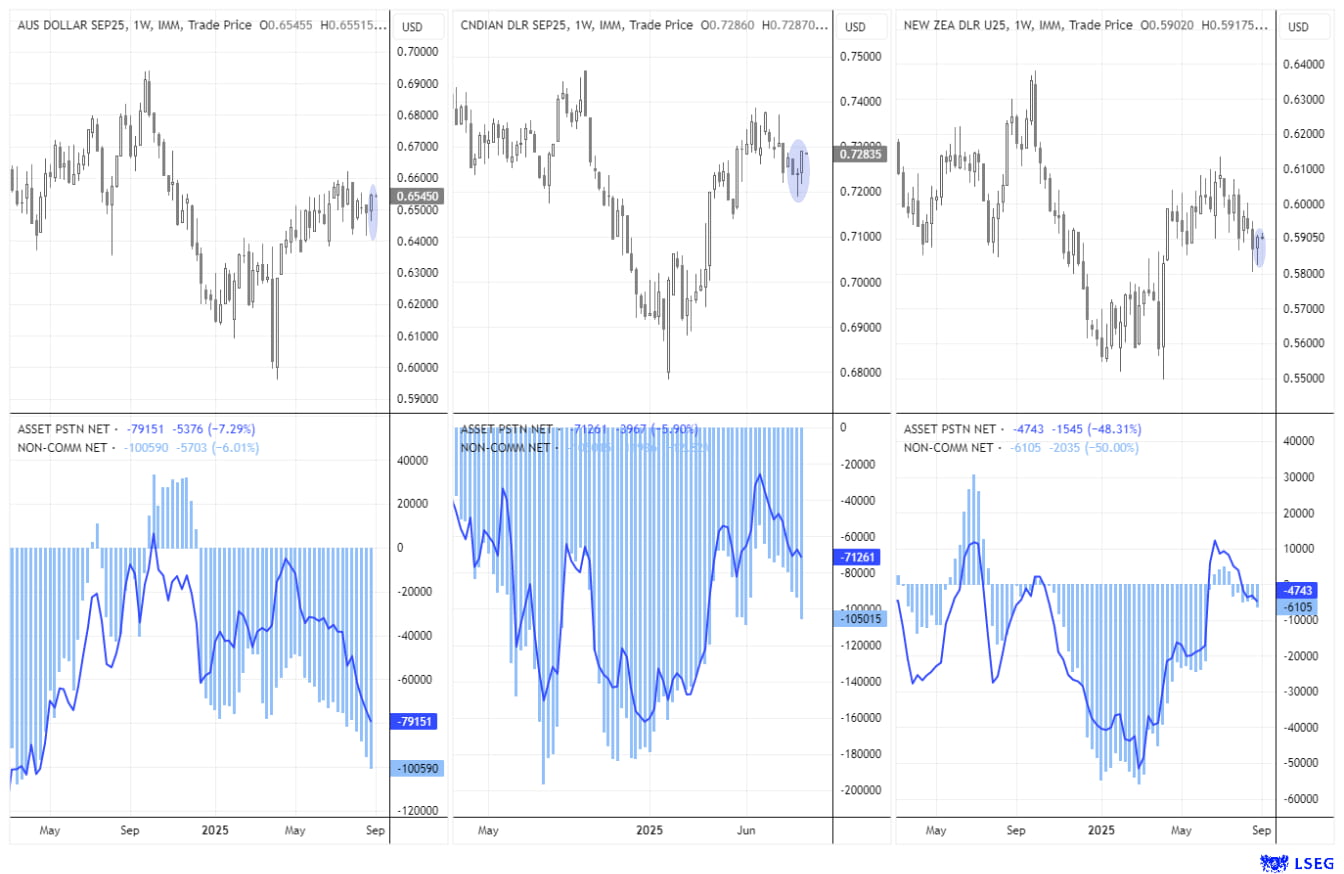
Chart analysis by Matt Simpson, Source: CME Futures, LSEG
CAD/USD Positioning: Canadian Dollar Futures – Weekly COT Report Analysis
Bears added to their net-short exposure in Canadian dollar futures for a fourth consecutive week, marking the most bearish stance since early June. This positioning shift occurred ahead of softer GDP figures, which strengthened bets of another Bank of Canada (BoC) cut.
Despite this, the Canadian dollar closed last week strongly, buoyed by US dollar weakness. The price action also formed a Morning Star reversal pattern on CAD/USD futures — the inverse of an Evening Star on USD/CAD, which reinforces a bearish outlook for the greenback.
NZD/USD Positioning: New Zealand Dollar Futures – Weekly COT Report Analysis
The Reserve Bank of New Zealand (RBNZ) delivered a dovish cut two weeks ago, yet net-short exposure to New Zealand dollar futures remains relatively light among both asset managers and large speculators.
However, this has not translated into stronger NZD/USD performance compared to the Australian or Canadian dollar. NZD/USD has endured the deepest pullback from its June high and the weakest rebound. Last week’s price action only managed to produce a modest bullish inside candle — a muted response that underscores the kiwi’s relative underperformance.
View the full economic calendar
-- Written by Matt Simpson
Follow Matt on Twitter @cLeverEdge
How to trade with City Index
You can trade with City Index by following these four easy steps:
- Open an account, or log in if you’re already a customer
• Open an account in the UK
• Open an account in Australia
• Open an account in Singapore
- Search for the market you want to trade in our award-winning platform
- Choose your position and size, and your stop and limit levels
- Place the trade