



US futures
Dow futures 0.02%, S&P futures 0.06% & Nasdaq futures 0.13%
In Europe
FTSE 0.60% & DAX 0.96%
- US stocks hold steady but are set for strong weekly gains
- US CPI data is expected to rise to 3.3% YoY
- US-Iran peace talks could take place this weekend
- Oil falls sharply across the week, even as the Strait remains effectively closed

US stocks hold steady but are set for strong weekly gains
U.S. stock indices are pointing to a broadly flat open on Friday, as investors pause after strong gains earlier in the week and await key inflation data, while continuing to monitor geopolitical developments in the Middle East.
The announcement of a temporary ceasefire between the U.S. and Iran earlier this week helped drive a sharp improvement in risk sentiment, putting the S&P 500 and Nasdaq on track for their strongest weekly performances since November, while the Dow is set for its best week since June. That rally was largely driven by a sharp drop in oil prices and a corresponding easing in stagflation concerns.
However, momentum is now stalling somewhat as markets reassess the durability of the two-week truce. There are increasing signs that the agreement remains fragile, with ongoing military activity in Lebanon and continued disruption to shipping flows through the Strait of Hormuz. This suggests that while risk appetite has improved, investors are not yet fully pricing in a sustained de-escalation.
Attention now turns to U.S. CPI data for March, which is expected to show inflation rising to 3.3% year-on-year. A stronger-than-expected reading could challenge the recent improvement in sentiment by reinforcing the view that inflation remains sticky. Notably, markets are no longer pricing in any rate cuts from the Federal Reserve in 2026, a significant shift from earlier expectations prior to the escalation in geopolitical tensions.
In parallel, diplomatic developments remain in focus. Talks between Washington and Tehran could begin as early as this weekend, although prospects for progress remain uncertain. Benjamin Netanyahu has indicated openness to direct negotiations with Lebanon, but the continuation of military operations highlights the complexity of the situation. As such, markets are likely to remain highly sensitive to headlines, with sentiment vulnerable to any signs of renewed escalation.
Corporate Movers
Nike is under pressure after being downgraded to neutral by Piper Sandler, with concerns centred on slowing demand and margin pressures in a more challenging consumer environment.
TSMC is moving higher in premarket trading after reporting first-quarter revenue ahead of expectations, reinforcing the view that demand linked to AI and advanced computing remains resilient despite broader macro uncertainty.
Meanwhile, DocuSign is falling after Citigroup cut its rating to neutral, pointing to valuation concerns and a more competitive growth outlook in the digital services space.
Nasdaq 100 forecast – technical analysis
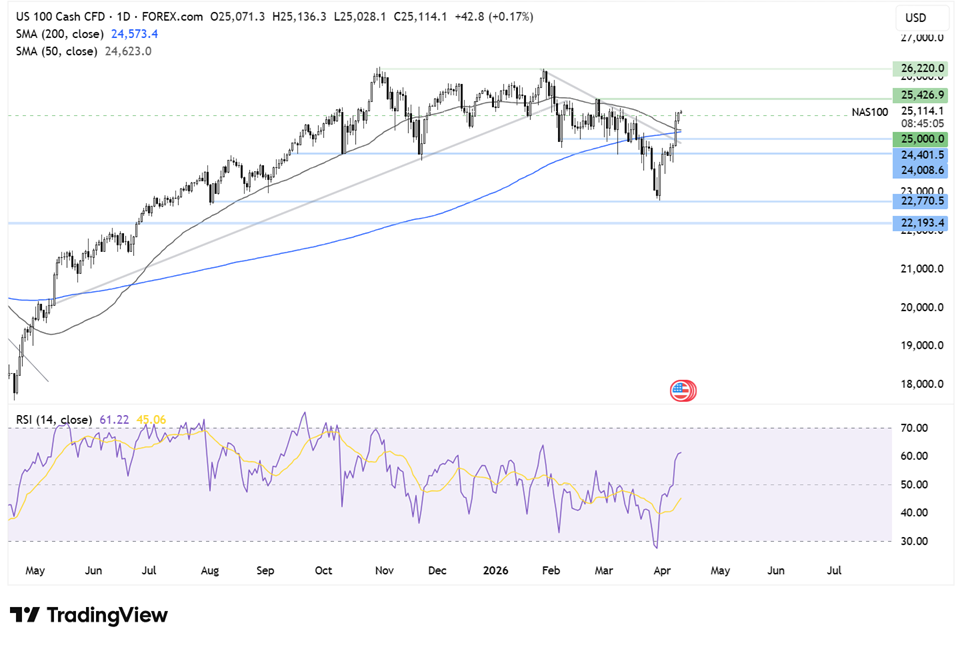
The Nasdaq rebounded from the 22780 March low, rising above the falling trendline resistance, the 200 and 50 SMA, to 25000.
Buyers supported by the RSIs above 50 will look to extend gains towards 25,440, the late February high, ahead of 26,220, the record high.
Immediate support is at 24,600, the confluence of the 50 and 200 SMA, and at 24,350, the horizontal support and falling trendline. Below here 24,000 comes into focus ahead of 22,780, the 2026 low.
FX Markets -USD flat, EUR/USD steady
The U.S. dollar is broadly steady on Friday but remains on track for a weekly decline of around 1.3%, which would mark its largest drop since January. The move reflects a combination of safe-haven outflows following the ceasefire announcement and a pullback in U.S. Treasury yields. However, the dollar’s downside appears to be limited for now, as investors remain cautious ahead of key inflation data and ongoing geopolitical uncertainty. A stronger-than-expected CPI print could quickly revive support for the currency by reinforcing higher-for-longer rate expectations.
EUR/USD is extending its gains, rising around 1.4% over the week. The move has been supported not only by improved global risk sentiment but also by stronger domestic data, with German inflation rising to 2.8% year-on-year from 1.9%. This increase, driven largely by energy prices, may strengthen the case for a more cautious or even hawkish stance from the European Central Bank, particularly if inflation pressures prove persistent.
GBP/USD is also advancing, up roughly 1.7% on the week. Sterling is benefiting from broad dollar weakness as well as the decline in oil prices, which helps ease stagflation concerns for the UK economy. Given the UK’s reliance on imported energy, lower oil prices reduce pressure on both inflation and household incomes, supporting the currency in the near term.
Oil set for largest weekly decline since June
Oil prices are edging higher on Friday but are still set for their largest weekly decline since June, down approximately 10–12% after the ceasefire announcement pushed crude below $100 per barrel.
Despite this sharp correction, underlying supply risks remain significant. Shipping flows through the Strait of Hormuz are still running at only around 10% of normal levels, indicating that the physical disruption to global energy markets has not yet been resolved.
In addition, around 2.4 million barrels per day of refining capacity in the Gulf has reportedly been taken offline due to damage from drone and missile strikes. This highlights that, even with a ceasefire in place, the structural impact on supply chains could persist for some time.
As a result, while markets have partially priced in a normalisation scenario, a meaningful further decline in oil prices will depend on tangible progress in negotiations and, crucially, a reopening of the Strait of Hormuz. Until then, a geopolitical risk premium is likely to remain embedded in energy markets.