



Bitcoin Key Points
- The historically-reliable 4-year halving cycle suggests that Bitcoin’s current bear market may stretch through Q3 before forming a durable bottom.
- Other measures, including valuations, ETF purchases, and global money supply point to potential upside later in the year.
- Accordingly, readers should exercise caution unless and until Bitcoin can break above $74K and ideally form a “higher low” on from there.
Bitcoin Q1 2026 in Review
In our last Bitcoin outlook, we warned traders that they should “watch the key levels for near-term setups, rather than staking out a strong position and maintaining it all year” amid mixed fundamental signals. As it turns out, the late January break below $84K support served as a clear warning that more downside was coming, and Bitcoin then spent the last eight weeks of 2026 consolidating in the $60-$74K range.
Below, we update our quarterly outlook for the king of cryptocurrencies and highlight relevant fundamental and technical trends that will drive Bitcoin in the coming months.
Bitcoin Q2 2026 Outlook
Starting from a top-down perspective, analysts have identified a reliable 4-year cycle centered around the Bitcoin Halving that has relatively reliably helped traders identify significant tops and bottoms over the years, though that’s no guarantee it will necessarily continue to do so moving forward.
For the uninitiated, the Bitcoin Halving is when the reward for mining new bitcoins is cut in half. This reduces the rate at which new Bitcoins are created and thus lowers the total supply of new Bitcoin coming into the market. The halving tends to increase scarcity and can make Bitcoin a more compelling investment for some traders. As any Bitcoin bull will tell you, the April 2024 halving took the “inflation rate” of Bitcoin’s supply to below 1% per year, less than half of gold’s annual inflation rate.
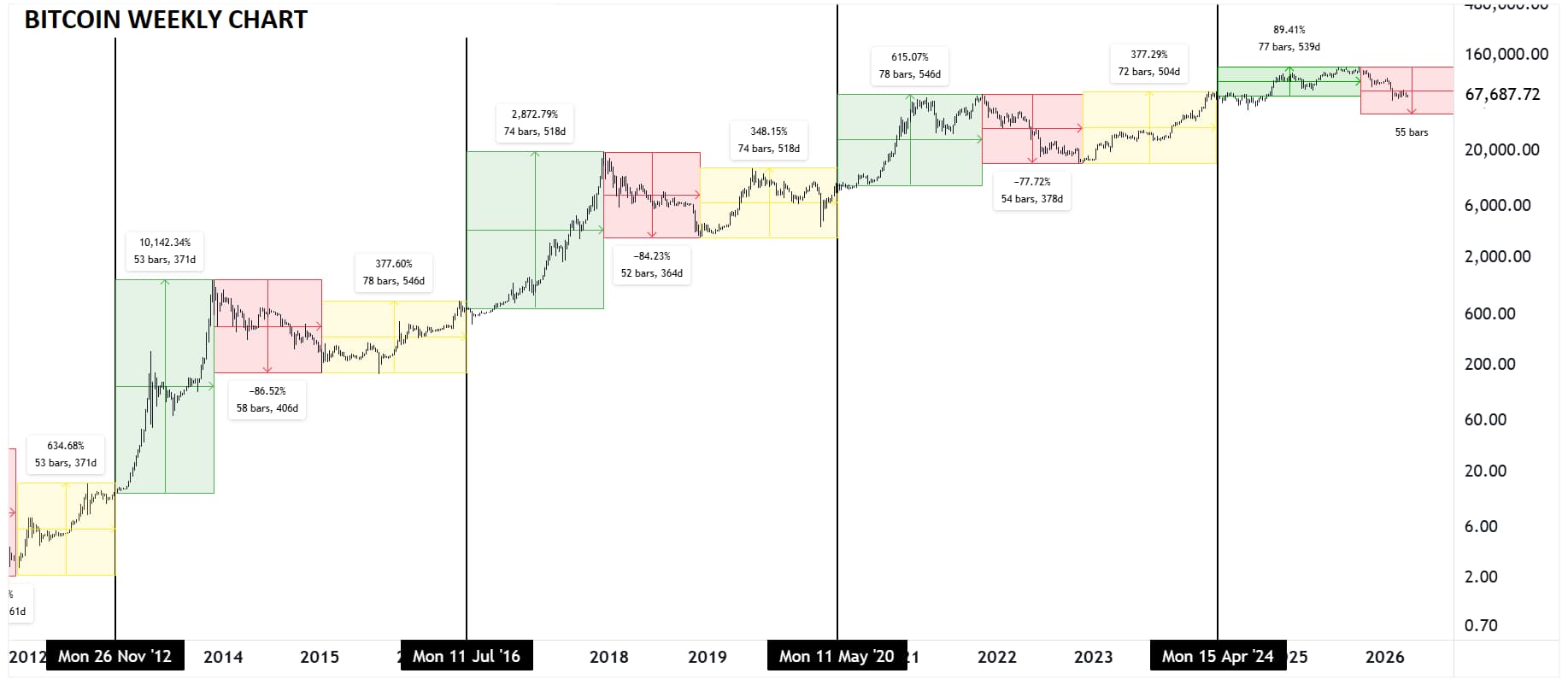
Looking at my favorite chart, which I colloquially call “The Only Bitcoin Chart You'll Ever Need™”, previous Bitcoin halvings have marked the transition from the (yellow) post-bottom recovery rally stage to the (green) full-blown bull market stage, followed by a (red) bear market stage as sentiment resets.
Projecting a similar time-based cycle forward from the last halving suggests that we reached the peak of the last cycle at the start of Q4, and that a durable bottom may not be found until closer to the start of Q4 2026:
Source: TradingView, StoneX. Past performance is no guarantee of future returns.
Beyond the 4-year cycle, the fundamental and technical outlook for Bitcoin is relatively mixed, as we discuss in more detail below.
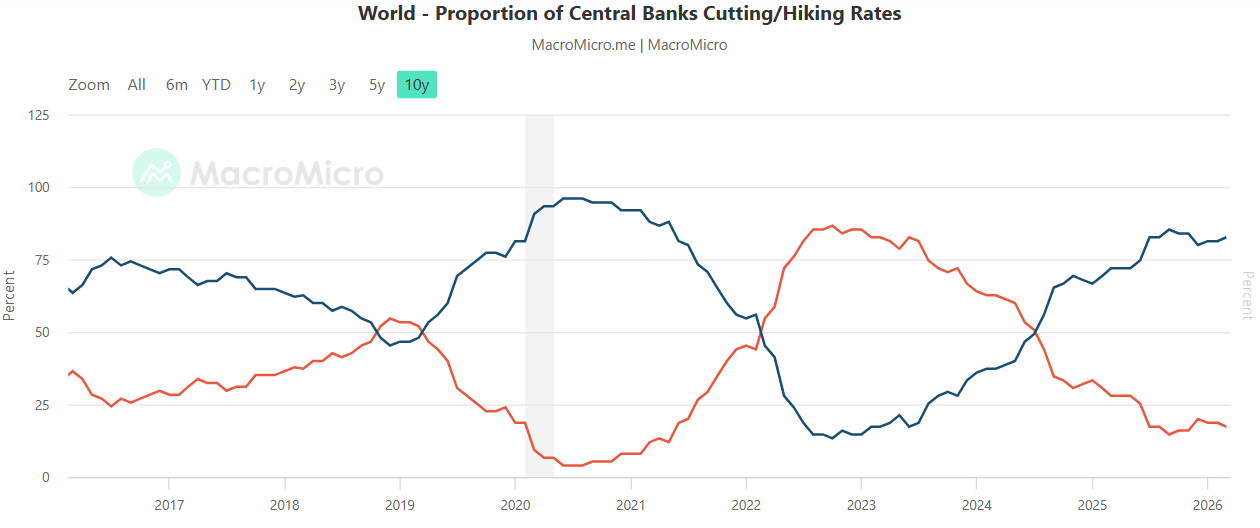
From a macroeconomic perspective, the monetary policy backdrop has remained generally supportive, though the conflict in Iran and shuttering of the Strait of Hormuz has central banks shifting toward potential interest rate increases as we go press.
As the chart below shows, global central banks have still been cutting interest rates generally, but we have seen that trend stalling in recent months, with major central banks like the ECB, BOJ, BOC and RBA currently expected to raise interest rates in the coming year:
Source: MacroMicro
Looking ahead, the risk that central banks shift focus back to the risks of re-accelerating inflation may develop into a potential headwind for Bitcoin as we move through Q2, especially amidst generally accommodative fiscal policy across the globe. A prolonged closure of the Strait of Hormuz would only exacerbate that risk.
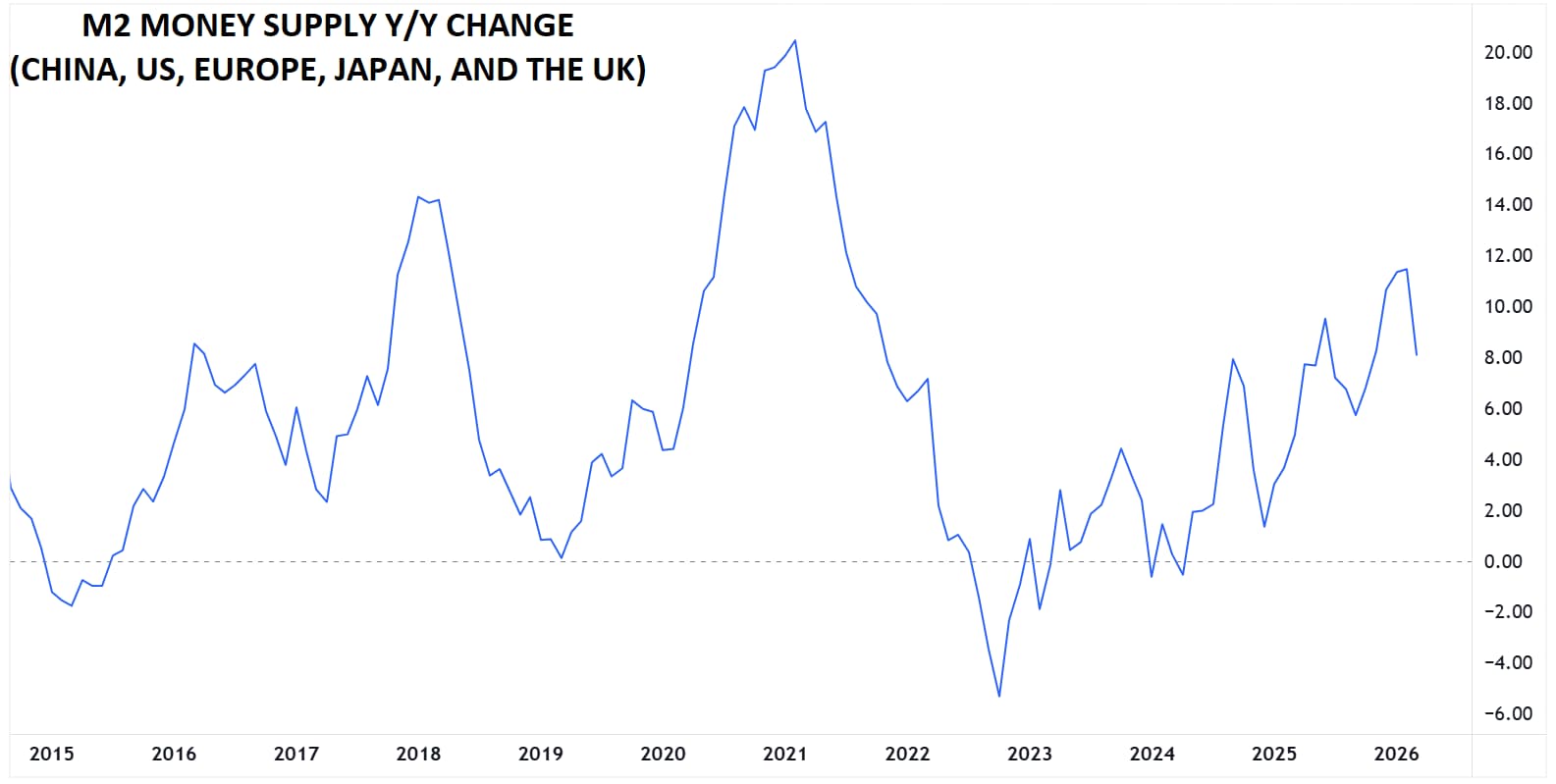
Meanwhile, the growth rate of fiat money in the financial system has turned to a more stimulative direction. So-called “M2” is central banks’ estimate of the total money supply, including all the cash people have on hand, plus all the money deposited in checking accounts, savings accounts, and other short-term saving vehicles such as certificates of deposit (CDs).
The year-over-year growth in global money supply has accelerated in recent years and is currently running around 8% as we go to press:
Source: TradingView, StoneX.
One of the key narratives driving Bitcoin’s value is the idea of “hard money” or a hedge against fiat currency debasement, and as long as the global supply of money continues to increase, that theme could help support the cryptocurrency’s price.
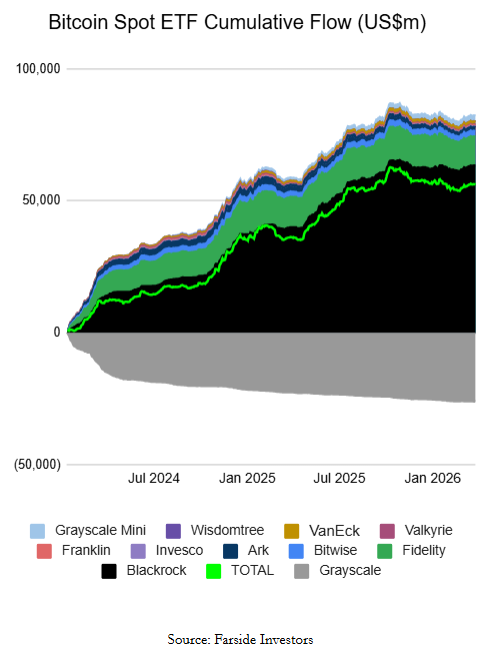
Beyond broad macroeconomic dynamics, a key theme support Bitcoin in recent years has been accumulation by large financial institutions and mom-and-pop investors. In addition to the growing popularity of firms accumulating the cryptocurrency as a treasury asset, we’ve also seen impressive inflows from “TradFi” institutional investors buying spot Bitcoin ETFs, with total inflows into Bitcoin ETFs near $60B, albeit down slightly from the early Q4 peak:
Source: Farside Investors
Broadly speaking, as long as “TradFi” ETF purchases remain positive, downside dips in Bitcoin may be more limited than they have in the past.
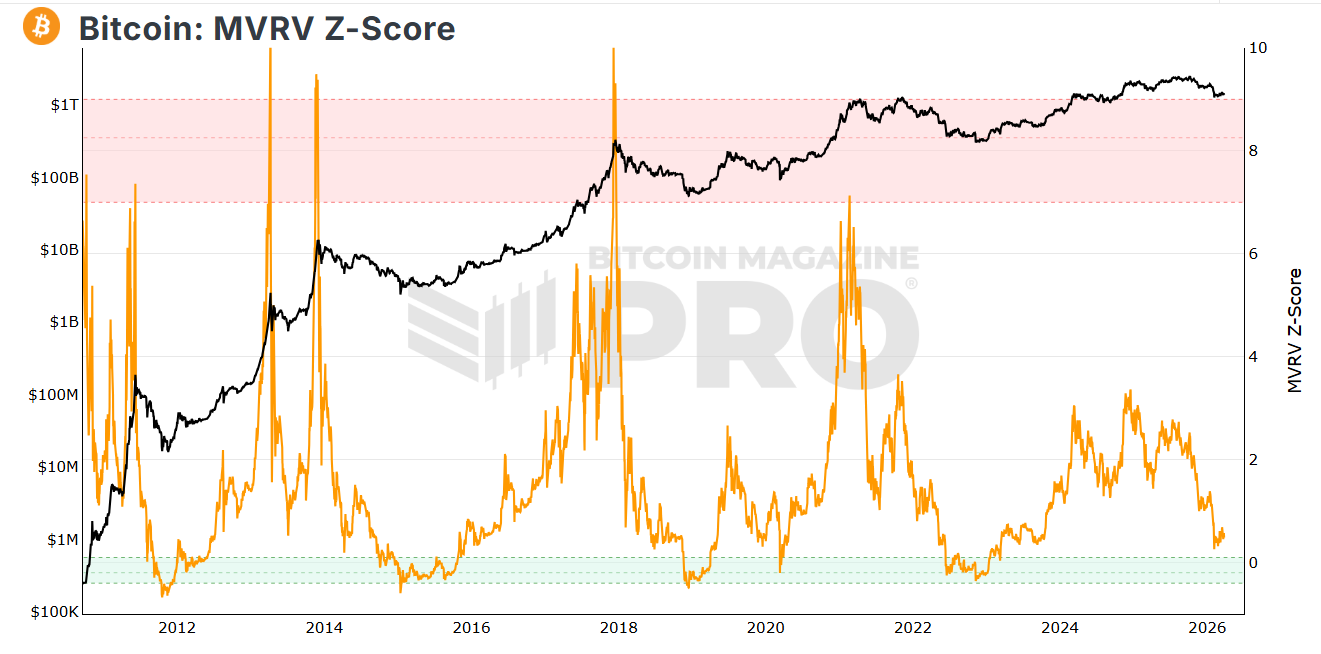
From a valuation perspective, the MVRV (Market Value to Realized Value) Z-score, which compares the current price to the aggregate cost paid for all outstanding Bitcoin, has fallen to just 0.5, closer to the typical bear market bottom zone at 0 than the recent peak above 3:
Source: Bitcoin Magazine. Past performance is not indicative of future returns.
In a sign that Bitcoin is maturing as an investment and arguably, a new asset class, this valuation metric has become less volatile over time; for instance, the most recent peak never crossed 4, far from previous cycle peaks in the 7-10 range. Accordingly, it may not fall as far below 0 as the past bottoms in the -0.3 to -0.6 region would suggest. Time will tell whether this indicator remains a reliable measure moving forward.
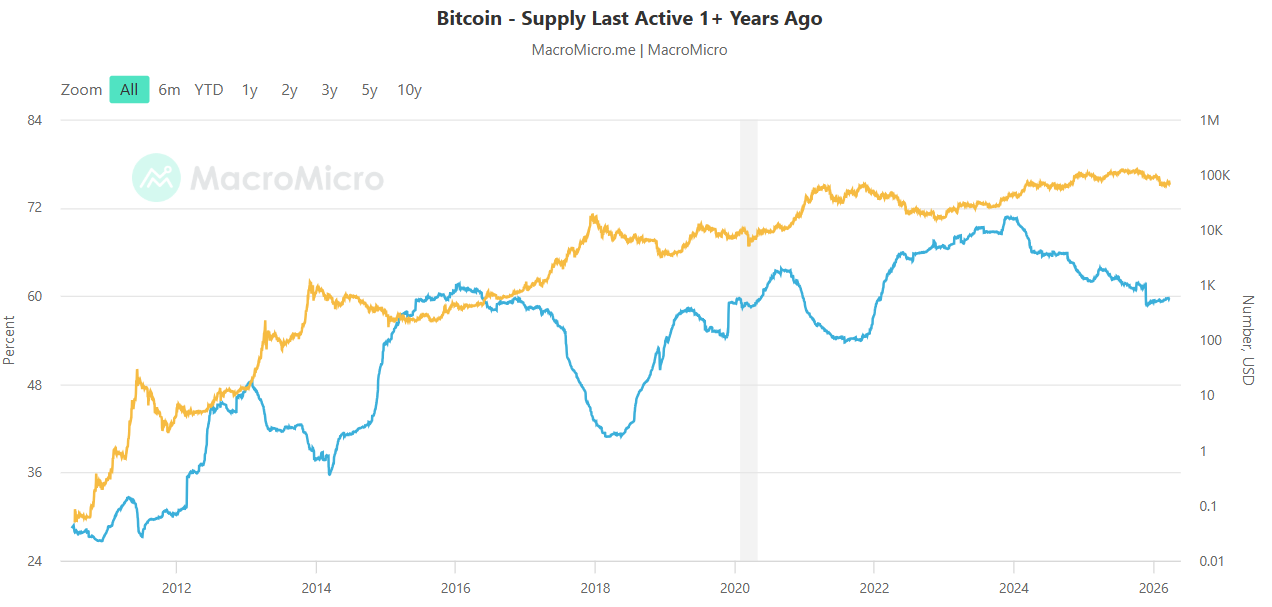
A final consideration is the behavior of long-term holders. As we’ve noted in previous outlooks, those who have held their Bitcoin for more than a year, almost tautologically, are not trying to make a “quick buck” off the cryptocurrency; rather they are more likely to be “true believers” or “HODLers” who are unlikely to sell unless they’re sitting on a truly massive gain.
As the chart below shows, the proportion of Bitcoin that has been held for at least a year has fallen from record highs above 70% to stabilize just below 60% as of writing. While that -10% drop may seem relatively small, it represents over 2 million BTC in marginal Bitcoin supply, weighing on the Bitcoin price. This measure, by definition, moves relatively slowly, but any renewed selling from longer-term “HODLers” may offset inflows into ETFs as we move through Q2:
Source: MacroMicro.me
Taking these diverse forms of analysis in totality, the outlook for Bitcoin in 2026 is mixed: While valuations, money supply, and ETF purchases hint at upside potential, a shift in monetary policy, the behavior of long-term holders, and the 4-year cycle all point to weakness over the coming quarter. Accordingly, it makes sense to defer to the technical outlook (below) and watch the key levels for near-term setups, rather than blindly buying as readers might during a bull phase.
Of course, the catalysts we highlight in this report may not play out as expected – and to some extent, they may already be priced in, so readers should always exercise caution when trading Bitcoin and other cryptoassets. As ever, it will be critical to monitor a broad swath of macroeconomic and crypto-specific metrics as the year develops.
Bitcoin Technical Analysis – BTC/USD Weekly Chart
Source: TradingView, StoneX
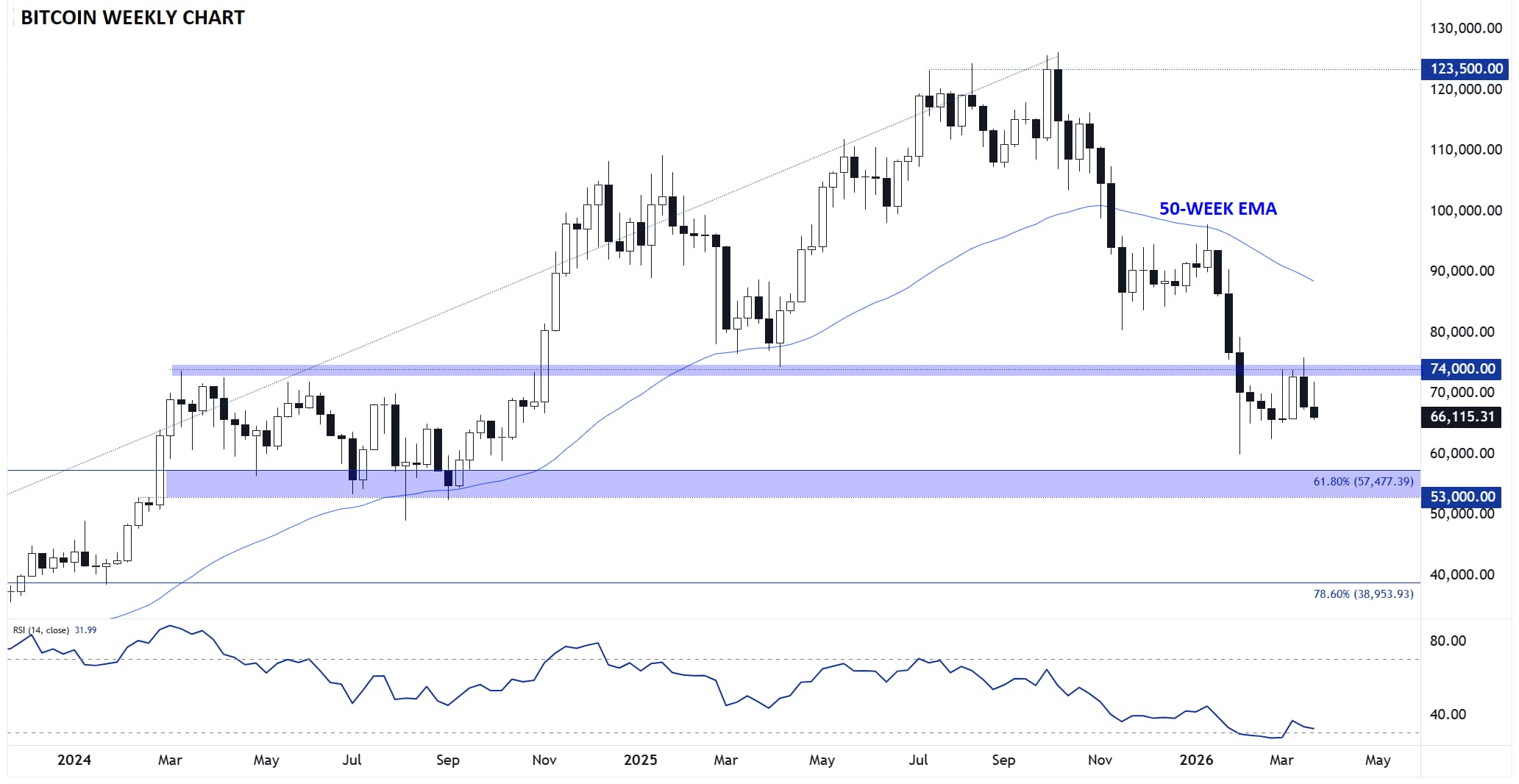
Looking at the longer-term chart, Bitcoin remains in a downtrend off the October 2025 high. Since then, the cryptocurrency has formed a stairstep pattern lower, with occasional sideways consolidation ranges along the way, including the current one in the $60-$74K range as we go to press.
For now, there’s no evidence that the current downtrend is ending yet, with the next support zone starting in the mid-$50K range if the year-to-date lows are broken. This would represent a roughly -60% from the peak, aligning with the progressively smaller bear markets as the asset class has matured across cycles (-93%, -86%, -84%, -78% in 2011, 2014, 2018, and 2022 respectively.
Meanwhile, for bulls to grow more constructive that the longer-term trend may be shifting, Bitcoin would have to break above the high near $74K and ideally establish a “higher low” that would give traders confidence that the cycle is shifting higher ahead of the 2028 halving.
-- Written by Matt Weller, Global Head of Research
Follow Matt on Twitter: @MWellerFX