



As the trading week continues to unfold, the S&P 500 has started to show a consistent recovery in short-term confidence, with the index gaining more than 2.5% during the session while attempting to sustain relatively stable buying momentum. For now, short-term confidence has managed to reestablish itself, as the market has interpreted recent comments from Trump as a potential de-escalation of the conflict in the Middle East, allowing demand for equities to stabilize. If this sense of temporary security holds, buying pressure could begin to gain relevance in the coming sessions.

Hopes pinned on de-escalation
During today’s session, President Trump stated that the war against Iran “will not last much longer,” suggesting that the United States has significantly weakened the country through recent air operations. He also noted that the situation around the Strait of Hormuz could be resolved once the U.S. decides to withdraw. These remarks introduced a more optimistic tone regarding the escalation of the conflict, opening the door to potential negotiations in the short term. Even if temporary, this has helped ease market risk sentiment.
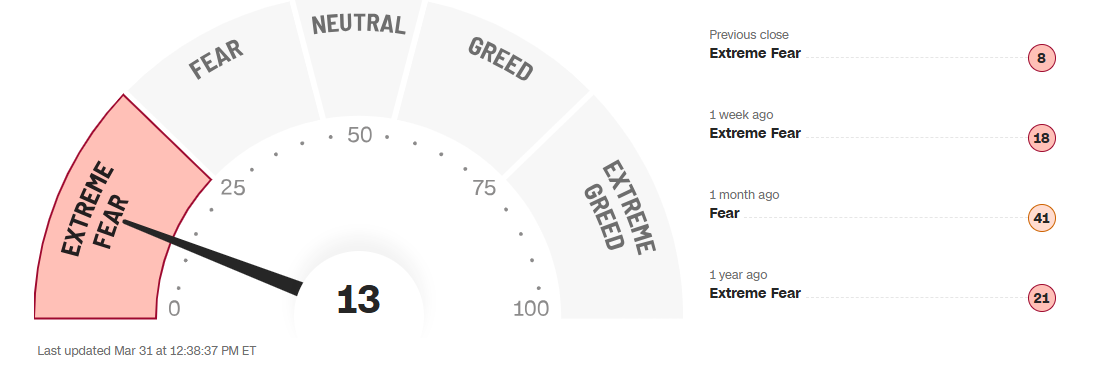
This can be seen in the CNN Fear and Greed Index, which improved from 8 points to around 13 points during the session. Although it remains in “extreme fear” territory, it shows a modest improvement in market sentiment, likely supported by recent comments from the U.S. government regarding efforts to contain the conflict in the Middle East.
Source: CNN
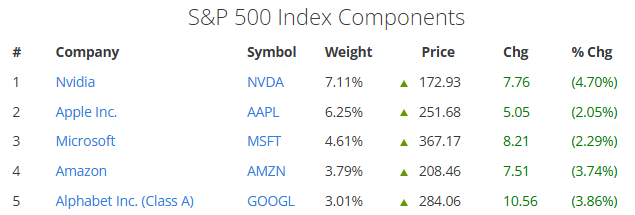
The slight rebound in confidence has allowed the main components of the SPX to post a notable short-term recovery. Nvidia is leading gains with an increase of around 4.7%, followed by Apple (2.05%), Microsoft (2.29%), Amazon (3.74%), and Google (3.86%). This reflects a temporary improvement in equity market confidence, supporting a mild bullish bias in the index.
Source: Slickcharts
In this context, SPX price action remains highly sensitive to developments in the Middle East, as this factor continues to shape overall market risk perception. As long as constructive comments persist, confidence may continue to recover in the short term, potentially translating into stronger buying pressure. However, any renewed escalation could quickly reverse recent gains and bring back a risk-off sentiment.
Long-term confidence remains fragile
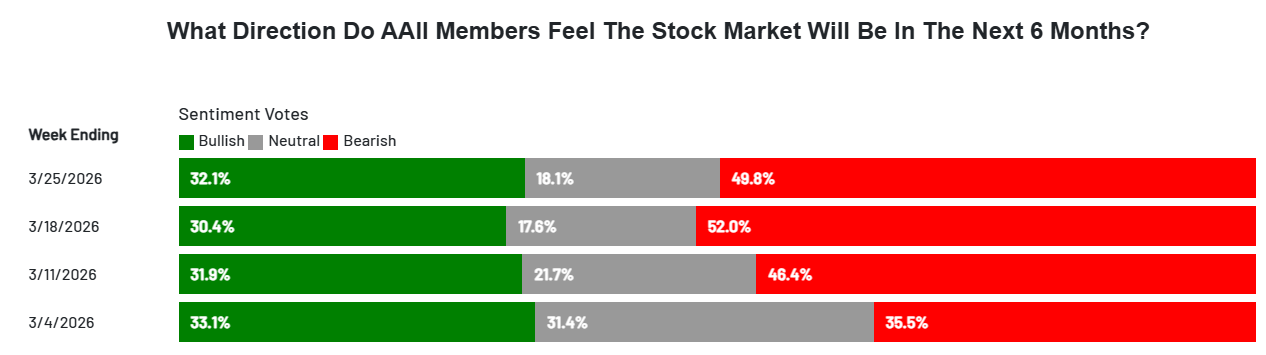
Despite the recent short-term recovery, the long-term outlook remains fragile. According to the AAII Investor Sentiment Survey, expectations for the next six months stand at 32.1% bullish, 18.1% neutral, and 49.8% bearish, suggesting that the market still does not anticipate a sustained recovery in equities.
Source: AAII
This environment could limit a structural recovery in equities, including indices like the Dow Jones, as persistent uncertainty restricts sustained demand. As long as sentiment remains skewed to the downside, the S&P 500 is likely to maintain a weaker medium-term dynamic.
S&P 500 Technical Outlook
Surce: StoneX, Tradingview
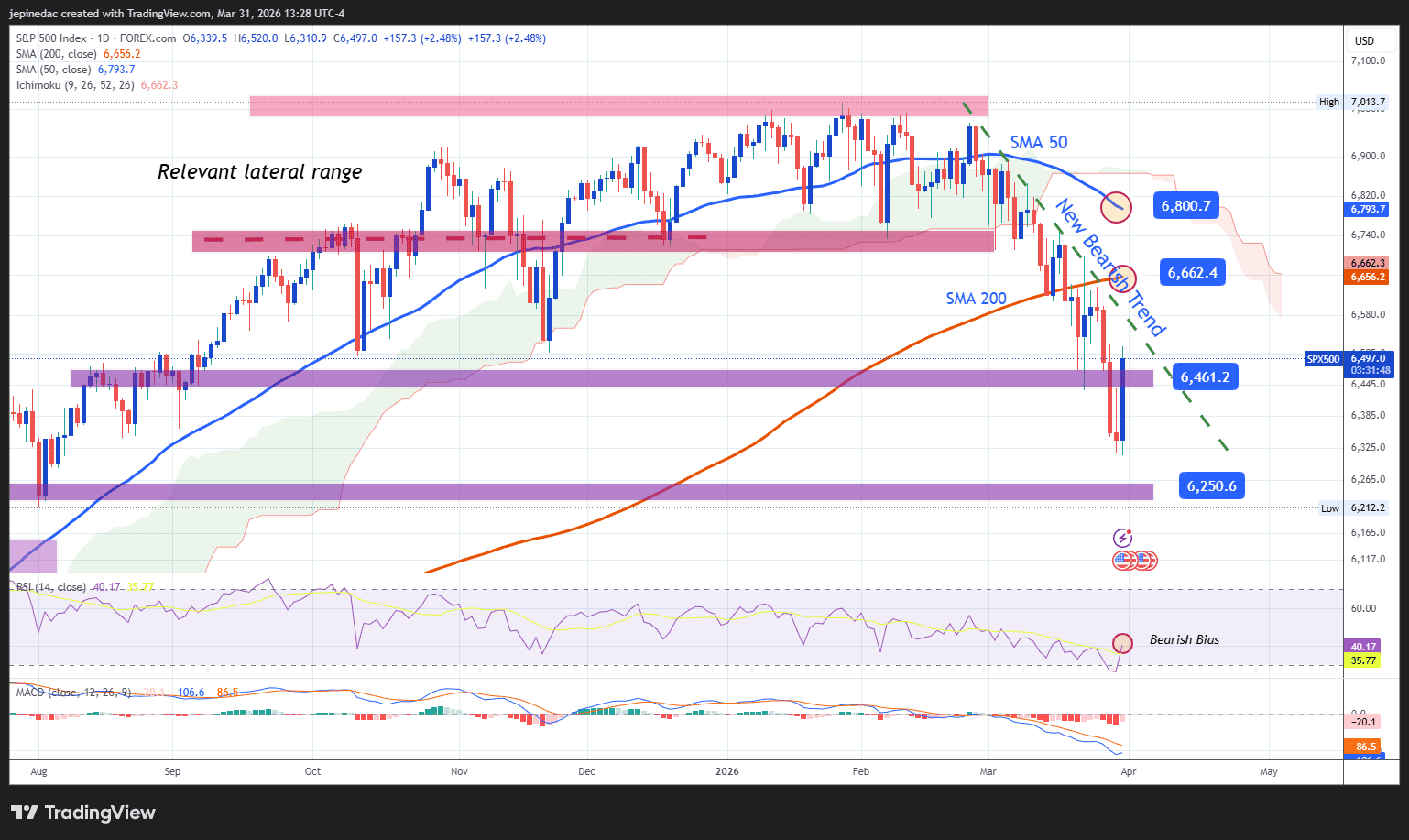
- Downtrend line remains intact: Since late February 2026, SPX price action has respected a consistent downward trendline, which continues to stand out as the most relevant technical structure. Despite the recent rebound, there has not been a strong enough move to challenge this trend, meaning the bearish structure still conditions price action in the near term.
- RSI: Despite the recent bounce, the indicator remains below the 50 neutral level, suggesting that momentum over the past 14 sessions still reflects a dominant bearish bias. Unless this level is clearly broken, downside pressure may remain relevant.
- MACD: The histogram remains below the zero line, indicating that short-term selling pressure is still significant. This reinforces the idea that the bearish bias continues to be part of SPX dynamics.
Key levels:
- 6,662 points – Key resistance: This level aligns with the 200-period simple moving average. A sustained move above it would not only invalidate the current downtrend but could also open the door for a stronger bullish bias.
- 6,461 points – Near-term barrier: A key neutral zone that has acted as a pullback area in previous months. Price action around this level could lead to a range-bound or indecisive scenario in the short term.
- 6,250 points – Key support: A level not seen since August 2025. A move toward this area could reactivate a more aggressive bearish bias and extend the current downtrend.
Written by Julian Pineda, CFA, CMT – Market Analyst
Follow him on: @julianpineda25