


Anyone expecting a calm start to the year has been in for a surprise. The US dollar is on track for its third consecutive monthly decline, with a high-to-low range of nearly 4% — its most volatile month in six. Inflation expectations have remained firm while growth momentum has softened, preventing a meaningful lift in real yields despite higher nominal rates. With markets increasingly questioning how long the Fed can remain restrictive, the foundations of US growth exceptionalism are eroding rapidly.
View related analysis:
- US Dollar Rebound Appears Corrective, EUR/USD And GBPUSD Set To Bounce?
- Silver Outlook: Volatility Tests Bulls in Early 2026
- Australian Dollar Outlook: AUD/USD Surges as Risk Appetite Returns Ahead of AU CPI
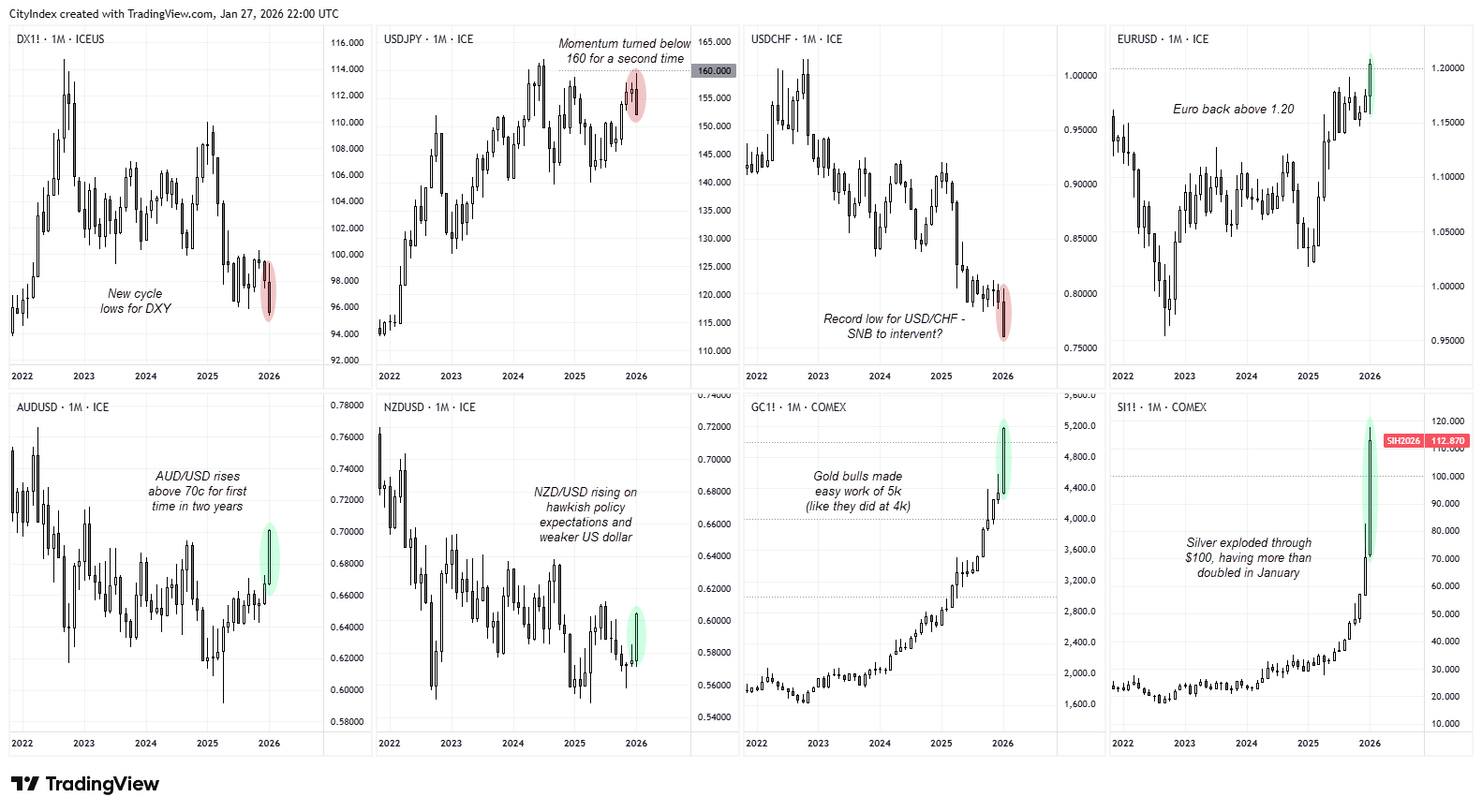
Source: TradingView, ICE, COMEX
- Gold has broken above $5,000 and is up 18.5% for the month at the time of writing, though that pales in comparison to silver’s 56% rally over the same period.
- USD/JPY has sharply reversed from its highs before it could test the elusive 160 handle, fuelling speculation around currency intervention, although this has not been backed up by data.
- The Swiss franc is trading near a record low, down 5.4% from January’s high, potentially leaving it vulnerable to intervention from the SNB.
- EUR/USD is on track for its best month in seven and is trading above 1.12.
However, it is the antipodean commodity currencies that are leading the pack this month, with both the Australian and New Zealand dollars up around 5% against the US dollar. Pressure on the RBA to hike is rising, and some reports suggest the RBNZ could hike as early as May. While a weaker US dollar and shifting monetary policy expectations have been key drivers behind the strength in AUD/USD and NZD/USD, the rally in base metals has also provided support.

Why the US Dollar’s Breakdown Has Been Years in the Making
US Dollar Breakdown Signals Were Years in the Making
I have been warning of a breakdown in the US dollar for several months, based predominantly on technical factors. I argued that the dollar’s multi-year rally from the 2008 low topped in 2022, and that the sharp sell-off from the January 2025 high was an impulsive move that realigned momentum with the broader bear trend from the 2022 peak. As a result, the rebound from the June lows was viewed as a bearish correction, and prices have now broken lower from that structure, placing the dollar on the brink of multi-year lows.
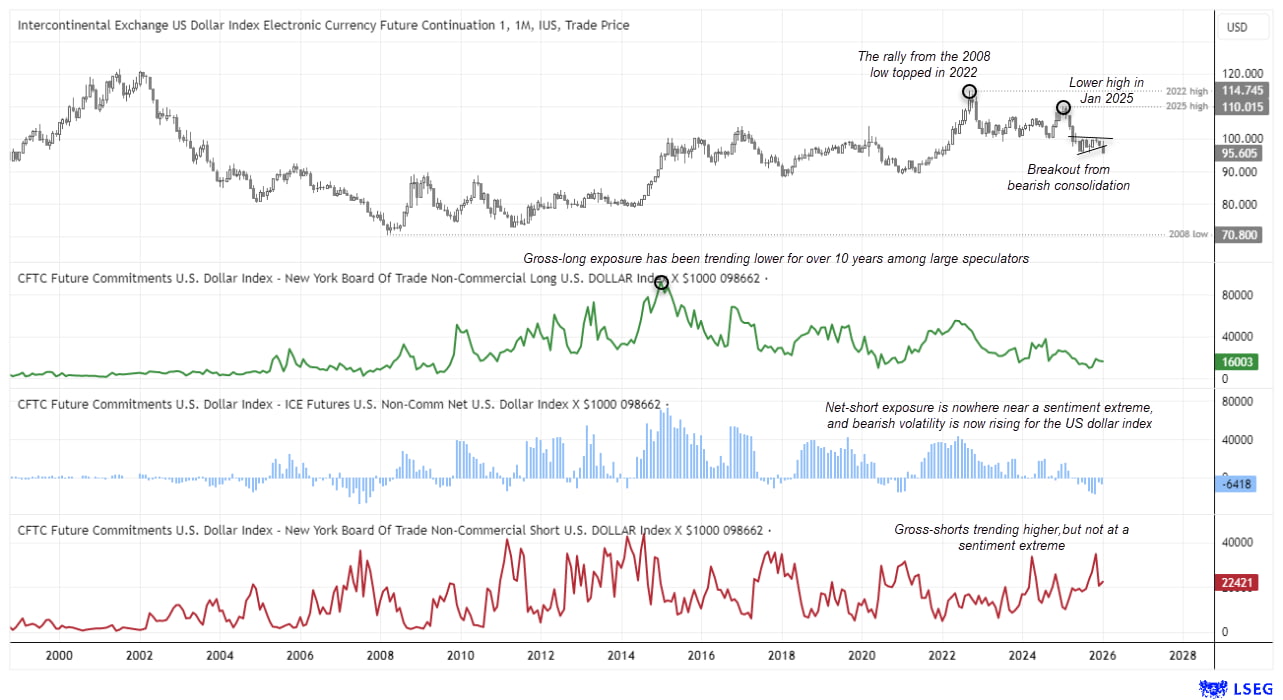
Source: CFTC, IMM, CME, LSEG
Net-Long USD Exposure Has Been Unwinding Since 2014
The slide in the US dollar has also not occurred without warning from market positioning. Net-long exposure has been trending lower since peaking in 2014, driven primarily by a steady reduction in gross-long positions. Traders have been net-short for several weeks without reaching a sentiment extreme, while gross-short exposure continues to build.
Politics and Policy Bias Favour a Weaker US Dollar
So while the US dollar may appear oversold on lower timeframes, I suspect there is considerably more downside ahead. Positioning is not stretched, it has been signalling a fading bullish appetite for years, and President Trump likely wants — and may ultimately get — a weaker US dollar alongside a more dovish Federal Reserve. This sell-off could have much further to run, with attention now turning to a decisive break below the June low.

US Dollar Index (DXY) Technical Analysis
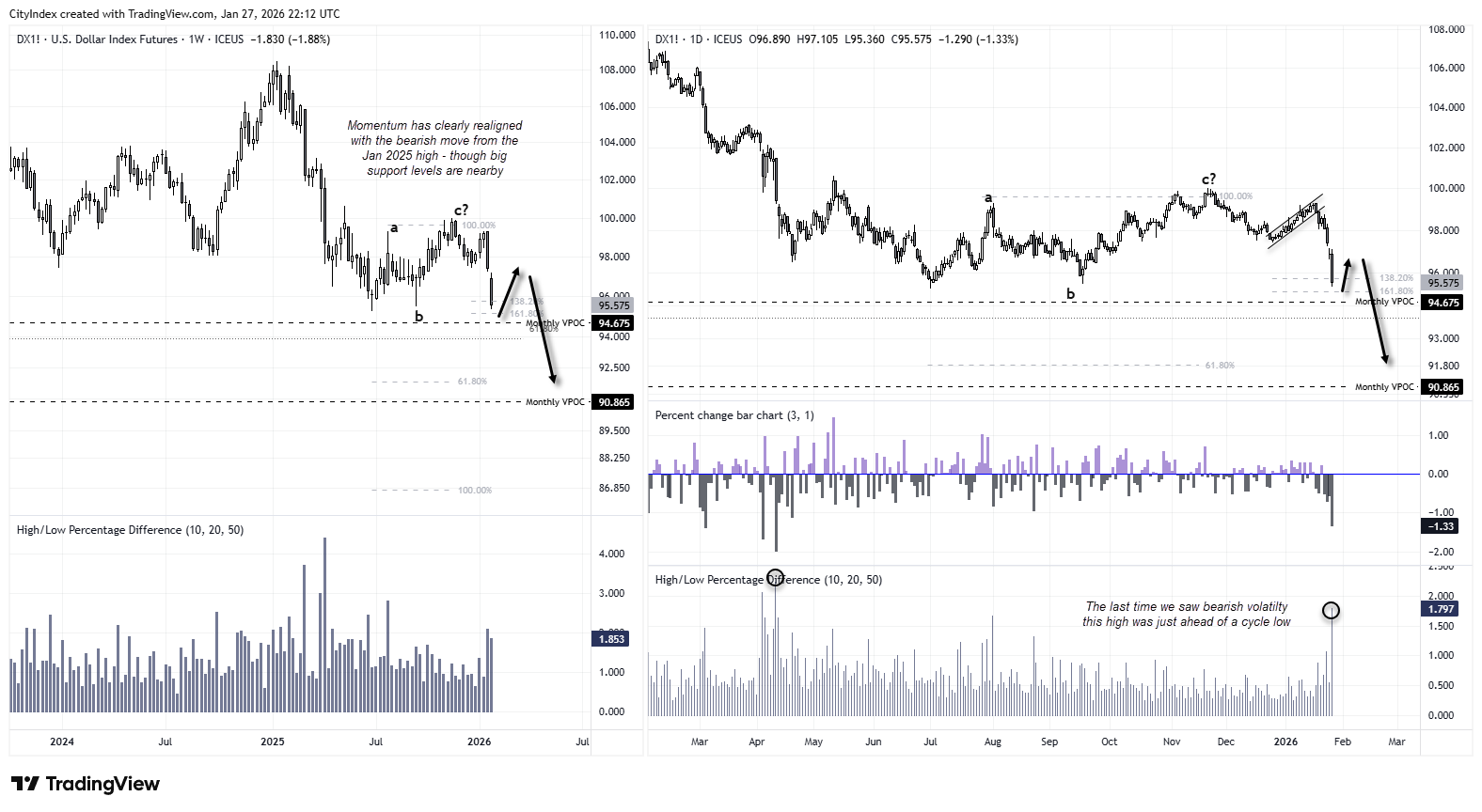
The US dollar index could be heading towards 90 at a minimum, given the recent pickup in bearish volatility. A monthly VPOC sits at 90.86, with the 61.8% Fibonacci projection at 91.81. If the wheels truly come off, the 100% projection lies at 86.85, with the 138.2% extension just below 82.
However, bears should tread carefully given the heavy support clustered around 94, including the long-term 38.2% Fibonacci retracement, a monthly VPOC at 94.67, and the June low. Also note on the daily chart that the last time bearish volatility reached similar levels, a swing low soon followed before losses resumed. Tuesday’s low also landed between the 138.2% and 161.8% Fibonacci projections, reinforcing the risk of near-term two-way volatility.
That said, any bounce is likely to be viewed as a selling opportunity, with bears expected to fade rallies and ultimately push the US dollar index below 94.
Source: ICE, TradingView
View the full economic calendar
-- Written by Matt Simpson
Follow Matt on Twitter @cLeverEdge
How to trade with City Index
You can trade with City Index by following these four easy steps:
- Open an account, or log in if you’re already a customer
• Open an account in the UK
• Open an account in Australia
• Open an account in Singapore
- Search for the market you want to trade in our award-winning platform
- Choose your position and size, and your stop and limit levels
- Place the trade