



At the start of the trading week, a consistent indecision continues to be present in USDJPY price action in the short term. The pair has only recorded a variation of slightly less than 0.5% over the last two sessions, without a clear direction in the short term.
For now, this indecision bias appears to have developed following last week’s central bank decisions in the United States and Japan. The outlook for monetary policy and the comments regarding interest rate management have become increasingly relevant amid diverging expectations in the market, leading to a more neutral behavior in USDJPY. As the market continues to closely monitor both central banks, this phase of indecision may remain relevant in the coming sessions.

Is the central bank battle beginning?
Last week was particularly relevant for both the yen and the U.S. dollar, as interest rate decisions and forward guidance from both institutions were released. In the case of the United States, the rate remained at 3.75%, and post-decision comments indicated that inflation remains in a sensitive zone and is not fully under control.
Additionally, Federal Reserve Chairman Jerome Powell emphasized that further inflationary pressures could emerge during 2026, driven by rising energy costs linked to the Middle East conflict. The central bank’s current stance is to maintain a neutral policy, with no changes in interest rates in the short term.
This outlook is already reflected in market probabilities for the next decision on April 29, 2026, where, according to CME Group, there is a 91.7% probability that rates will remain unchanged. This scenario is expected to continue, at least until September 2027, reinforcing the low probability of seeing rate cuts in the coming months.
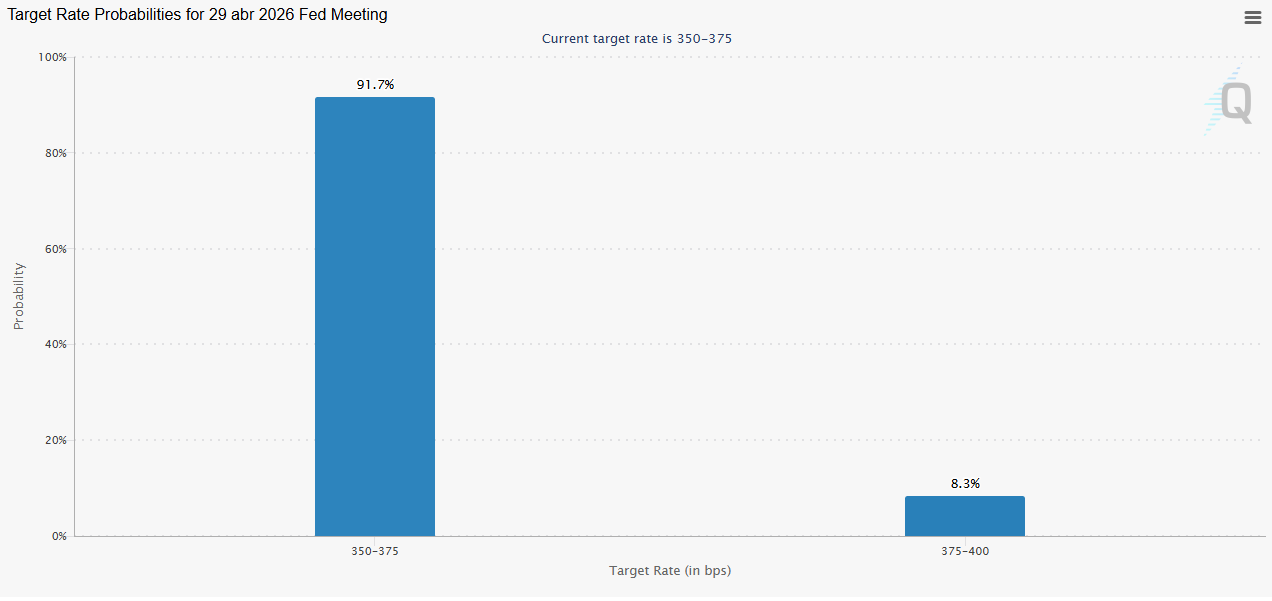
Source: CMEGROUP
By contrast, the Bank of Japan appears to be following a similar path to the Federal Reserve. Last week, the central bank kept rates unchanged at 0.75%, in line with expectations, but emphasized that inflation risks still persist.
It was also noted that wages have been rising significantly, which could lead to additional inflationary pressures in the future. Although rate hikes are not currently expected, the central bank indicated that it will maintain a restrictive policy stance, without anticipating rate cuts in the near term. Overall, the market has interpreted these signals as a potential shift toward a more aggressive stance in the future.
For now, it is important to highlight that, unlike the United States, Japan’s annual inflation stood at 1.3% for February data, showing a downward trend from levels close to 3.00% observed in October 2025. This keeps inflation below the 2.00% target, allowing room for the Bank of Japan to avoid raising rates in the short term.
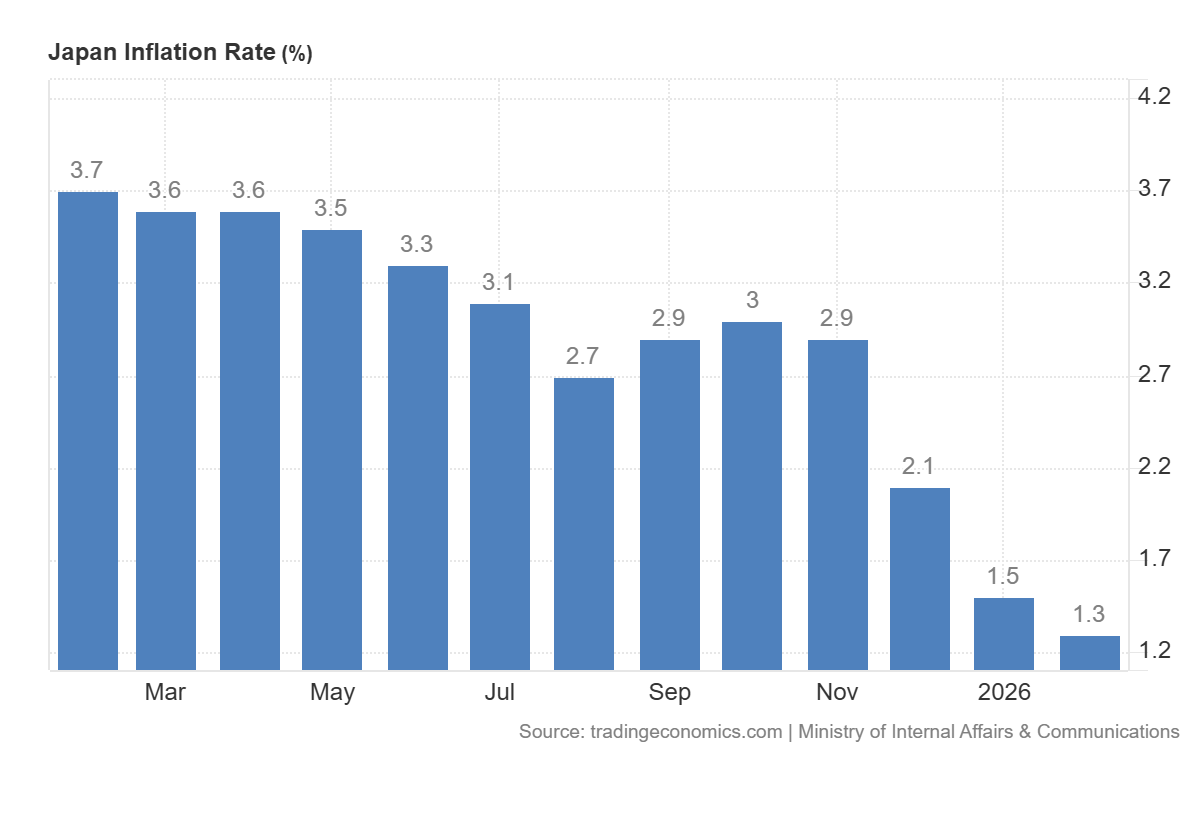
Source: TradingEconomics
Taking all of the above into account, last week’s central bank announcements, rather than generating strong directional moves, have contributed to the formation of an indecision environment in USDJPY, driven by expectations of policy neutrality from both institutions. This dynamic may continue to influence short-term price action.
However, it is also important to consider that interest rates in the United States remain significantly higher than in Japan, which continues to favor dollar-denominated assets. This rate differential could remain a key driver of buying pressure in USDJPY in the coming weeks, as long as there is no expectation that the gap between both central banks will begin to narrow.
USD/JPY Technical Outlook
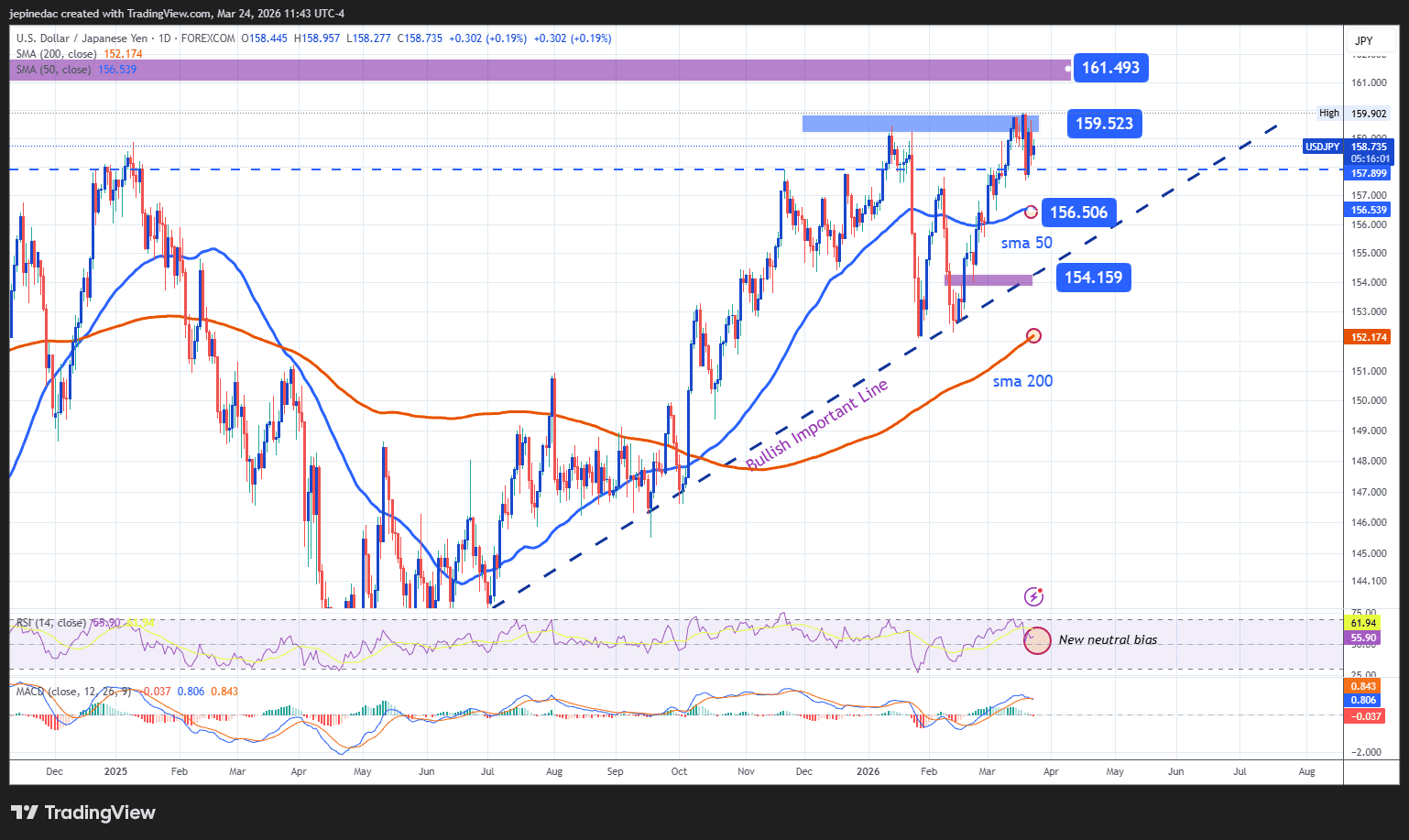
Source: StoneX, Tradingview
- The broader uptrend remains dominant: Since April 2025, USDJPY price action has maintained a consistent upward trend, leading to the formation of a long-term upward trendline, which remains the dominant technical pattern. So far, no significant bearish correction has threatened this structure, meaning that despite the recent neutrality, the underlying bias remains bullish. However, the current phase of indecision could lead to the development of a short-term sideways range within the broader uptrend.
- RSI: The RSI indicator remains oscillating around the 50 level, suggesting a balance between buying and selling pressure. This behavior confirms the presence of a short-term indecision phase, which could persist if the indicator continues to move around this zone.
- MACD: A similar scenario is observed in the MACD indicator, with the histogram remaining close to the zero line, reflecting neutral momentum in short-term moving averages. This further reinforces the idea of an indecision phase in the pair.
Key levels:
- 159.523 – Key resistance: Level corresponding to the highs of 2026 and the main upside barrier to monitor. A break above this area could confirm a dominant bullish bias and allow for a further extension of the uptrend.
- 156.506 – Near-term barrier: A relevant neutrality zone aligned with the 50-period moving average. Price action around this level could reinforce a phase of indecision and lead to the formation of a short-term range.
- 154.159 – Key support: Level corresponding to the most relevant recent lows and aligned with the upward trendline. A break below this zone could put the bullish structure at risk and open the door to a more dominant bearish bias in the coming sessions.
Written by Julian Pineda, CFA, CMT – Market Analyst
Follow him on: @julianpineda25