



The last three trading sessions have been bearish for USD/MXN price action, with the pair posting a decline of more than 1.3% in the short term, favoring the Mexican peso and establishing a new bearish bias after an extended period of U.S. dollar strength. This renewed selling pressure has mainly been driven by the recent loss of momentum in the U.S. dollar, supported by expectations of a potential de-escalation of the conflict in the Middle East, which has reduced demand for the currency in the short term. If this dynamic persists, selling pressure could remain relevant in the coming sessions.

Is the end of the conflict approaching?
Recent sessions have been particularly important for overall market risk sentiment. During yesterday’s session, President Trump stated that he does not expect the conflict to last much longer and suggested it could be resolved within two to three weeks. He even hinted that it may not be necessary for Iran to accept specific conditions. Beyond signaling a concrete agreement, these remarks reflect a growing willingness from the United States to step back from direct involvement, which has been interpreted as a potential short-term de-escalation.
This has started to bring back a temporary sense of confidence in financial markets, allowing flows to return to risk assets. As a result, the strong demand for safe-haven assets seen in previous sessions has begun to fade.
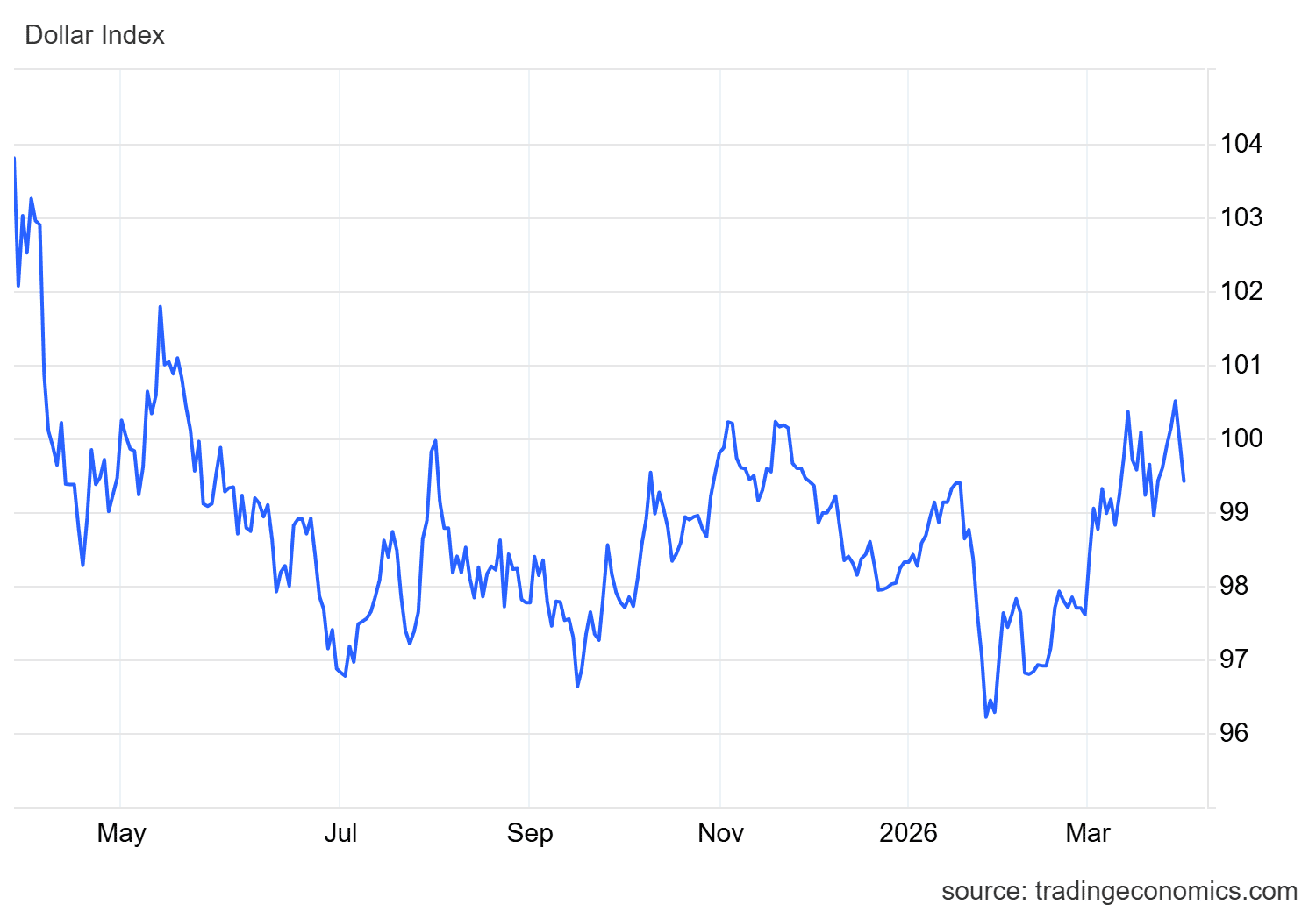
The impact of this shift has been reflected in the recent weakness of the U.S. dollar, which had been acting as the primary safe-haven asset due to its liquidity and stability. At this point, demand for the dollar has started to ease, as seen in the DXY index, which has fallen from levels above 100 down to around 99.4, highlighting a loss of strength in the short term.
Source: TradingEconomics
In this context, the Mexican peso — typically considered a higher-risk currency — tends to benefit when risk appetite improves. As this dynamic continues, capital outflows from the dollar into emerging market currencies could further support the peso. This could translate into additional downside pressure for USD/MXN in the short term.
However, it is important to note that this scenario heavily depends on the continuation of de-escalation expectations. If a clear resolution to the conflict is not confirmed, market risk perception could quickly rise again, which would likely restore strength to the dollar and trigger a rebound in USD/MXN.
Do central banks still matter?
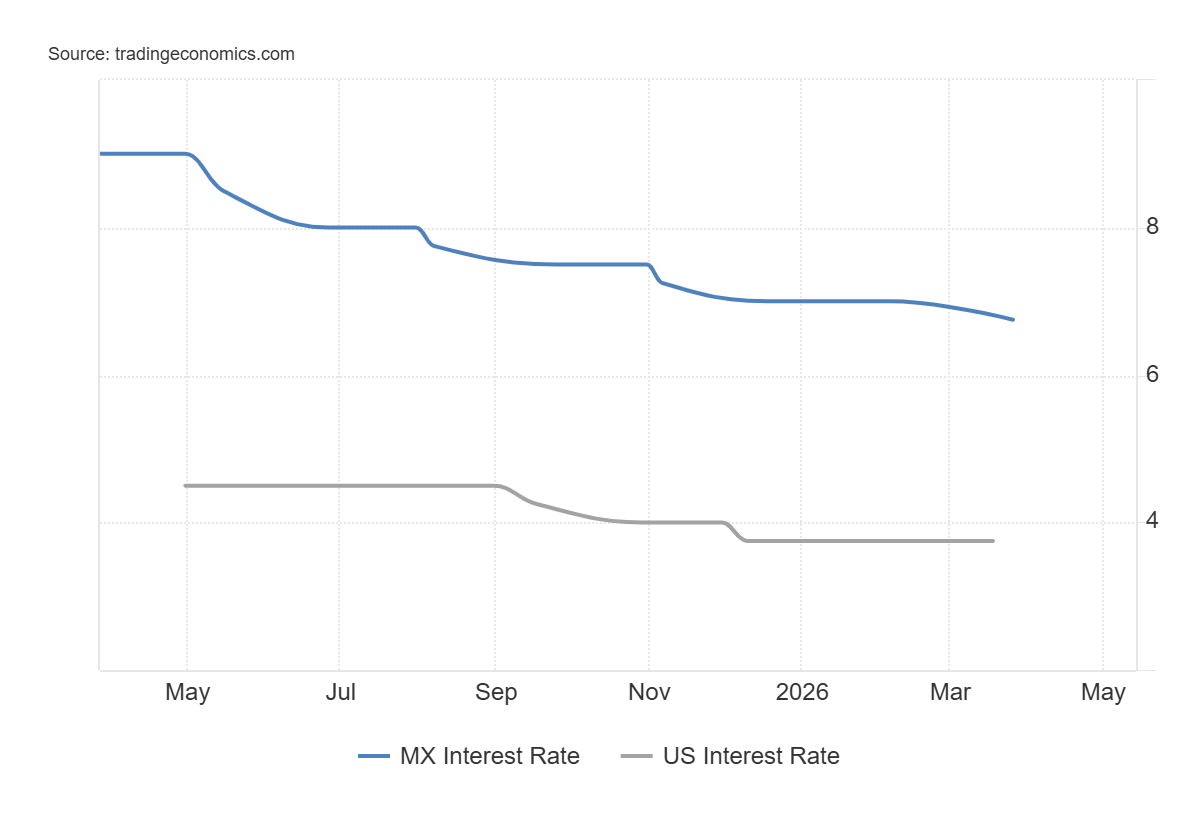
Several sessions have passed since Banco de México decided to cut its interest rate to 6.75%, which has started to reduce its relative advantage compared to the United States, where rates remain around 3.75%. Although Mexico’s rate is still relatively high, perceived risk in peso-denominated assets remains greater than in dollar-denominated assets in the short term.
Source: TradingEconomics
Even so, the interest rate differential remains a key factor. In periods where confidence improves, investments in Mexican pesos can regain attractiveness, supporting stronger demand for the local currency. However, expectations for monetary policy are also crucial. While the Federal Reserve maintains a stance of stable rates through 2026, Mexico’s central bank appears more divided, with potential additional rate cuts on the horizon.
If this differential continues to narrow, peso-denominated assets could lose appeal in the long term, potentially maintaining a structural bullish bias in USD/MXN.
USD/MXN Technical Outlook
Source: StoneX, Tradingview
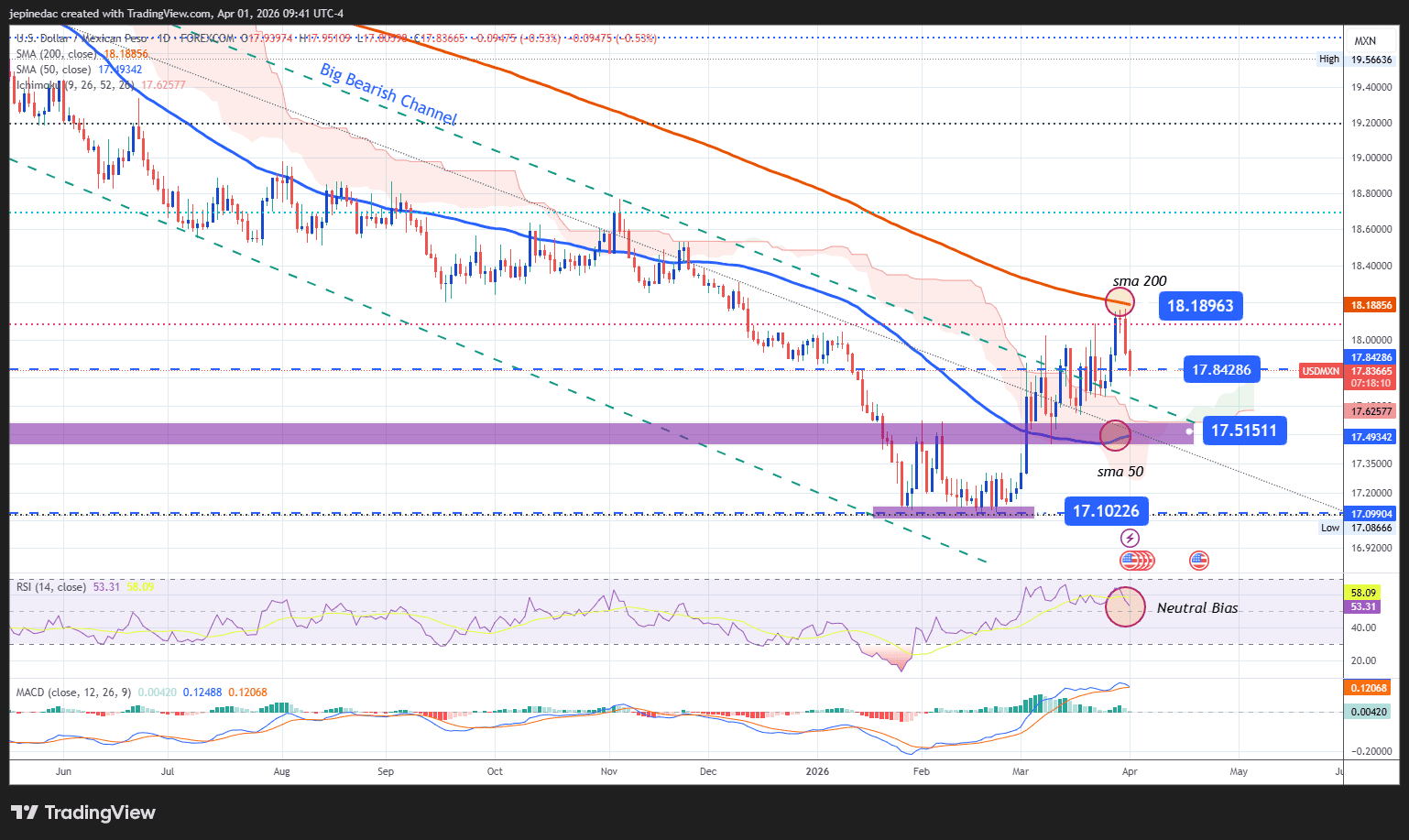
- The broader bearish channel remains at risk: Although the daily chart of USD/MXN had been showing a well-defined upward channel throughout much of 2025, recent price action suggests that this structure has started to weaken. However, the latest bearish move is still not strong enough to establish clear selling dominance, pointing instead to a short-term indecision phase that could evolve into a range-bound environment.
- RSI: The indicator remains close to the 50 neutral level, reflecting a balance between buying and selling momentum over the last 14 sessions. This supports the view of a lack of clear direction in price action.
- MACD: The histogram is also hovering near the zero line, indicating a balanced short-term momentum between moving averages, reinforcing the current neutral setup.
Key levels:
- 18.18 – Key resistance: This level aligns with the 200-period simple moving average. A break above this zone could trigger a stronger bullish bias and open the door to a new upward trend.
- 17.84 – Current barrier: A key neutral zone. Price action around this level could maintain a range-bound or indecisive environment in the short term.
- 17.50 – Key support: A level near the 50-period simple moving average. A break below this zone could reactivate a dominant bearish bias and bring back the relevance of the previous downtrend.
Written by Julian Pineda, CFA, CMT – Market Analyst
Follow him on: @julianpineda25