

EUR/USD Key Points
- The euro could be one of the biggest beneficiaries of peace in Iran given its extreme energy import dependence.
- Since the start of the war, the expectation of higher interest rates in the Eurozone has actually been weighing on the euro, rather than supporting it. That dynamic could now flip.
- EUR/USD’s near-term bullish momentum could take the pair back toward the 1-month high near previous-support-turned-resistance at 1.1670 next.
With the US and Iran seemingly on track to sign a Memorandum of Understanding to “end the war” (for 60 more days at least) by the end of the week, risk assets are rallying across the board, while crude oil prices are falling to their lowest levels in more than 3 months.
The drop in oil in particular is a big catalyst for the Eurozone economy. According to Eurostat, the EU imports nearly 60% of its energy needs, and more than 90% of these imports are linked to oil and gas, exactly the areas most sensitive to supply disruptions from the conflict in the Middle East.
The euro is a big winner from Middle East peace not because Europe gets most of its energy from the region directly, but because Europe is one of the world’s most energy-import-dependent major economies. Accordingly, any durable reduction in the Middle East risk premium improves Europe’s terms of trade, eases inflation pressure, supports real incomes, and reduces the chance that the ECB has to tighten into an energy shock.

Euro Technical Analysis: EUR/USD 4-Hour Chart
Source: Tradingview, StoneX
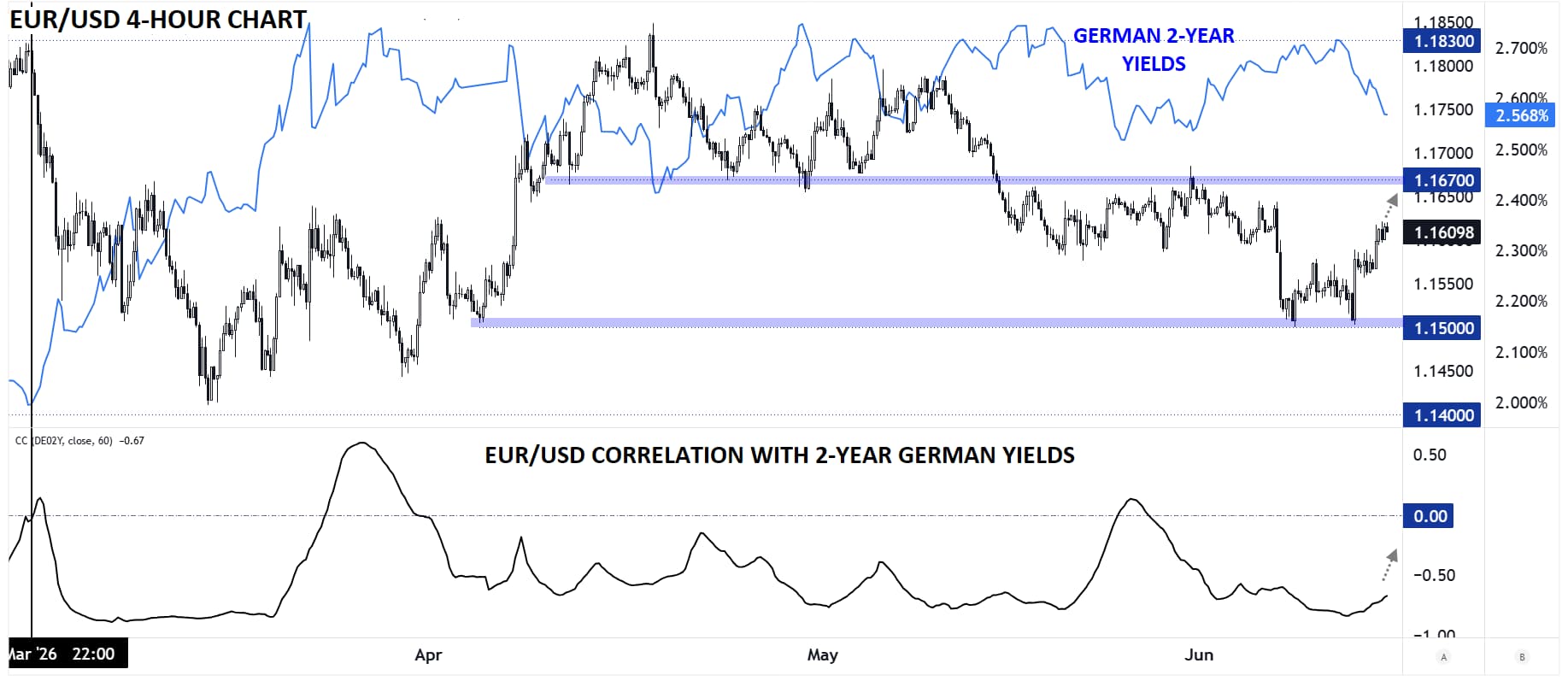
The last point in particular is notable for FX traders. Since the start of the war in Iran, the 2-week correlation between 2-year German yields, a proxy for ECB interest rates, and EUR/USD has been predominantly negative. While interest rate increases, like the ECB delivered last week, would usually be a bullish catalyst for the euro, the price action over the last 2.5 months suggests that the market believes that higher interest rates would weigh on the jobs market and broader economy while doing little to address the energy supply shock.
In other words, the expectation of higher interest rates in the Eurozone has actually been weighing on the euro, rather than supporting it. With the conflict winding down, the euro could now revert back to its historical relationship and start to benefit from higher interest rates.
From a technical perspective, EUR/USD has bounced strongly from 1.1500 support to trade back above 1.1600 as we go to press. Assuming the headlines from the US and Iran remain positive, EUR/USD’s near-term bullish momentum could take the pair back toward the 1-month high near previous-support-turned-resistance at 1.1670 next. Of course, re-escalation of military activity in the region could reverse the rally, but that remains a lower-probability scenario for now.
-- Written by Matt Weller, Global Head of Research
Check out Matt’s Daily Market Update videos on YouTube and be sure to follow Matt on Twitter: @MWellerFX