



Traders cannot say Thursday’s surge in the Japanese yen came without warning. Japan’s top FX diplomat had already issued what he called a “final warning” just hours earlier. The near 500-pip drop in USD/JPY certainly fits the profile of a classic intervention by the Ministry of Finance Japan—although, as is typical, official confirmation has yet to come.
Naturally, this has traders on edge for a potential second wave of volatility. But officials would likely need to be provoked again for moves of that magnitude to repeat. Besides, history suggests volatility tends to diminish after the initial intervention.
When you watch charts all day, you develop a feel for how volatility behaves around major events. Still, it pays to run the numbers—and in this case, they back it up.
View related analysis:
- US Dollar Outlook: Bullish May Seasonality Meets Volatility Risk
- US Dollar, Yields Rally Post-Fed as USD/JPY Tests Resistance
- Euro Price Action Setups into FOMC: EUR/USD, EUR/CAD, EUR/JPY
Japanese Yen Intervention: Volatility Patterns and Market Impact
Volatility in the Japanese yen peaks on the day of intervention, then fades in the sessions that follow. The sample size may be small and well below the textbook 30, but the pattern is clear: an initial spike in volatility followed by compression and choppier trade.
- USD/JPY averages a -1.2% decline on intervention day (median -1.45%)
- The average daily range expands to ~3.1% (median 3.33%)
- There is no strong directional bias from T+1 to T+6, reinforcing the idea of consolidation rather than trend
- Daily ranges steadily contract after T+0

Source: LSEG
This isn’t unique to intervention. You see similar behaviour after most market shocks: volatility explodes on impact, then fades as traders regroup and reassess positioning. However, just because volatility diminishes does not mean there is no impact, as intervention usually preceded turning points on USD/JPY.

USD/JPY Technical Analysis: US Dollar vs Japanese Yen
Intervention and Turning Points on USD/JPY
Zooming out, intervention tends to coincide with meaningful turning points, regardless of the underlying fundamentals. Of the four major interventions between 2022 and 2024, three aligned with significant reversals. The remaining case saw USD/JPY rebound after an initial ~850-pip drop, but even then it took around two months to break above the prior intervention high—ultimately triggering another intervention and a broader -13.7% downtrend of over 2,200 pips.

Source: ICE, TradingView
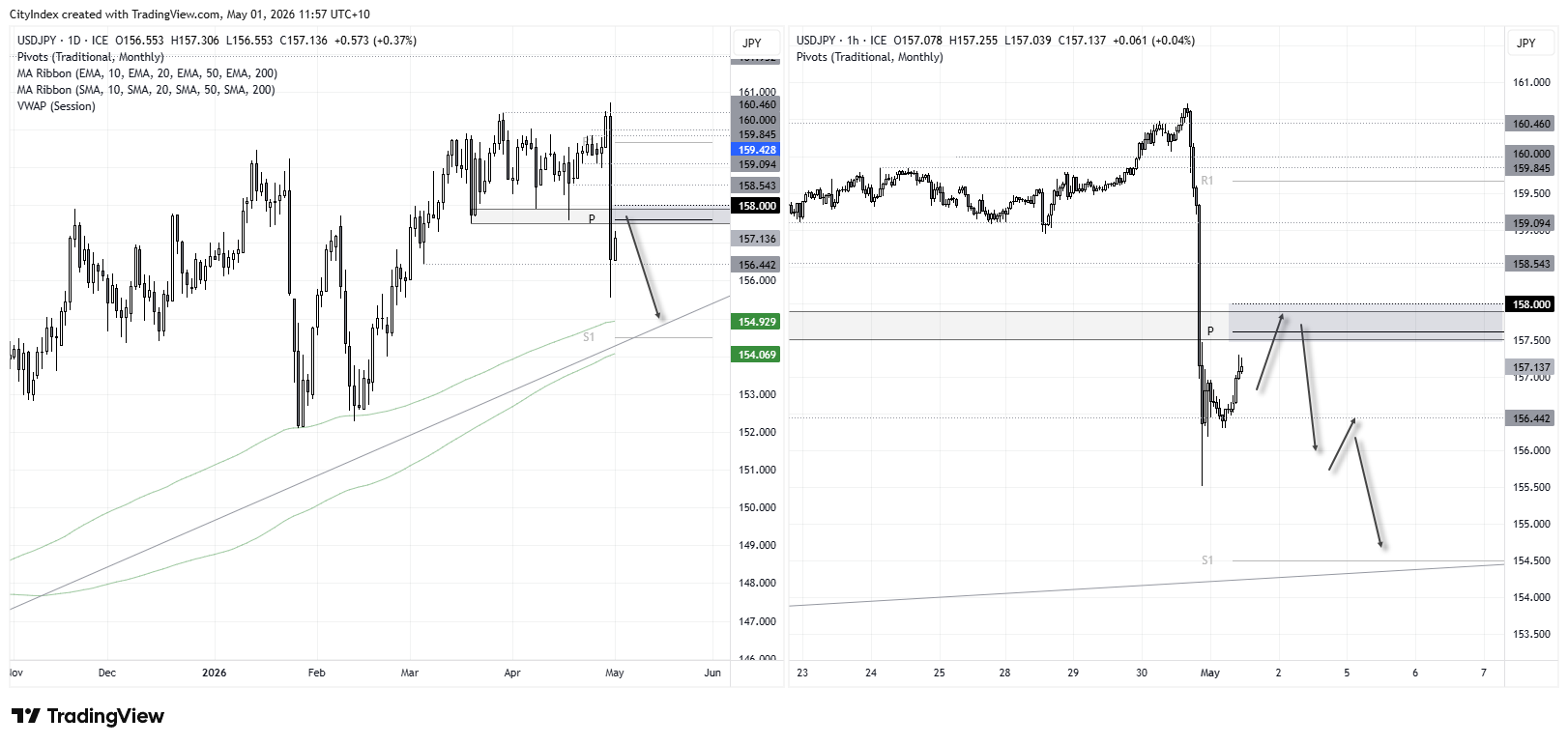
USD/JPY Short-Term Outlook: Bearish Bias Below 158
The daily chart shows a clear bearish engulfing candle, with prices retracing from the lows during today’s Asian session. But with the monthly pivot, range lows and the 158 handle nearby as potential resistance, it almost invites bears to fade into strength.
The 1-hour chart shows momentum pushing higher into that zone, but unless traders are keen to goad the MOF into further action, my bias is for a swing high to form just below—or around—the 158 area.
Note the 200-day averages and long term bullish trendline that could become bearish targets, should momentum roll over once more.
Source: ICE, TradingView
View the full economic calendar
-- Written by Matt Simpson
Follow Matt on Twitter @cLeverEdge
How to trade with City Index
You can trade with City Index by following these four easy steps:
- Open an account, or log in if you’re already a customer
• Open an account in the UK
• Open an account in Australia
• Open an account in Singapore
- Search for the market you want to trade in our award-winning platform
- Choose your position and size, and your stop and limit levels
- Place the trade