

The Australian dollar dipped its toe into the upper 60s last week, although for now it is not ready to commit to a break below 70c. And while it mostly finished lower against its major peers, its performance was mixed and not akin to a currency in freefall. Although short bets rose in the futures market, we have also seen a sufficient reduction in long exposure to entertain the idea that the Australian dollar is not yet ready to fully roll over — unless monetary policy expectations between the RBA and Fed diverge meaningfully following this week's meetings. I'm just not convinced they will.
View related analysis:
- Japanese Yen Outlook: Middle East Peace Hopes Sink USD/JPY, Lift AUD/JPY
- Australian Dollar Outlook: AUD/USD Bears Tighten Grip with 60s in Sight
- Short Yen Bets Hit Record High, AUD Nears Net-Short Flip | COT Report
- How to Read the COT Report to Track Forex Market Sentiment
AUD/USD Holds Near 70c Ahead of RBA, BOJ and Fed Decisions
Australian Dollar Performance
With the exception of the Canadian dollar and Swiss franc, it was a weak week for the Australian dollar. Its performance was uneven overall, however, with AUD/USD and AUD/JPY showing signs of stability while clearly losing ground to the British pound, euro and New Zealand dollar.
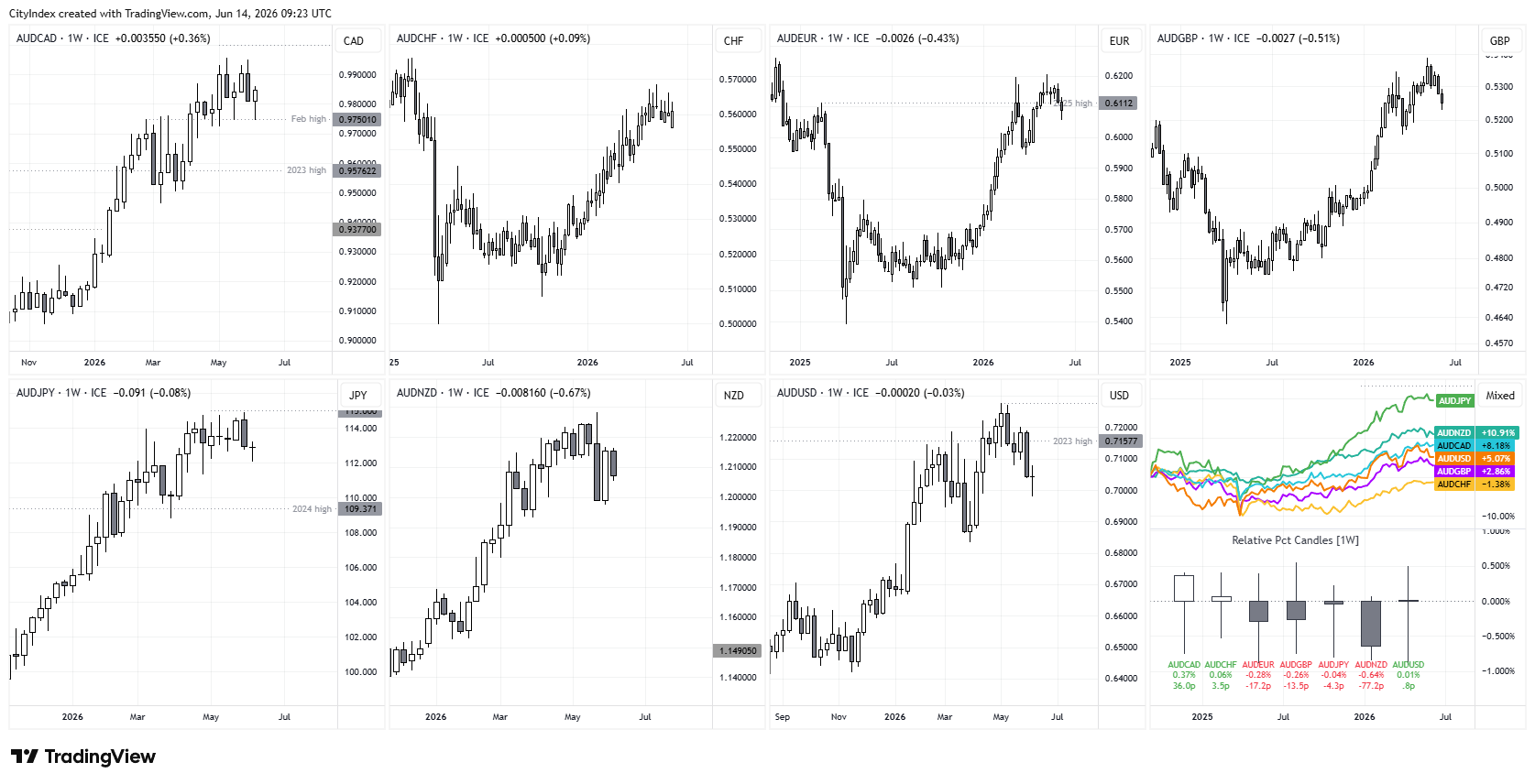
Chart prepared by Matt Simpson - Source: LSEG
- AUD/USD: Rickshaw Man doji week at 70c hints at an interim swing low, although the bias remains for an eventual move towards 69c.
- AUD/CAD: Small bullish week above the February high keeps the cross in a sideways range within a broader uptrend.
- AUD/CHF: Small bullish engulfing week suggests the cross may be undergoing a shallow pullback within a strong uptrend.
- AUD/EUR: Second consecutive weekly loss after forming a lower high beneath 0.6200, hinting at further weakness in the week ahead.
- AUD/GBP: Similar setup to AUD/EUR, with British pound strength hinting at higher GBP/AUD in the coming weeks.
- AUD/JPY: Small Rickshaw Man doji above 112 shows a reluctance for the Aussie to lose too much ground against the yen without a hawkish BOJ hike or MOF intervention.
- AUD/NZD: Bearish inside week provides few clues for direction, although it may simply be a shallow correction within a broader bullish trend.
Australia This Week: Economic Data and Events for AUD/USD Traders
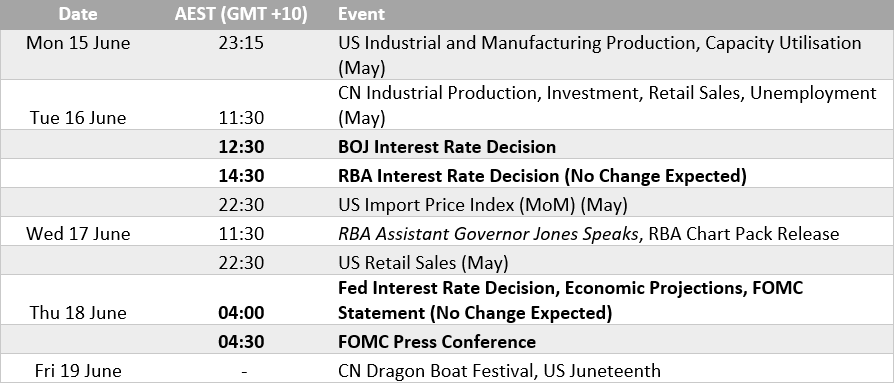
BOJ Expected to Raise Rates to a 31-Year High
The hike has been expected for some time and was effectively confirmed by a Reuters report on Friday. Governor Ueda will not attend the meeting due to medical treatment, leaving Deputy Governor Uchida to deliver the post-meeting press conference.
If there is any scope for a surprise, it is likely to come from the accompanying guidance rather than the rate decision itself. While the meeting is unlikely to be a major market driver, AUD/USD could get caught in the crosswinds of risk-off sentiment if the BOJ delivers a more hawkish-than-expected 25bp hike.
This content was created by an affiliate of FOREX.com and represents the views and opinions of the author/speakers, not the views and opinions of FOREX.com, StoneX Group Inc., or its subsidiaries. The content has not been independently reviewed by FOREX.com.
RBA to Hold, But Too Soon to Signal Cuts
Markets were still assuming the RBA remained on a hiking path at its previous meeting, although that is now far less certain. Softer employment figures, slowing growth and cooler-than-expected CPI data have all but eliminated hawkish bets. Consumer confidence has also weakened further, not helped by the government's GST rug pull in the latest budget. Governor Bullock recently noted that rate hikes appear to be doing their job, which to my ears suggests the RBA has more time to assess incoming data before considering its next move. With cash rate futures implying a 100% chance of rates remaining on hold, there is little reason to expect this meeting to be a live one.
While there is speculation that the next move from the RBA may be a cut, it is far too soon for policymakers to publicly endorse such a view. Inflation expectations remain elevated, and talking about cuts now would simply undo some of the work achieved by the previous three hikes.
A hawkish hold remains the most likely outcome.
Fed Expected to Hold Rates at Warsh's First Meeting
The Fed is widely expected to leave rates unchanged at Kevin Warsh's first meeting as Chair, although traders will be paying close attention to the updated dot plot and economic forecasts for clues on the policy outlook. There is scope for a hawkish shift after March's projections showed most officials still anticipating cuts this year, while inflation forecasts may also be revised higher. With markets pricing rates on hold through September and a strong chance of a hike by year-end, the risks appear skewed towards a hawkish outcome that could support the US dollar and weigh on AUD/USD.


AUD/USD Technical Analysis: Australian Dollar vs US Dollar
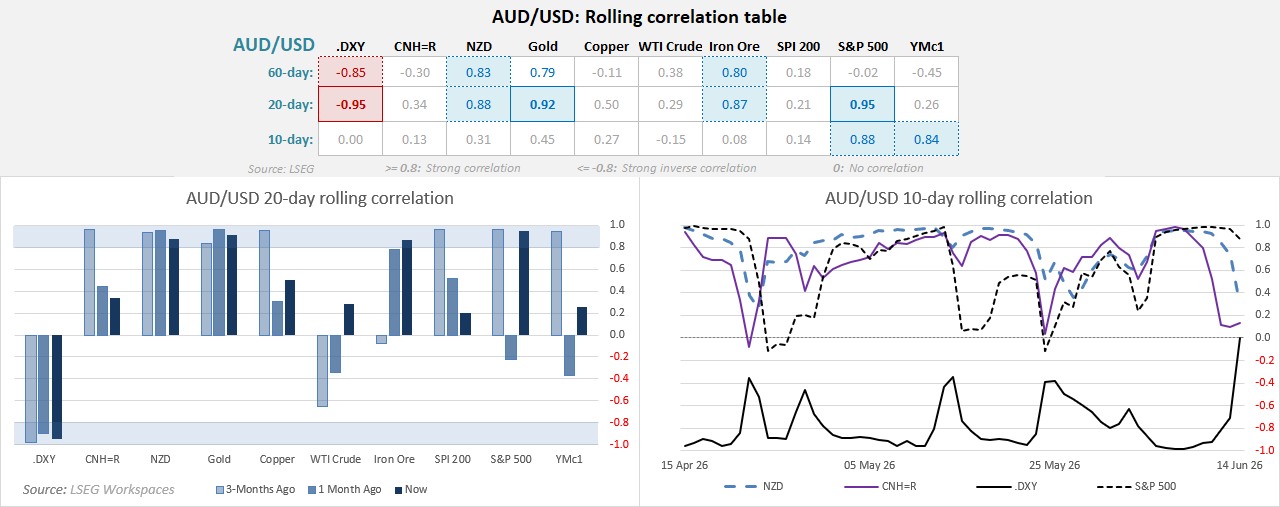
AUD/USD Correlations
The strong correlations seen over the medium term have weakened over the past 10 days. AUD/USD's correlation with the US dollar index has fallen to zero, while its relationship with the Chinese yuan has also faded to near-zero levels. However, the Aussie remains strongly correlated with broader risk sentiment, retaining robust links to the S&P 500 and Dow futures. Overall, the mixed correlation profile aligns with the choppy price action seen over the past week and suggests traders are awaiting a fresh catalyst.
Unless the RBA and Fed meetings deliver a clear policy divergence, or the US and Iran reach a concrete agreement, AUD/USD may struggle to establish a sustained directional move in the near term.
Source: LSEG
AUD/USD Futures Positioning | COT Report
Short bets picked up against the Australian dollar, with gross shorts rising to a 17-week high among large speculators (74.8k contracts) and asset managers (73.8k contracts). This saw large speculators flip to net-short exposure for the first time in four months, while net-long exposure among asset managers fell to a 19-week low. However, the decline in net-long exposure was driven primarily by long liquidation rather than aggressive short building, with gross longs falling far more sharply than shorts increased. With positioning now considerably less stretched than it was a month ago, the Aussie may be able to find some stability unless traders become more aggressively bearish following the RBA and Fed meetings.
- Asset managers increased gross shorts by 13.7k contracts (+22.8%), while gross longs fell by 19.0k contracts (-23.5%)
- Large speculators increased gross shorts by 11.4k contracts (+18.1%), while gross longs fell by 36.1k contracts (-11.6%)
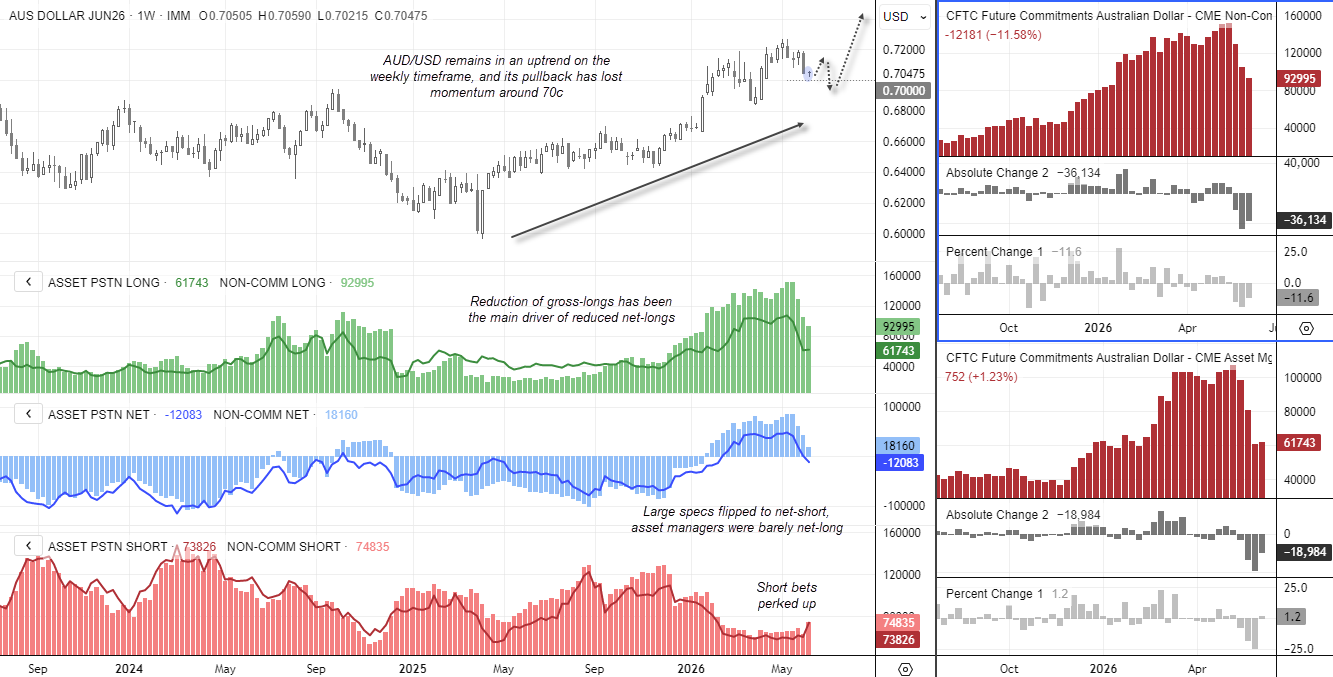
Source: CFTC (COT) CME, LSEG
For traders wanting a deeper understanding of futures positioning, I’ve also published a guide on how to read and interpret weekly COT data in forex markets.
AUD/USD Volatility Rises Ahead of Central Bank Meetings
The 1-week implied volatility level rose above the 1-month for the first week in four ahead of this week’s central bank meetings. When adjusted for their respective timeframes, it hints at a 89-pip move in either direction over the next week, or 161 over the next four weeks. This suggest with a probability of 68% that AUD/USD will close between 0.6954 – 0.7132 by Friday, or 0.6882 – 0.7204 in a month.
A bullish engulfing candle formed on Thursday around 70c to hint at a swing low. Yet there is a divergence between options and bond yields. Risk reversals curled higher to show demand for puts fell relative to demand for calls, yet the 2-year AU-US 2-year yield fell to a 7-month low.
Ultimately, I suspect bonds are telling the truth as my bias remains for an eventual move towards 69c before bulls return with conviction. But with stability above 70c I am on guard for a minor bounce ahead of its next leg lower.
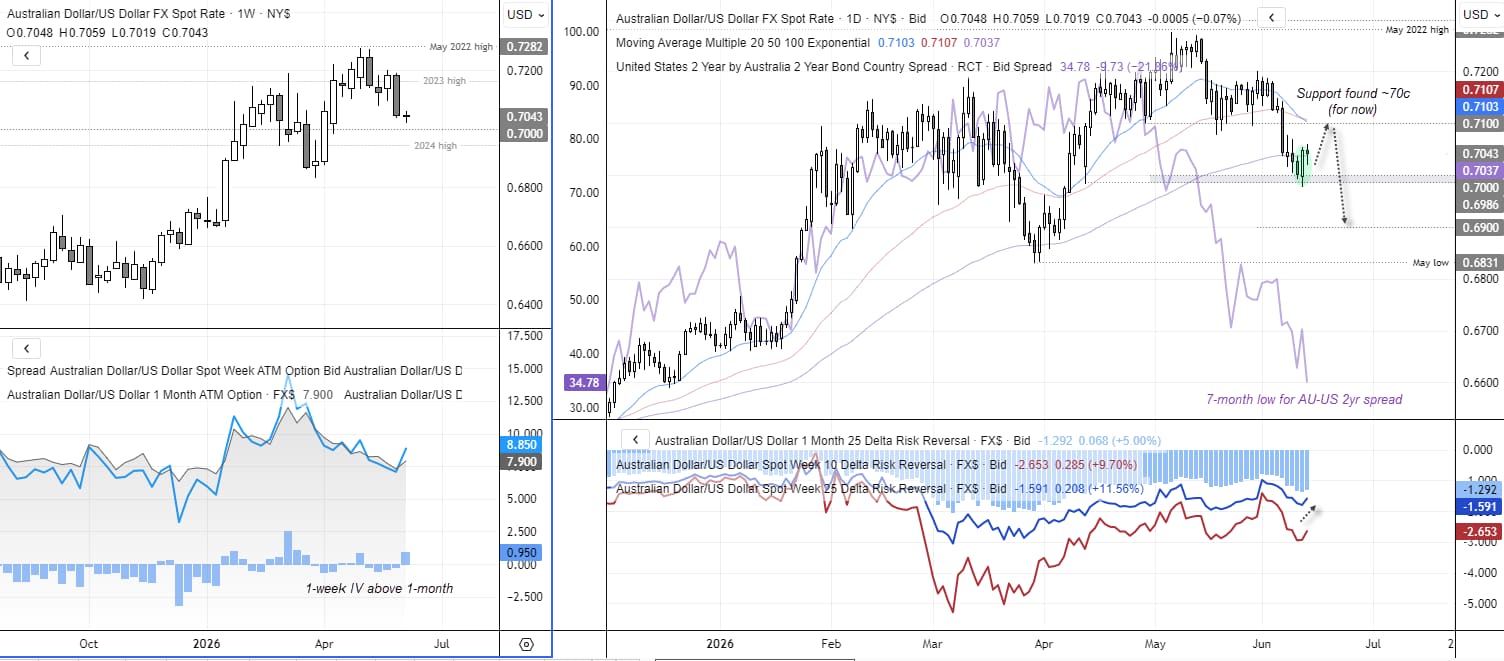
Source: ICE, TradingView
View the full economic calendar
-- Written by Matt Simpson
Follow Matt on Twitter @cLeverEdge
How to trade with City Index
You can trade with City Index by following these four easy steps:
- Open an account, or log in if you’re already a customer
• Open an account in the UK
• Open an account in Australia
• Open an account in Singapore
- Search for the market you want to trade in our award-winning platform
- Choose your position and size, and your stop and limit levels
- Place the trade