



If we cut through the noise of the past week, traders still appear hopeful that a ceasefire can hold or that a broader deal can be reached. Risk assets rallied on the announcement of last week’s ceasefire, yet sentiment has largely held up despite it being quickly annulled.
Wall Street indices have climbed to a five-week high, with the ASX 200 tagging along for the move. Bitcoin is at a 4-week high – the digital proxy to Wall Street. AUD/USD is back around 0.71 after another volatile Monday, although as noted last week, it likely requires sustained peace in the Middle East before a breakout above 0.72 can be assumed.
With several resistance levels nearby, price action could remain choppy for bulls, while bears may look to fade rallies unless relations between Iran and the US materially improve.
View related analysis:
- ASX 200 Outlook: Futures Rebound Tests Key Resistance as Volatility Rises
- Australian Dollar Soars as Iran Ceasefire Fuels Risk-On Rally
- AUD/USD Outlook: Trump Address Could Trigger Breakout or Breakdown
AUD/USD Holds Firm as Australian Dollar Navigates Geopolitical Uncertainty
RBA Reiterate Hiking Message
- Spiking fuel prices and the risk of further rate hikes were the main drivers behind a -12.5% drop in consumer sentiment in April, according to Westpac
- RBA Assistant Governor Andrew Hauser added to concerns, saying he is not confident rates are at the right level to tame inflation
- Odds of an RBA hike on May 5 are around 62%, according to cash rate futures
- The RBA cash rate futures curve implies a peak rate of 4.73% by March 2027, before around two to three 25bp cuts
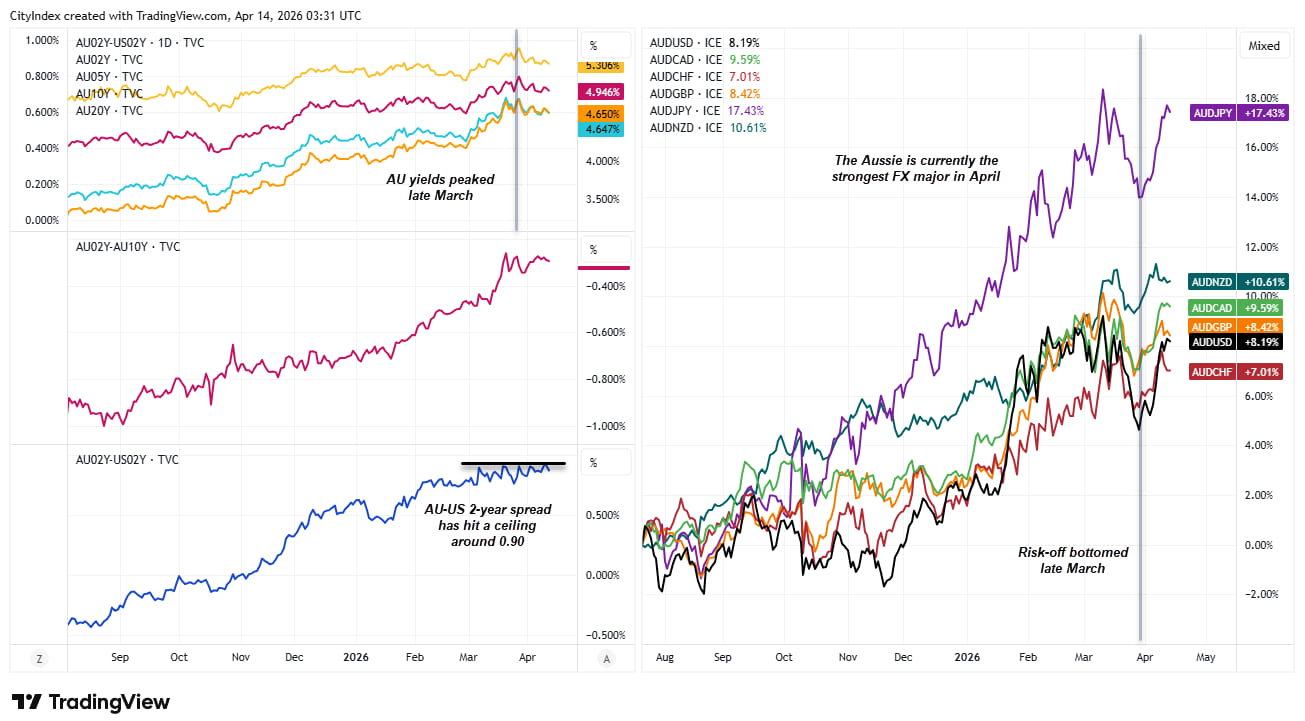
- While market pricing remains hawkish, the 3-year yield topped at 4.8% on March 29 and now sits at 4.62%
- Also note that the AU–US 2-year yield differential has hit a ceiling around 90bps, reinforcing the view that the Australian dollar’s rebound may be about to stall
Source: ICE, TradingView

AUD/USD Technical Analysis: Australian Dollar vs US Dollar
Australian Doller Correlation Analysis
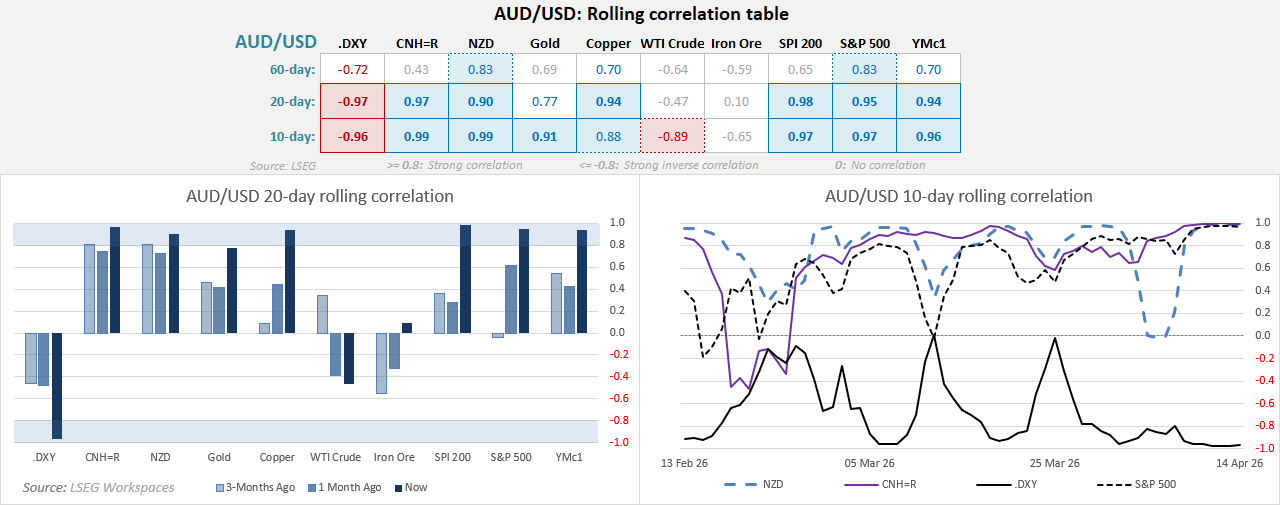
AUD/USD continues to trade as a clean proxy for global risk sentiment, with correlations reinforcing that macro flows — not domestic drivers — are in control right now.
- Strong risk-on alignment: AUD/USD maintains high positive correlations with equities (S&P 500, SPI 200) and growth-sensitive assets like copper and NZD
- USD remains the key driver: The inverse correlation with DXY is near extreme levels, showing AUD/USD is largely a function of US dollar weakness
- Short-term correlations strengthening: 10–20 day correlations with equities and CNH have tightened, signalling recent moves are being driven by macro sentiment
- Commodities less influential: Correlations with oil and iron ore are weaker and less consistent, suggesting limited support from traditional commodity drivers
- High-beta behaviour: The Aussie is acting like a leveraged risk asset — rising with equities, but vulnerable to sharp reversals if sentiment turns
Source: TradingView
AUD/USD Rally Faces Skepticism as Options Signal Downside Risk
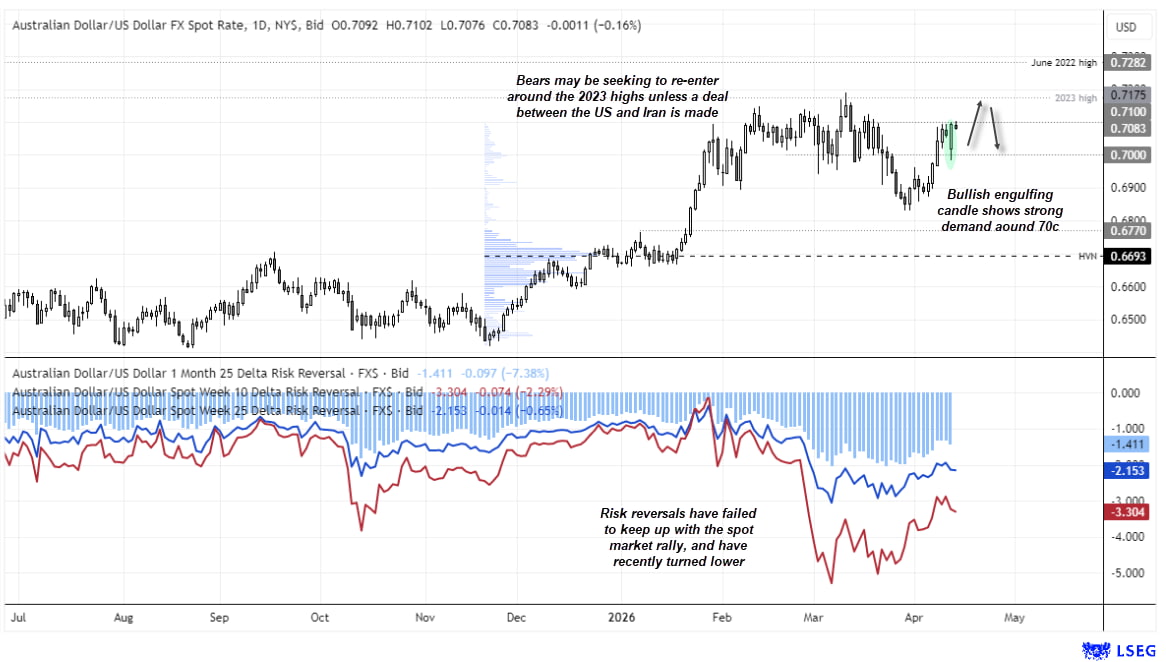
Options traders remain wary of the AUD/USD rally over the past couple of weeks. While risk reversals have moved higher alongside spot, AUD/USD has rallied at a faster pace and positioning remains heavily skewed towards puts. Moreover, the 1-month 25-delta has moved lower this week, indicating institutional demand for downside protection is increasing.
AUD/USD Pauses Around 0.71 as Bulls Eye Break Higher
While AUD/USD formed a bullish engulfing candle on Monday, the rally has paused around 0.71 for now. Bulls may look to buy dips within Monday’s range for a move towards the March high (0.7189), a break above which brings 0.72 and the 2022 high (0.7282) into focus.
However, a move towards the upper targets likely requires a meaningful de-escalation in the Middle East. Failing that, bears may look to re-enter below 0.72 and attempt another push beneath 0.70.
Source: CME, LSEG

Australian Dollar (AUD/USD) Futures Positioning | COT Report
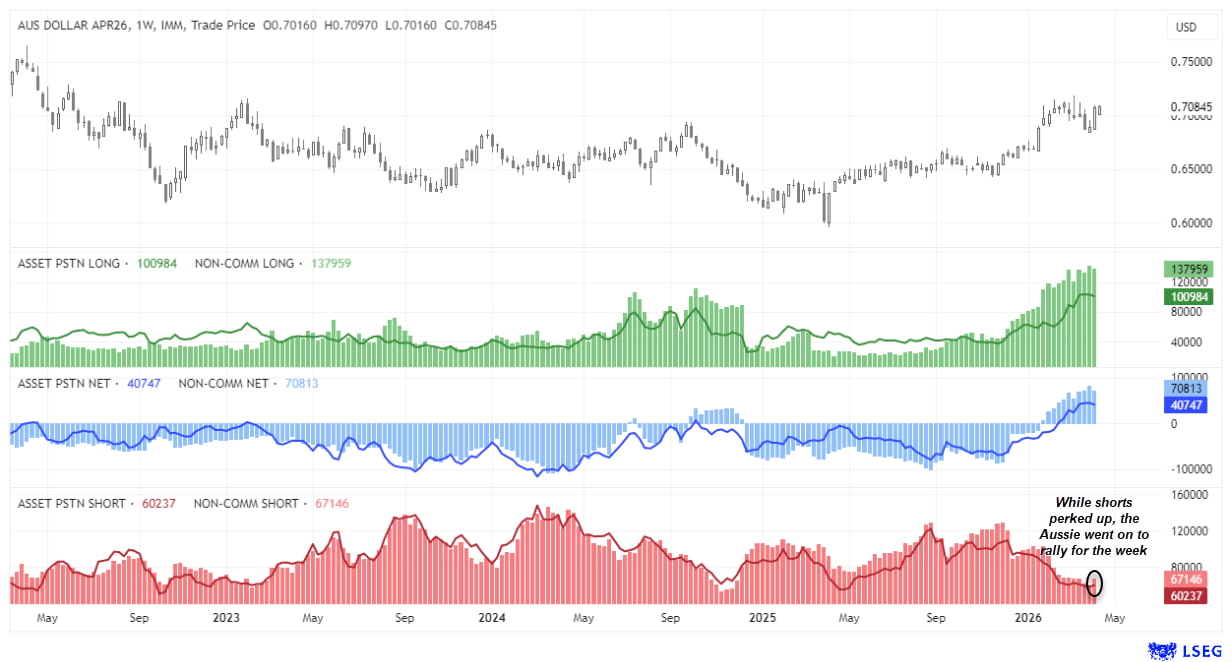
The standout pattern from last week’s positioning data is that futures traders increased short exposure, trimmed longs, and dragged net-long exposure lower. However, ceasefire talks ahead of the weekend allowed the Australian dollar to rally into Friday and likely reverse much of those bets. The fact that AUD/USD has held up despite the ceasefire deal falling apart suggests markets are taking a more constructive view, retaining hopes that the Strait of Hormuz will reopen and a deal is eventually reached.
- Large speculators increased their net-short exposure to AUD/USD futures by 6.7k contracts (11.4%) – the fastest weekly pace this year
- Longs were trimmed by 3.8k contracts (-2.6%)
- Asset managers also increased longs and trimmed shorts, though only marginally
Source: CFTC (COT), CME, LSEG
View the full economic calendar
-- Written by Matt Simpson
Follow Matt on Twitter @cLeverEdge
How to trade with City Index
You can trade with City Index by following these four easy steps:
- Open an account, or log in if you’re already a customer
• Open an account in the UK
• Open an account in Australia
• Open an account in Singapore
- Search for the market you want to trade in our award-winning platform
- Choose your position and size, and your stop and limit levels
- Place the trade