



Weekly Drivers: Oil Prices, Geopolitics, and Supply Risks
- Trump stated that the latest Iranian peace proposal is unacceptable, following a bullish weekly close in crude prices, above $96.
- OPEC’s Sunday meeting highlighted the group’s unity despite the UAE’s exit, announcing a symbolic production increase of 188,000 barrels for June. However, production quotas remain ineffective as long as the Hormuz Strait stays disrupted, stranding and threatening tanker flows.
- Hormuz blockages and facility strikes are extending the recovery timeline required for the region to restore oil and gas supply capacity.
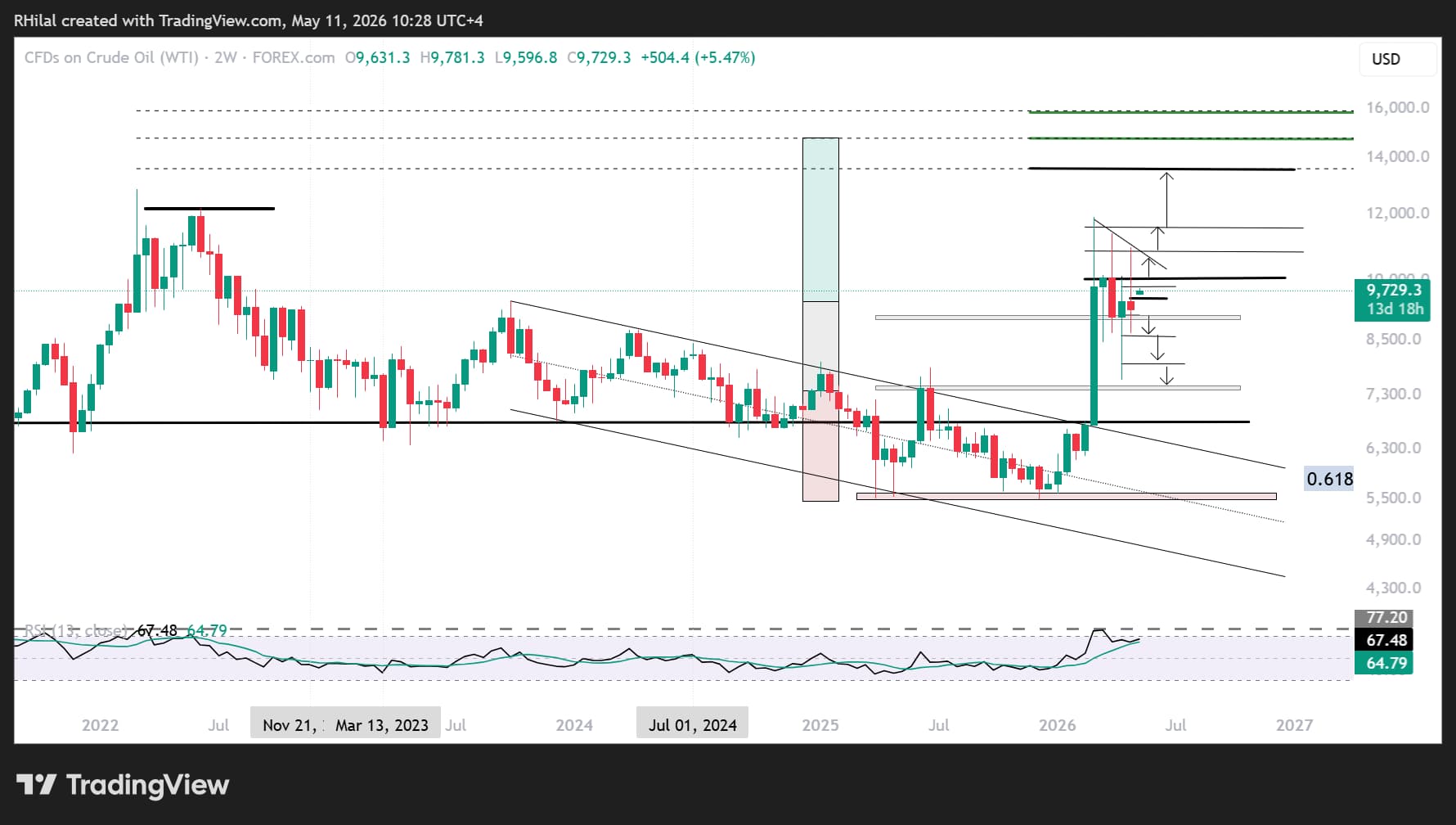
- Price action suggests bullish positioning above the 2023 highs, with key levels at $93 for WTI and $95 for Brent.
From a 2-week perspective, strong price rejections are visible below the $120 level, forming lower highs. At the same time, a strong bullish rejection from the $76 zone reinforces a broader structure of indecision with a bullish bias on the crude oil chart—until either diplomatic alignment or further geopolitical escalation materializes.
Crude Oil Price Forecast: 2-Week Chart Analysis (Log Scale)
 Source: Trading view
The following framework remains anchored in the Q2 2026 outlook, reinforcing the importance of long-term levels over political narratives on the price chart.
Scenario Framework:
- Bearish Scenario:
A diplomatic breakthrough, combined with a close below $91, $88, and $84, would expose prices to the previous rejection zone at $76–$74—the highs of June 2025 during prior Middle East tensions—testing the waters for a deeper crude unwind or another volatility-driven whipsaw. - Base Case:
Prolonged supply disruption keeps crude oil prices trading within the $91–$115 range. - Bullish Scenario:
Extreme geopolitical escalation could drive a sustained breakout above $115, extending toward $135 and $157, aligning with the 0.786 and 100% Fibonacci extensions of the 2020–2022–2026 price cycle.
Headline-driven volatility is one aspect of the market, but long-term price closes and sustained levels ultimately reveal the dominant trend and broader outlook for crude oil beyond short-term noise.
Written by Razan Hilal, CMT
Follow on X: @Rh_waves