


During the second week of June, one of the main developments in the cryptocurrency market has been the recovery attempt seen across major crypto assets. However, rather than confirming a clear improvement in confidence, this move still reflects a phase of indecision around market demand.
Mixed developments, such as a possible easing of tensions in the Middle East, have not fully removed expectations of a significant inflationary scenario for 2026. For now, this continues to keep uncertainty present across markets and has prevented crypto demand from gaining consistent strength in the short term. If these concerns remain in place, the indecision phase could continue to be relevant over the coming sessions.

Demand remains limited
The trading week was shaped by important developments in the Middle East. At first, President Trump said that certain planned attacks against Iran would be cancelled, partly due to progress in potential negotiations that could lead to the end of the conflict. However, although this helped market confidence recover partially, concerns remain around the situation in the Strait of Hormuz, which has not fully normalized yet. As long as there is no signed agreement, oil trade could take several months to return to a more stable environment.
Inflationary effects linked to the conflict also started to appear this week. Recent US CPI inflation data showed that, for the first time since 2023, the average annual inflation rate moved above the 4.00% area. A significant part of this increase was related to higher energy costs, suggesting that a more relevant inflation problem could be taking shape if there is no quick resolution to the Middle East conflict.
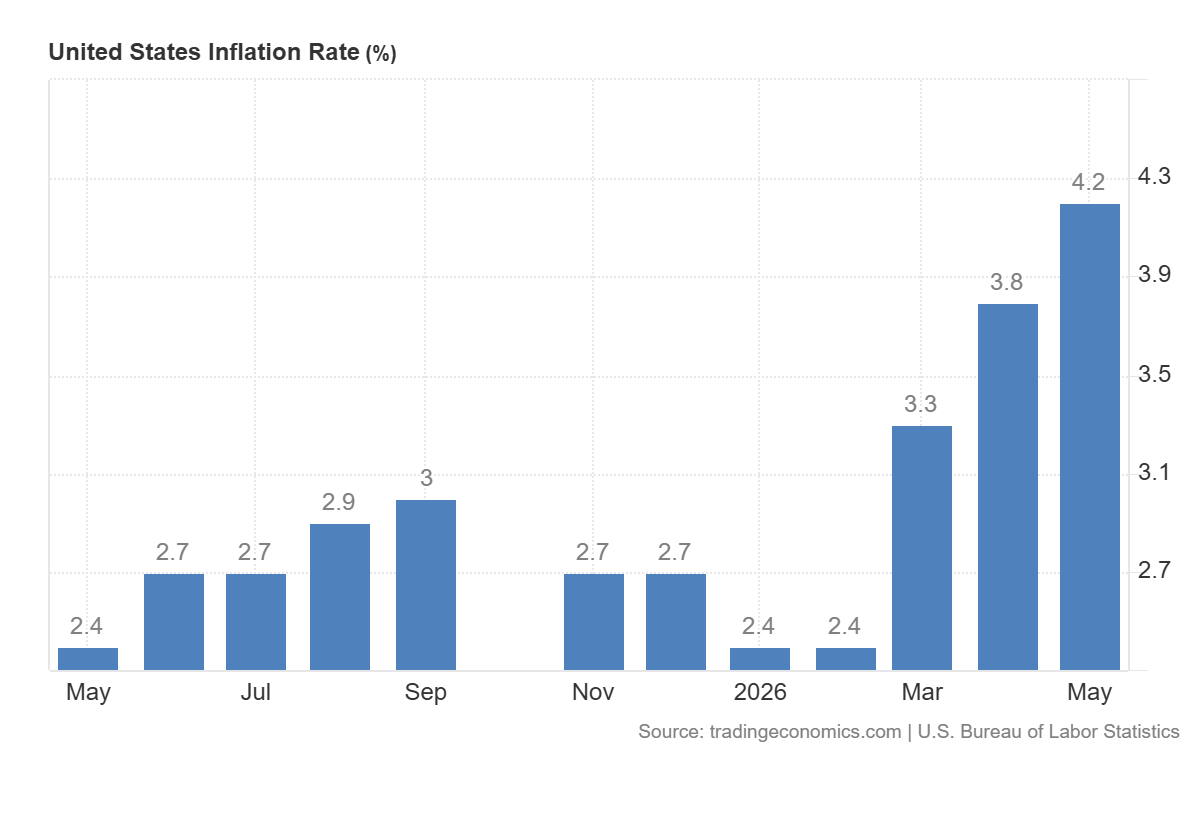
Source: TradingEconomics
This combination of events has not been especially favorable for cryptocurrencies. There is still no clear exit from the conflict in the short term, and inflationary pressures are already becoming an important global factor. This could open the door to a more aggressive central bank environment over the coming months. In this context, the possibility of higher interest rates from central banks such as the Federal Reserve could limit available liquidity for risk assets like cryptocurrencies. For that reason, a higher-rate environment may continue to weigh on demand expectations and confidence in the crypto market.
Demand in markets such as Bitcoin, the main benchmark cryptocurrency, has still not fully recovered in the short term. During the week, Bitcoin ETF flows failed to show meaningful capital inflows, and most of the last four trading sessions registered net outflows, accumulating more than 60 million dollars by the close of June 11. This reflects a weak demand backdrop, possibly linked to macroeconomic conditions that are not favoring crypto exposure or to investors looking for alternatives perceived as more attractive than BTC.
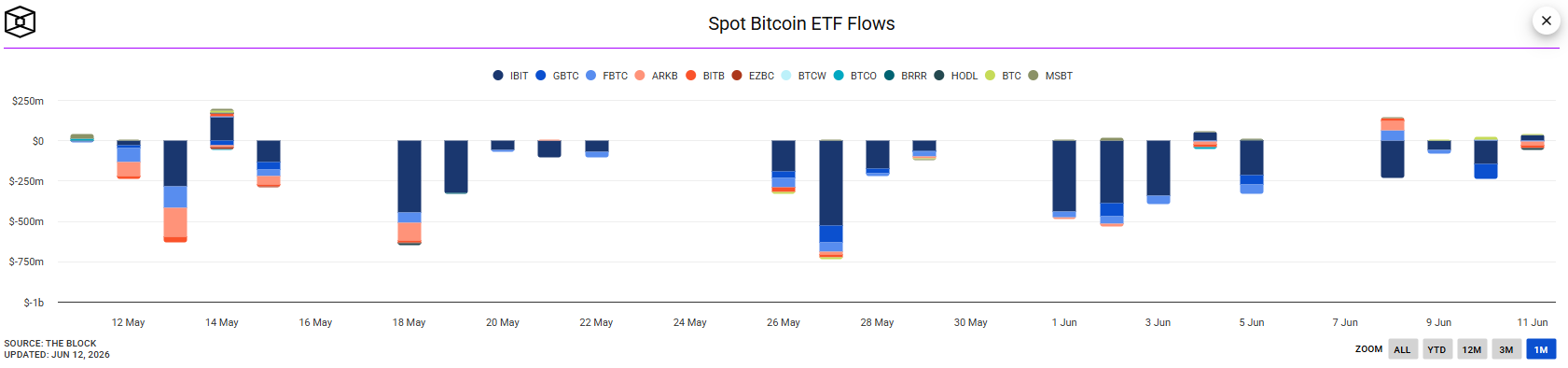
Source: Theblock
Overall, although negotiations in the Middle East appear to be moving in a more favorable direction, global inflation risks continue to create concern among market participants. This has not helped crypto demand gain relevance in the short term. Until macroeconomic conditions become more supportive and uncertainty starts to fade, indecision could remain an important feature of the crypto market over the coming sessions.
Bitcoin relative to other markets
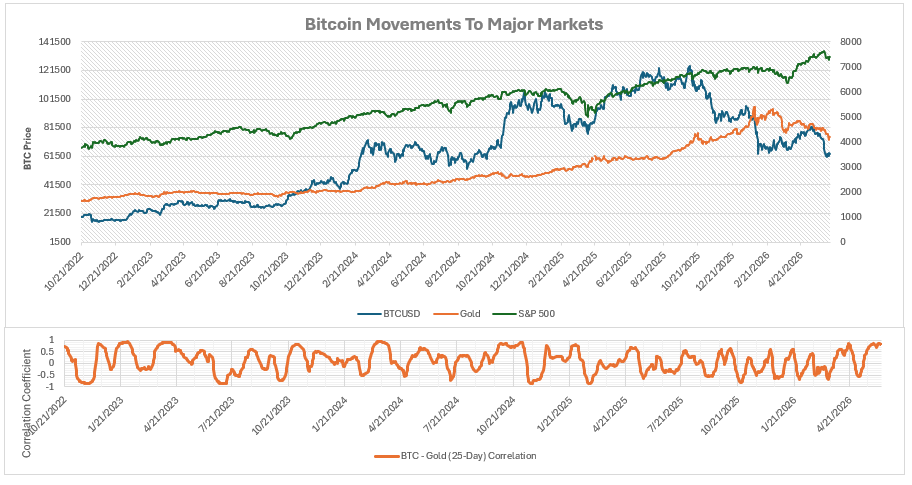
One short-term behavior that has started to stand out is the increase in the correlation coefficient between gold and Bitcoin. Now, the coefficient is near 1, showing a strong positive correlation between both markets over the last 25 sessions. It is important to remember that correlation coefficients can change over time.
Source: Data – TVC, StoneX, Tradingview
This relationship matters because gold has lost appeal over the past few months. It does not seem to be clearly perceived either as an attractive risk asset or as a dominant safe haven, especially against a bond market that has remained strong during 2026. Bitcoin’s positive correlation with gold may be reflecting a similar dynamic, where the cryptocurrency is also struggling to recover a clear role in the market: neither as a traditional risk asset nor as a relevant defensive alternative.
In this environment, while other markets continue to look more attractive in the short term, demand for cryptocurrencies could remain limited. This could reinforce a phase of indecision and neutrality in the crypto market over the coming sessions.
Confidence remains in sensitive territory
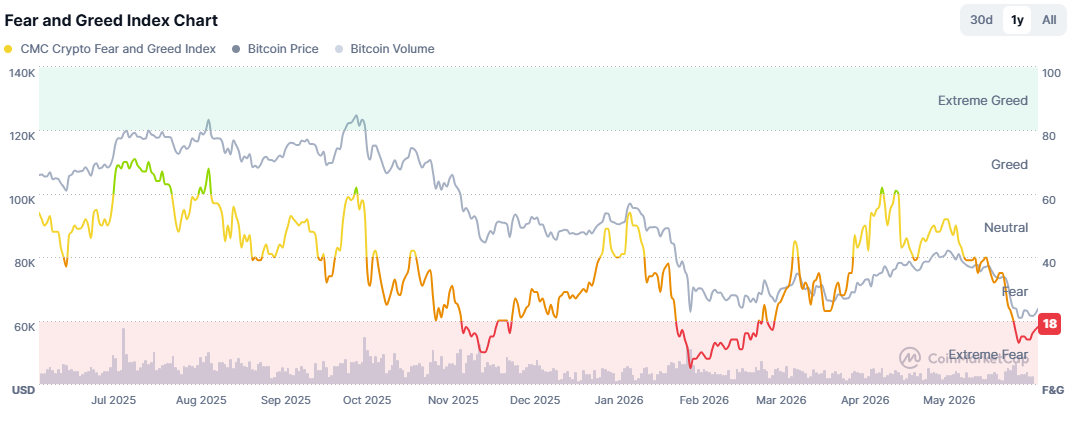
Looking at the Crypto Fear and Greed Index, the indicator remains around the 18-point area, still inside “extreme fear” territory. Although there has been a recent attempt to recover confidence, the index remains far from showing an optimistic environment and continues to trade in a sensitive short-term area.
Source: Coinmarketcap
This behavior shows that market participants remain highly concerned about cryptocurrencies. As long as the index fails to recover more clearly, it will continue to suggest that conditions are not strong enough to support a relevant demand environment. It may also point to a consistent phase of indecision in the crypto market, which could remain in place over the coming sessions.
Written by Julian Pineda, CFA, CMT – Market Analyst
Follow him on: @julianpineda25