



Just like the start of last week, investors were slightly alarmed by the latest pick up in tensions in the Middle East, causing oil prices to rebound around 3% on the day, even if global equity markets were once again ignoring the noise. But the FX markets reacted with the dollar rising across the board, while currencies of oil importers were, predictably, under pressure again. Last week Trump had suggested negotiations with Tehran were “proceeding nicely” and that their naval blockade would be removed immediately. But that hasn’t happened and traders are once again left betrayed by Trump’s jawboning, while Israel has carried out strikes in southern Lebanon to raise serious question marks over the “ceasefire” agreement. The near-term EUR/USD forecast remains tilted to the downside, for as long as the Strait of Hormuz remains effectively shut.
EUR/USD forecast: Expect some focus on US fundamentals this week
The lack of any progress in the US-Iran stalemate over the weekend has, so far, generated only a modest reaction across financial markets. Reports over the weekend suggested that Washington and Tehran continue to pursue diplomatic negotiations despite limited military exchanges, helping push oil prices higher. Yet the broader market response has been restrained. Equity markets remain relatively stable, while currency markets have shown little inclination to react aggressively, albeit the dollar has come back slightly.
The decline in foreign exchange volatility over recent weeks suggests that geopolitical developments are no longer the dominant force driving currency markets. Only if oil prices were spike materially higher, would investors appear show the same sort of reaction we saw at the height of the conflict. Right now, investors are unsure as to whether to panic or hold steady ahead of a potential deal or fresh escalation, leaving all the headline-driven volatility for the oil market.
Labour market data takes centre stage
Attention will be shifting back towards the domestic US economic story, which may provide a firmer foundation for the dollar in the days ahead barring some much weaker data. A packed calendar of employment indicators and business activity surveys will offer investors fresh evidence on the underlying health of the US economy.
The labour market focus begins with April’s JOLTS job openings report on Tuesday, followed by the May ADP employment release on Wednesday. Thursday brings Challenger job-cut announcements before Friday’s closely watched non-farm payrolls report. Economists are looking for payroll growth of around 95,000 jobs, while the unemployment rate is expected to remain steady at 4.3%.
Alongside employment data, investors will assess the latest ISM surveys covering both manufacturing and services activity. These reports will be scrutinised not only for employment trends but also for signals around demand, new orders and pricing behaviour.
If labour market conditions continue to hold up, policymakers at the Fed are likely to remain more focused on inflation risks than concerns about economic weakness. In that case, investors may begin assigning a greater probability to monetary tightening.
Technical EUR/USD forecast and key levels to watch
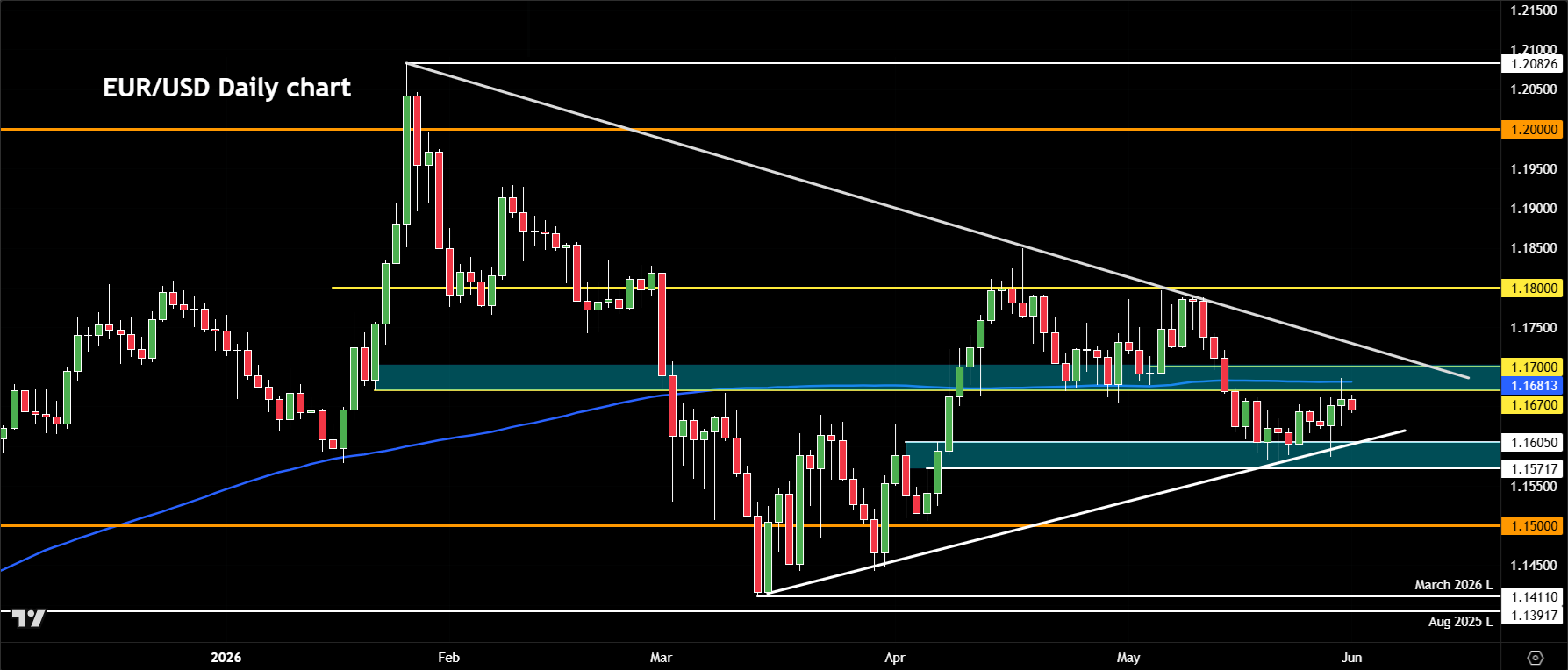
The EUR/USD remains inside a chop zone with volatility strangely limited. As was the case before, the EUR/USD bears need to see a clean below the 1.1570-1.600 support zone to open the door for another test of 1.1500. At the same time, any meaningful progress towards a temporary deal may only offer limited support for EUR/USD forecast until such a time that oil prices fall sharply again. Europe is still likely to face the lingering effects of the recent energy shock for several months, which could put a ceiling to near term to any short-term gains. To get past the key 1.1800 resistance level, this would most likely require a confirmed deal between the two sides. Near-term resistance comes in around the 1.1660-1.1690 area now.

-- Written by Fawad Razaqzada, Market Analyst
Follow Fawad on Twitter @Trader_F_R
How to trade with City Index
You can trade with City Index by following these four easy steps:
- Open an account, or log in if you’re already a customer
• Open an account in the UK
• Open an account in Australia
• Open an account in Singapore
- Search for the company you want to trade in our award-winning platform
- Choose your position and size, and your stop and limit levels
- Place the trade