



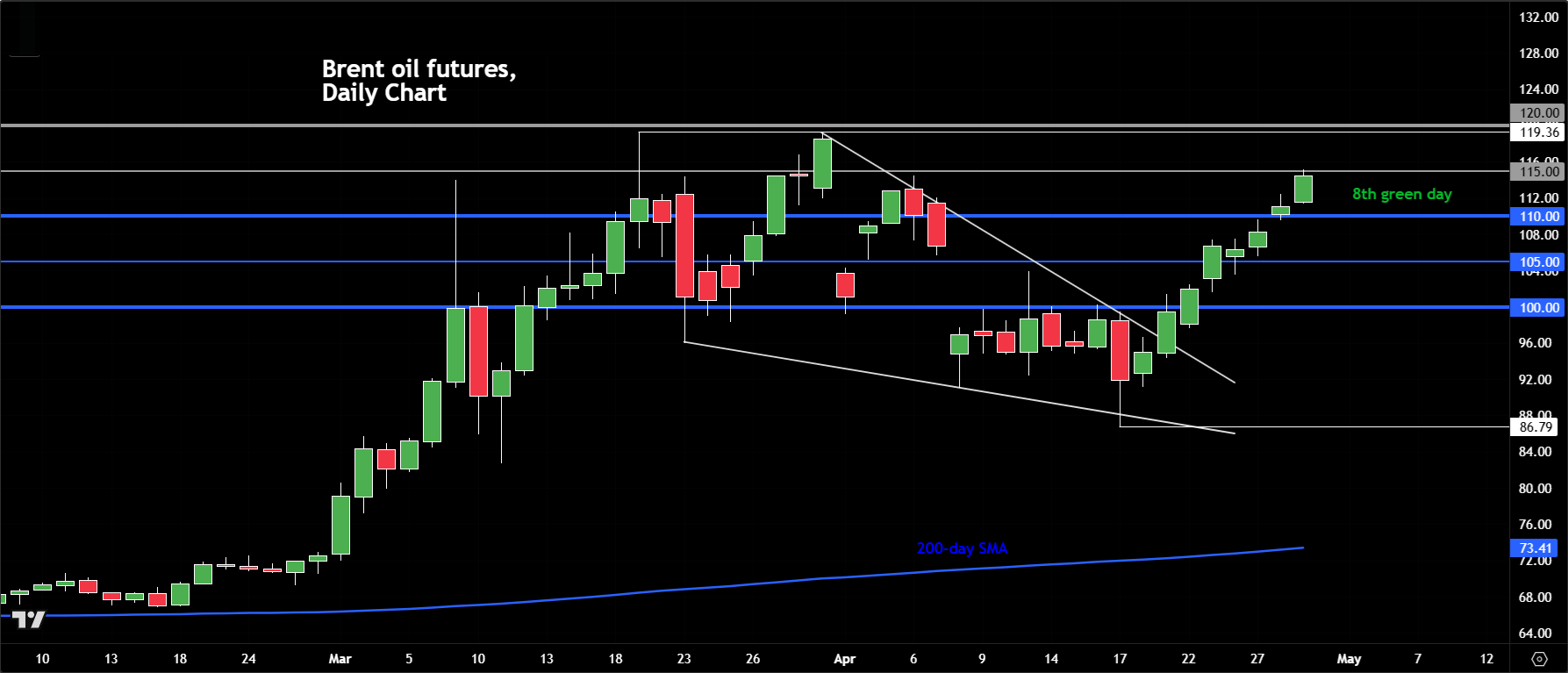
Another day, another rise in oil prices. Brent futures were now up for the eighth consecutive day, testing $115 per barrel and adding more inflationary pressure into the global economy. This is keeping the EUR/USD forecast tilted to the downside ahead of policy decisions from both the Federal Reserve and the European Central Bank. The greenback has been supported by the sharp rally in crude oil, given the fact the US is an energy exporter and a lot less directly impacted by the Strait of Hormuz blockade than, for example, many Asian and European oil-importing economies. As investors continue to scale back expectations of near-term Fed rate cuts, the USD is regaining strength, particularly against currencies most exposed to oil-shock: the likes of the euro and yen.
Dollar: Oil, FOMC and earnings in focus
The surge in oil prices is continuing to be the main driver for FX markets. With US-Iran tensions not easing and the risk of prolonged disruption in the Strait of Hormuz, oil prices are continuing to rise, reflecting a tightening market. This is feeding directly into inflation expectations. In the US, higher fuel and transport costs are pushing CPI towards levels that may soon warrant rate hikes.
But today, though, the Fed is widely expected to keep rates unchanged within the 3.5% to 3.75% range. However, the real focus will be on forward guidance, although this could also be Chair Jerome Powell’s last meeting. For now, the Fed has framed rising inflation as supply-driven rather than demand-led and think it is temporary.
Markets, however, remain cautious about that narrative. Let’s see if those concerns are reflected in earnings or forward guidance from major firms such as Alphabet, Amazon, Meta and Microsoft who will be reporting their results tonight. IF their results inject downside volatility into the stock markets, then the dollar could find fresh support.
EUR/USD forecast dims as ECB weighs stagflation risks
Meanwhile, the eurozone outlook is becoming increasingly uncertain. Recent data points to a stagflationary environment, with weakening growth indicators alongside rising inflation expectations.
This has been reflected, for example, in Germany’s GfK consumer sentiment index falling sharply, alongside the Ifo survey, while the European Commission’s sentiment survey also pointed to slowing economic momentum across the Eurozone. At the same time, higher energy costs are feeding into inflation expectations, strengthening the case for more hawkish ECB voices.
Despite this, a rate hike at Thursday’s meeting is highly unlikely, but it could leave the door open for a potential move in June. However, the implications for the euro are less straightforward.
Normally, rising rate expectations would support the currency. But in a stagflationary environment, tightening policy risks further weakening growth. That dynamic could limit upside for the euro, even if markets begin pricing in more aggressive ECB action.
Interestingly, if the ECB signals a willingness to look through near-term inflation pressures, it could provide some support to both equities and the euro. While counterintuitive, avoiding aggressive tightening in a fragile growth environment may ultimately be seen as a stabilising move.
Technical EUR/USD forecast: Key levels to watch
From a technical standpoint, our EUR/USD forecast is titled slightly lower. We have seen the pair lose its prior bullish momentum after it stalled around the 1.1850 area, and since then, the bias has shifted gradually to the downside.
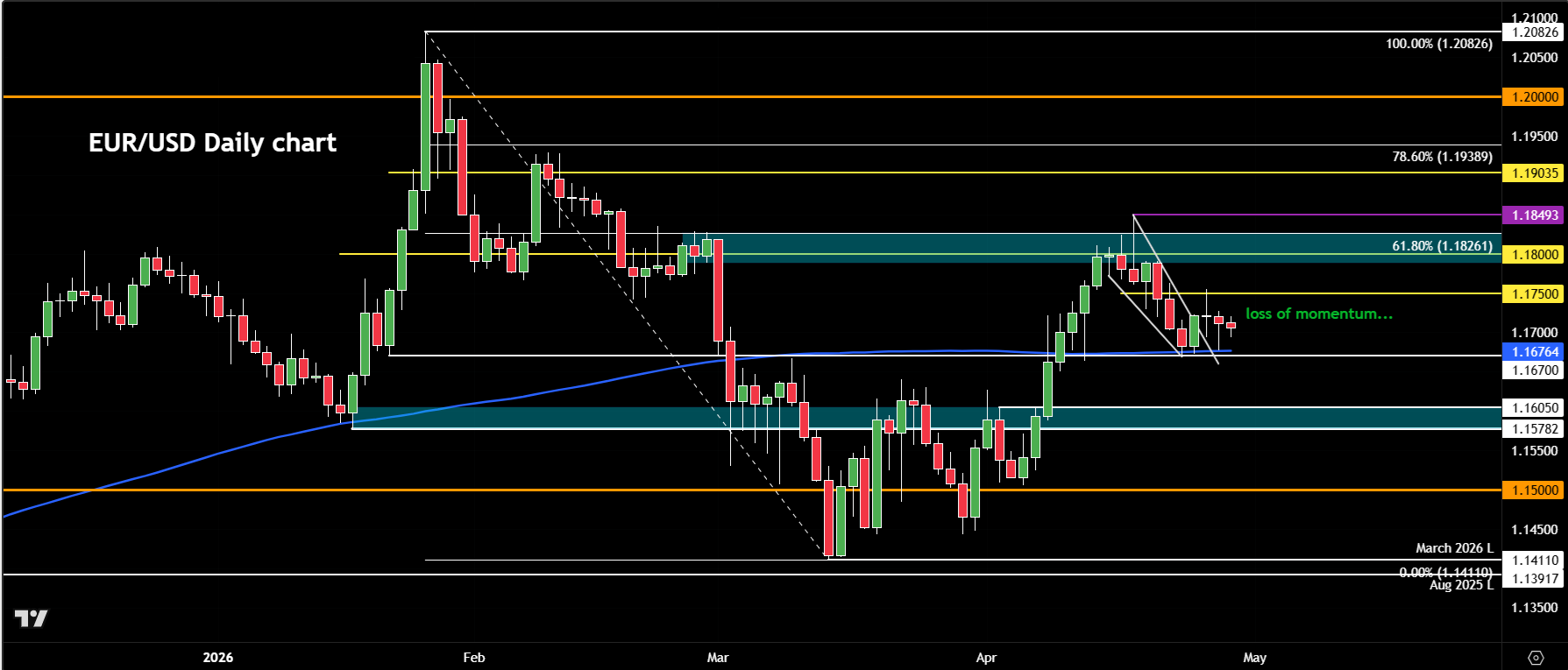
Key support on EUR/USD chart lies around the 200-day moving average, which aligns closely with the prior support/resistance zone in the 1.1665 to 1.1680 region. A break below this zone could open the door towards 1.1600, with further downside targets at 1.1550 and the key psychological level at 1.1500 being the next downside objectives.
On the upside, resistance is seen at 1.1750, followed by 1.1800. A sustained move above these levels would be required to shift the bias back in favour of the bulls, but for now, rallies may continue to attract selling interest.

-- Written by Fawad Razaqzada, Market Analyst
Follow Fawad on Twitter @Trader_F_R
How to trade with City Index
You can trade with City Index by following these four easy steps:
- Open an account, or log in if you’re already a customer
• Open an account in the UK
• Open an account in Australia
• Open an account in Singapore
- Search for the company you want to trade in our award-winning platform
- Choose your position and size, and your stop and limit levels
- Place the trade