



Gold prices remain trapped in an increasingly uncomfortable middle ground as investors attempt to balance mounting geopolitical tensions against a steadily firmer US rates backdrop, all thanks to elevated oil prices. Pressure is increasing and the metal is on the verge of a break below the 200-day moving average, which hasn’t happened since September 2023. The gold forecast could turn more decisively bearish in the event of a breakdown below this key technical barrier.
Diplomacy hopes fade as tensions reignite
Now, ordinarily, renewed military escalation in the Middle East would provide a clearer boost to haven assets, such as bullion. Instead, the latest flare-up between Washington and Tehran has produced a more complicated market reaction. Elevated oil prices and higher Treasury yields are offsetting much of gold’s traditional haven appeal, leaving the metal struggling to find support.
Any optimism surrounding a near-term US-Iran agreement has deteriorated sharply over the past couple of days. Fresh US strikes on Iranian military targets, alongside reports of intercepted drones and missile activity across the Gulf region, have revived concerns that negotiations remain far more fragile than markets had assumed earlier in the week. President Donald Trump’s latest remarks also struck a notably harder tone, particularly around sanctions policy and Iran’s uranium stockpile.
Oil markets responded accordingly. Brent crude pushed higher following reports of explosions near Bandar Abbas, reinforcing fears that disruption risks around the Strait of Hormuz remain elevated.
Under normal circumstances, that backdrop would likely generate a much stronger rally in gold. Yet the haven trade has so far proved surprisingly muted.
Dollar and yields continue to undermine gold forecast
The problem for gold is that geopolitical instability is no longer operating in isolation. Higher energy prices are once again feeding into inflation concerns, pushing Treasury yields modestly higher and strengthening the dollar at the same time. That combination creates a far more difficult environment for non-yielding assets such as bullion.
Markets have also become convinced that the Federal Reserve will have to tighten its policy again. Only a few weeks ago, investors were positioned for a relatively swift shift towards rate cuts as geopolitical tensions appeared to cool. That narrative has since reversed.
The longer oil remains elevated, the stickier the inflation, and the more cautious Fed rhetoric will become. For the gold forecast, that creates a mildly bearish dynamic. While geopolitical anxiety supports safe-haven demand, rising yields simultaneously erode the attractiveness of holding bullion.
Inflation data could shape the next move
Attention now turns to the latest US core PCE inflation figures, the Federal Reserve’s preferred measure of underlying price pressures, due for release shortly. A 0.3% month-over-month reading is expected. A softer-than-expected reading could offer gold some temporary relief if it nudges Treasury yields lower and weakens the dollar modestly. However, markets appear increasingly reluctant to embrace aggressive dovish positioning while energy markets remain volatile.
Gold tests 200-day average
At the time of writing, gold was holding below the 200-day average and key support around $4,400.
The last time gold closed below the 200-day average was back in September 2023. That led to a 5% drop over the course of the next 10 or 11 days, before prices recovered to eventually climb back above the average by mid-October of that year. Since then, gold has tested the 200-day average only twice: First time in November 2023 and the second time was in March this year. On both occasions we saw big rallies off the 200-day. This time, price action is looking quite heavy with gold drifting, rather than dropping, to the 200-day average. This points to more sustained pressure, unlike the previous couple of occasions. A potential breakdown could be significant and mark a major turning point in gold’s near-term direction.
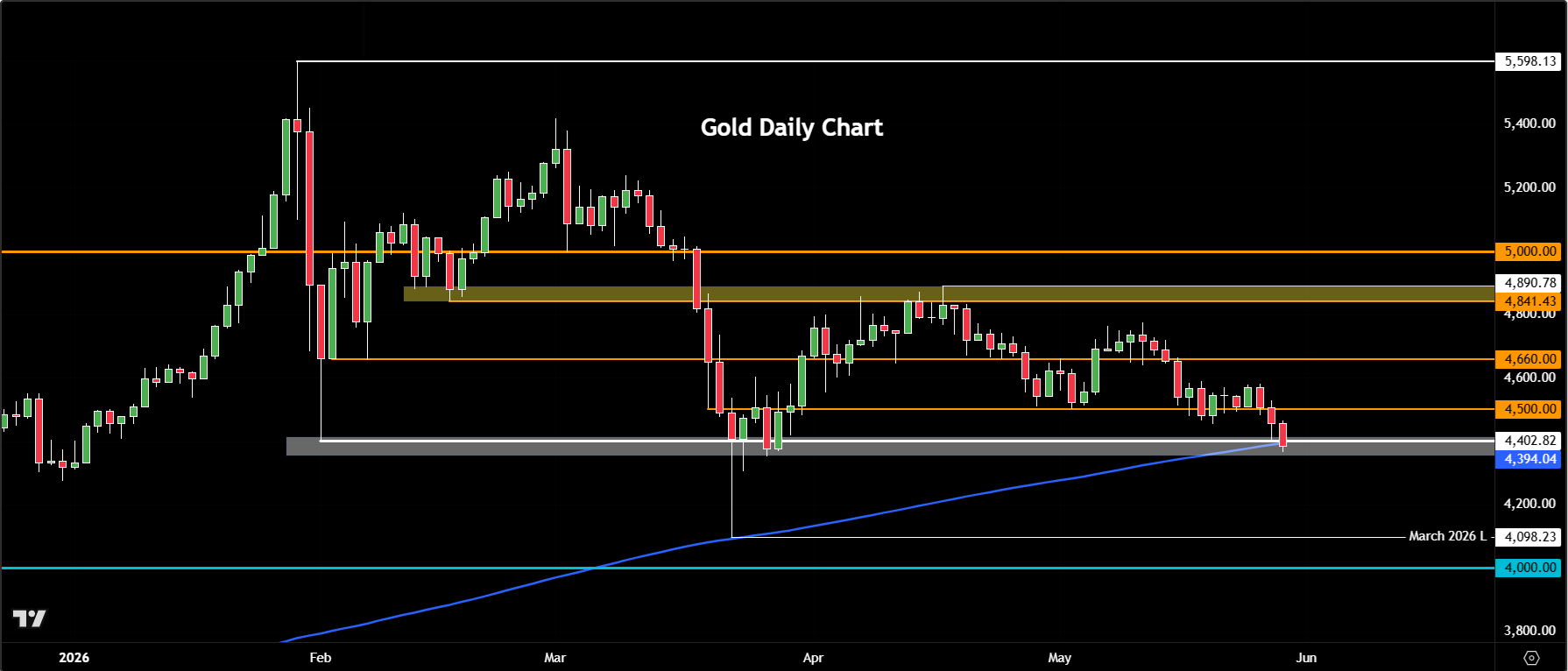
Should broader risk sentiment deteriorate more aggressively — particularly through another sharp rise in yields — XAUUSD could extend its losses and head towards $4,200 or event test the March low of $4098.
On the upside, the immediate focus will be on old support around the $4,500 region. A decisive break above that area would likely open the door to a continuation towards $4660.

-- Written by Fawad Razaqzada, Market Analyst
Follow Fawad on Twitter @Trader_F_R
How to trade with City Index
You can trade with City Index by following these four easy steps:
- Open an account, or log in if you’re already a customer
• Open an account in the UK
• Open an account in Australia
• Open an account in Singapore
- Search for the company you want to trade in our award-winning platform
- Choose your position and size, and your stop and limit levels
- Place the trade