


Oil prices, already higher on the day, spiked again in the afternoon trading, as stocks, crypto and FX markets all turned volatile on renewed escalation of Middle East tensions. Reports suggest that Iran has stopped talks with US in protest over Israel’s bombing of Lebanon. Gold prices fell further after the metal had started the session lower, giving back a chunk of its gains made at the end of last week. Any optimism that Washington and Tehran were edging closer to a longer-lasting truce appears to have faded, with fresh military exchanges over the weekend also reinforcing concerns that the conflict may remain unresolved for some time. Let’s see if Trump again lifts the markets with another classic jawbone. `
The renewed rise in oil prices comes at an important moment for gold. While bullion managed to recover from recent lows during the final sessions of June, the broader trend has become noticeably less convincing. The metal still finished the month lower, extending a period of consolidation after a strong first quarter. Following a sharp correction in March, gold posted further declines through April and May, highlighting a loss of upside momentum that investors will be watching closely in the weeks ahead.
Against that backdrop, attention is likely to remain firmly focused on geopolitical developments. Economic data will matter, but any significant shift in the US-Iran situation could once again prove the dominant driver of sentiment.
Diplomatic progress remains elusive
It was just a week and a bit ago that Trump said a deal with Iran was coming “shortly,” triggering a rally in all risk assets and a slide in the price of oil. Unfortunately, there was no deal to be seen and today, Iran has apparently backed out of all negations with the US and is threatening to block both the Strait of Hormuz and Bab el-Mandeb. This has seen gold give back a good chunk of its gains made towards the end of last week after the United States and Iran were discussing an extension to the current ceasefire arrangement. Negotiators had been exploring a proposal that would prolong the truce for another two months while easing restrictions on commercial shipping routes through the Strait of Hormuz. While hopes were high that a deal would emerge, and it may still do, right now that seems unlikely.
Gold briefly fell to its lowest level in two months last week, before bouncing back on Thursday and Friday. During Thursday’s decline, prices dipped beneath both the rising 200-day moving average and the important support area around $4,400 before buyers returned.
Part of the subsequent rebound reflected technical buying after the market tested a key longer-term support zone. However, the recovery was also helped by softer oil prices and a weaker US dollar as traders initially interpreted ceasefire headlines as reducing immediate geopolitical risks.
Those moves have since partially reversed. Oil has regained lost ground, the dollar has steadied, and gold has surrendered some of its recent gains.
Economic data takes centre stage
Last week’s US inflation figures highlighted that price pressures remain stubbornly elevated, with rising energy costs playing a significant role. The impact of higher oil prices linked to tensions in the Middle East has become increasingly visible across broader inflation measures. Traditionally, bullion benefits from periods of uncertainty and inflation concerns. However, persistent inflation also reduces the likelihood of any interest-rate cuts. As markets continue to anticipate a prolonged period of restrictive monetary policy, higher bond yields and elevated interest rates increase the opportunity cost of holding non-yielding assets such as gold.
The result is a market caught between competing forces. On one side, geopolitical uncertainty continues to provide haven support. On the other, expectations for higher rates remain a notable headwind.
Much of the attention will be on Friday’s Non-Farm Payrolls report, which is likely to be the most influential event of the week.
Markets will examine not only the headline employment figure but also wage growth and unemployment data for clues about underlying labour-market strength. A stronger-than-expected report could push Treasury yields higher and provide additional support for the dollar, potentially weighing on gold prices. A weaker outcome, meanwhile, could revive speculation around future policy easing and provide fresh support for bullion.
With inflation concerns, geopolitical risks and monetary policy expectations all competing for influence, upcoming data releases could play an important role in determining whether gold can stabilise after its recent correction.
Technical gold forecast and key levels to watch
The chart of gold continues to look undecisive. The area around $4,400 remains the most important support level to monitor.
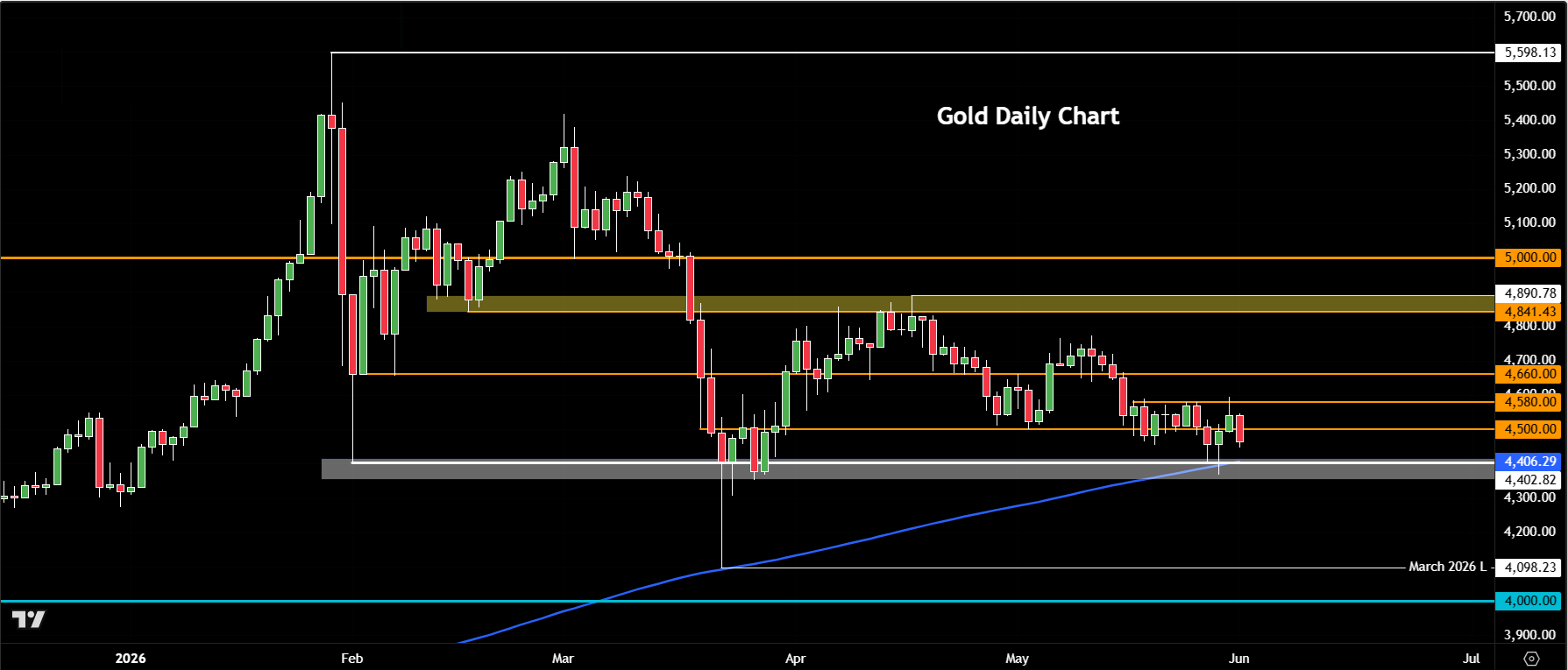
This region broadly coincides with the rising 200-day moving average on XAUUSD, a technical indicator that has provided an effective floor during previous pullbacks. Gold has spent most of the past two years trading comfortably above this longer-term trend measure, making the latest test particularly significant.
Historical precedent suggests caution. The last decisive break below the 200-day average occurred in late 2023 and triggered a meaningful short-term decline before buyers eventually regained control. Subsequent tests of the same indicator have produced strong recoveries, helping to preserve the broader bullish trend.
For now, the latest rebound suggests buyers are still prepared to defend this area. However, a clean break beneath $4,400 would likely shift sentiment considerably and expose deeper support levels around $4,200, followed by the psychologically important $4,000 mark.
On the upside, initial resistance is now seen around $4,500, above which $4,640-50 area will come into focus next, followed by around $4,570-75 area. A move above that zone could bring the $4,650 region into focus.
At present, gold appears trapped between two powerful narratives. Geopolitical uncertainty continues to underpin demand for safe-haven assets, while persistent inflation and elevated interest-rate expectations limit the scope for a sustained rally. Until one of those themes establishes a clearer advantage, periods of sharp volatility and range-bound trading are likely to remain the dominant feature of the market, with the bias remaining tilted slightly lower.

-- Written by Fawad Razaqzada, Market Analyst
Follow Fawad on Twitter @Trader_F_R
How to trade with City Index
You can trade with City Index by following these four easy steps:
- Open an account, or log in if you’re already a customer
• Open an account in the UK
• Open an account in Australia
• Open an account in Singapore
- Search for the company you want to trade in our award-winning platform
- Choose your position and size, and your stop and limit levels
- Place the trade