




Oil Falls as U.S.-Iran Deal Removes Geopolitical Risk Premium
Oil prices are falling 4% on Monday, dropping to a three-month low after President Trump and Iran's deputy foreign minister said they had reached a preliminary agreement to end the conflict in the Middle East and restore traffic through the Strait of Hormuz.
The two sides are expected to sign a memorandum of understanding in Switzerland later this week. Under the proposed agreement, shipping through the Strait of Hormuz would resume, while the U.S. naval blockade of Iranian ports would be lifted.
As a result, the geopolitical risk premium that had built up in crude markets over recent months is being rapidly unwound.
However, attention is now shifting from diplomacy to implementation. The key question for oil markets is not whether an agreement is reached, but how quickly disrupted production and exports can return to normal levels.
Oil flows through the Strait of Hormuz may need to recover to around 60-70% of pre-conflict levels before markets begin to resemble the oversupplied conditions seen before the war. Increased pipeline capacity and rising non-OPEC production mean the market may not require a full recovery in flows before supply concerns ease significantly.
Investors will also be watching compliance with the agreement and whether producers can restore output without further disruption.
Oil Forecast – Technical Analysis
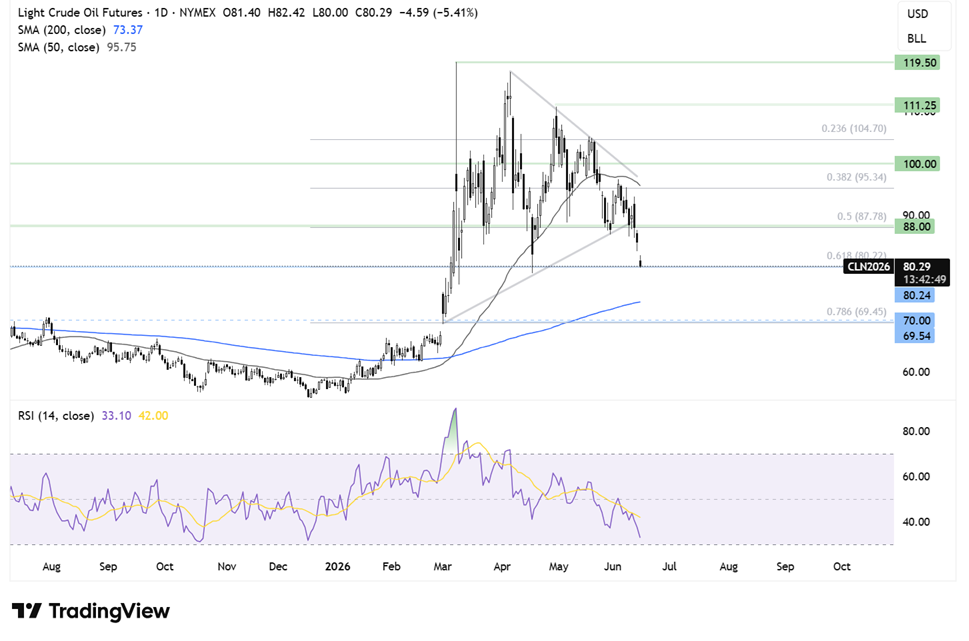
Oil has broken below a symmetrical triangle pattern, falling towards 80.00, a level last seen in mid-April. The breakdown, combined with an RSI below 50, keeps the near-term bias tilted to the downside.
Sellers will look for a break below 80.00, which coincides with the 61.8% Fibonacci retracement of the move from 55 to 120. A move below this level could expose the 200-day SMA at 73.40, followed by 69.20, the 78.6% retracement, and the March low.
On the upside, any recovery would need to reclaim 88.00, which marks the 50% Fibonacci retracement and former trendline support turned resistance. Above there, attention turns to 95.00, where the 38.2% retracement and 50-day SMA converge, ahead of the psychological 100.00 level.
DAX Rallies as Falling Oil Prices Improve Growth Outlook
The DAX and its European peers have opened sharply higher after the U.S. and Iran reached an agreement aimed at ending the conflict and reopening the Strait of Hormuz.
The immediate impact has been a sharp fall in oil prices, easing concerns over inflation and improving the outlook for growth. This is particularly supportive for economies that are heavily dependent on imported energy, including Germany and Japan.
Overnight, Asian equities rallied strongly, with Japan's Nikkei rising to a record high. European stocks and U.S. futures are also advancing as investors rotate back into geographical regions that were hit hardest by higher energy prices.
The decline in oil prices is also feeding through to bond markets. German government bond yields have fallen to their lowest levels in two weeks as investors reduce expectations for further ECB tightening. Markets now price roughly one additional ECB rate hike this year, compared with almost two hikes priced before last week's ECB meeting.
Looking ahead, investors will monitor eurozone industrial production data and tomorrow's German ZEW economic sentiment survey for further signs of how lower energy prices may affect the growth outlook.
DAX Forecast – Technical Analysis
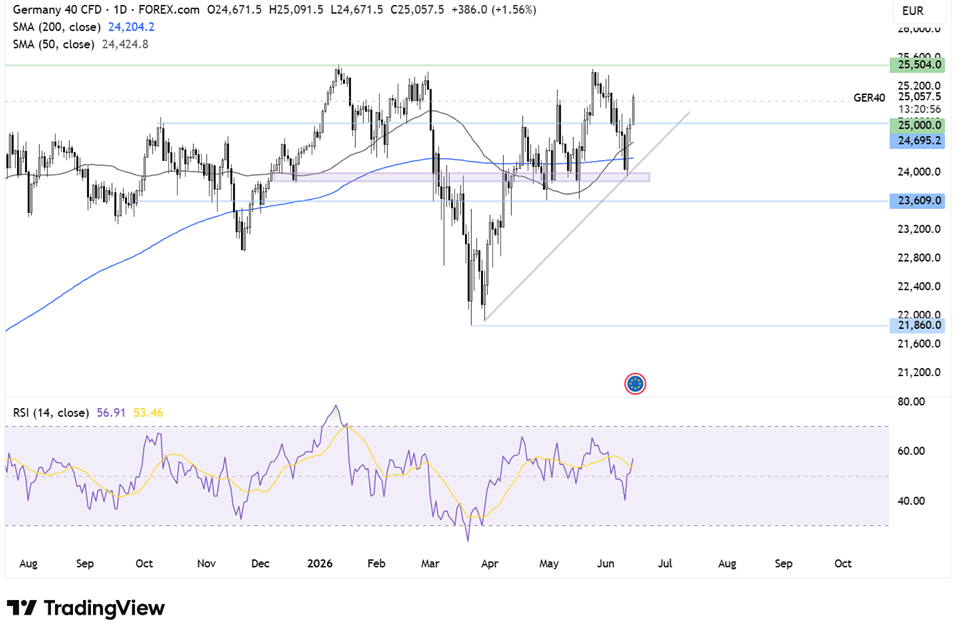
The DAX has recovered from the 23,950 swing low, rising back above the 200 and 50 SMA and reclaiming the 24,700 level before breaking through 25,000.
Momentum remains constructive, and buyers will look to extend gains towards 25,500 and fresh record highs.
Support is seen at 24,700. A break below this level could expose the 50-day SMA at 24,400, followed by the 200-day SMA at 24,180. Below there, the 23,900 support zone comes into focus.