




US futures
Dow futures 1%, S&P futures 1.3% & Nasdaq futures 2.1%
In Europe
FTSE 0.25% & DAX 1.36%
- U.S stocks jump on US -Iran agreement to end the war
- Oil, treasury yields, and inflation worries fall
- SpaceX, chip stocks, and travel stocks push higher
- Oil drops on hopes the Strait will be re-opened on Friday
U.S. Futures Rise as Iran Deal Hopes Lift Sentiment
U.S. futures are rising on Monday after the U.S. and Iran reached a preliminary agreement to end the Middle East conflict and reopen the Strait of Hormuz.
The framework for the deal is expected to be formally signed in Switzerland on Friday, although key issues, including Iran's nuclear programme, remain unresolved and an agreement on these needs to be achieved within 60 days.
Markets are nevertheless cheering the development. Crude oil prices have fallen around 5% to their lowest level since March, boosting airline and travel stocks while weighing on energy shares.
Investors are increasingly pricing in a lasting improvement in the geopolitical backdrop. However, with several details yet to be finalised, any setbacks could trigger a sharp market reaction. For now, confidence is growing that the Strait of Hormuz will reopen and energy supplies will normalise.
Lower oil prices are also helping to ease inflation concerns. Treasury yields have fallen as investors reassess the outlook for inflation and Federal Reserve policy ahead of this week's FOMC meeting, the first under Chair Kevin Warsh.
Markets expect the Fed to leave interest rates unchanged and have reduced the probability of a rate hike by year-end to around 50%, down from 75% last week.
Relief that SpaceX's blockbuster IPO enjoyed a smooth debut has also improved sentiment, potentially paving the way for other trillion-dollar listings later this year.
Corporate movers
SpaceX is rising 5.8% after ending its debut session with a market valuation above $2 trillion.
Chip stocks are higher pre-market, with Micron up 7.4% after several analysts raised their price targets. Nvidia is gaining 2%, while Intel is up 2.7%.
Paramount Skydance is rising more than 3% after the U.S. Department of Justice approved its acquisition of Warner Bros.
Energy stocks are under pressure as oil prices fall, while airlines and travel stocks are benefiting from lower fuel costs.
Dow Jones forecast – technical analysis
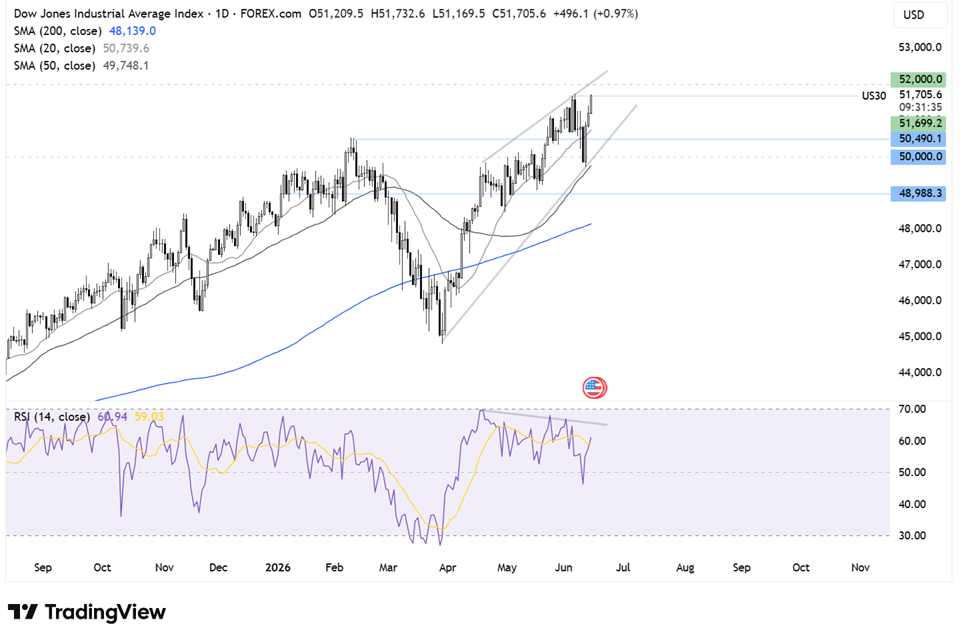
The Dow Jones continues to trade within a rising wedge pattern. The index recently rebounded from trendline support and is now testing its previous record high around 51,700.
Buyers will look for a break above 51,750 to target fresh record highs and the 52,000 psychological level. A sustained move above this region would invalidate the wedge reversal pattern, opening the door to further gains.
Support can be seen at 50,500, followed by 49,750, where trendline support, the June low and the 50-day SMA converge. Below here, 49,000 becomes the next key support level.
FX markets – USD falls as risk appetite improves
The U.S. dollar is weakening as safe-haven demand fades following the U.S.-Iran agreement. Attention is now turning to the Fed meeting, where policymakers are expected to leave rates unchanged but could signal a less accommodative policy stance.
EUR/USD is rising above 1.1600 as lower energy prices improve the outlook for the eurozone economy. The move is offsetting softer data, which showed industrial production rose just 0.1% in April after an upwardly revised 0.4% rise in March.
GBP/USD is also gaining amid a risk on market move. However, attention is shifting to this week's Bank of England meeting and a key Labour by-election. Falling energy prices may reduce the urgency for further BoE tightening, which could limit sterling's upside.
Oil Falls as U.S.-Iran Agreement Removes Risk Premium
Oil prices have fallen around 5%, dropping to a three-month low after the U.S. and Iran announced a preliminary agreement to end the conflict and restore shipping through the Strait of Hormuz.
The proposed deal would reopen the Strait and lift the U.S. naval blockade of Iranian ports, prompting traders to rapidly unwind the geopolitical risk premium built into crude prices.
Attention is now shifting from diplomacy to implementation. The key question is not whether a deal is reached, but how quickly oil exports and production can recover.
Flows through the Strait may need to return to around 60–70% of pre-conflict levels before markets begin to resemble the oversupplied conditions seen before the war.
Investors will also be watching compliance with the agreement and the pace of supply normalisation.