



Recent trading sessions have started to become challenging for the stability of the Japanese yen’s strength, as USD/JPY has now posted a three-session bullish streak, with a gain of around 0.8% in the short term. This reflects that the US dollar has begun to recover in strength.
The new and modest bullish bias that has started to appear in short-term price action has been supported in part by expectations of a more restrictive monetary policy from the Federal Reserve. This has once again pushed bond market yields higher, restoring the attractiveness of the US dollar and making it more difficult for the yen to gain ground consistently.
In this context, this dynamic could continue to generate a relevant buying pressure in USD/JPY in the coming trading sessions.

Is the Federal Reserve becoming a threat again?
During the previous session, US inflation data was released, with the figure coming in at 3.8% versus the 3.7% expected. This result has begun to highlight that inflationary pressures may be more relevant than previously anticipated.
This event has been key in shifting expectations around the Federal Reserve. Currently, the CME Group probability outlook shows more than 80% probability that rates will remain at 3.75% through the September decision, but there are also growing probabilities close to 40% that the rate could rise toward 4.00% starting in April 2027.
This shift is particularly relevant, as these probabilities were almost nonexistent just a few months ago, and now they reflect that the market is beginning to price in a more restrictive monetary policy stance.
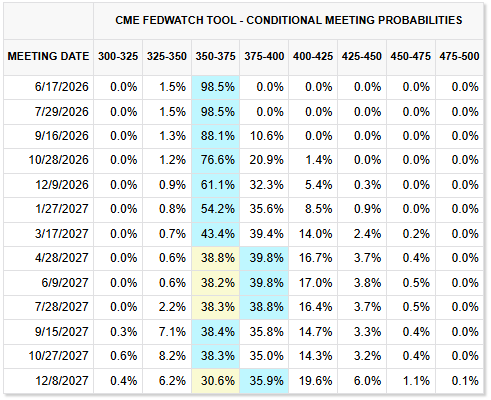
Source: CMEGROUP
This effect has already started to be reflected in the US bond market, where 10-year Treasury yields continue to show a consistent upward trend and are approaching the 4.5% level, levels not seen since June 2025.
Although Japanese bond yields show a similar structure, they remain significantly lower, currently around 2.6%, which keeps a relevant rate differential in favor of the United States.
This differential continues to be a key factor, as it increases the attractiveness of the US fixed income market relative to Japan in the short term.
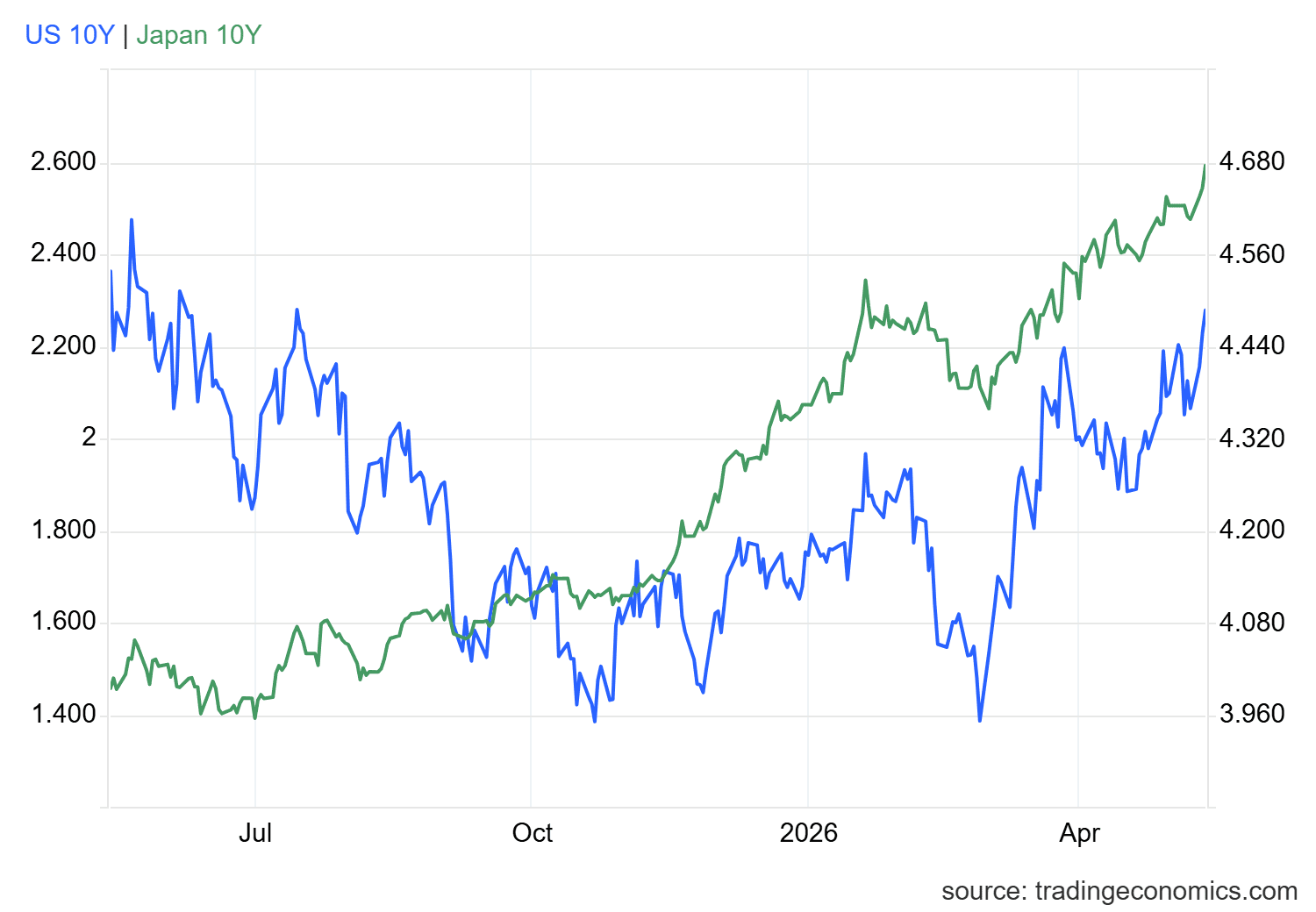
Source: TradingEconomics
These rate dynamics are also having a direct impact on FX market demand, as higher US yields continue to attract interest in USD-denominated investments.
This effect is already visible in the DXY index, which has recovered toward the 98.5 level, reflecting a strengthening in demand for the US dollar.
As a result, this dollar strength is limiting the yen’s ability to regain ground, and if this dynamic persists, the buying pressure in USD/JPY could continue to gain relevance in the short term.
New interventions could change the Outlook
Several sessions have passed since reports emerged of potential interventions by Japanese authorities through yen purchases. This event was key, as it triggered a significant strengthening in the yen at the time.
So far, there have been no official confirmations, but the tone from authorities remains firm, reiterating that they are closely monitoring the market and are prepared to act if necessary.
In this context, even without confirmation of immediate intervention, the market remains sensitive to this type of event. If sharp moves similar to those seen weeks ago reappear, where USD/JPY moved more than 2% in a single session, speculation about renewed interventions could quickly return.
In that scenario, the yen could regain strength in a more consistent way, which could offset the current buying pressure and bring back a more relevant bearish bias in USD/JPY price action.
Technical outlook for USD/JPY
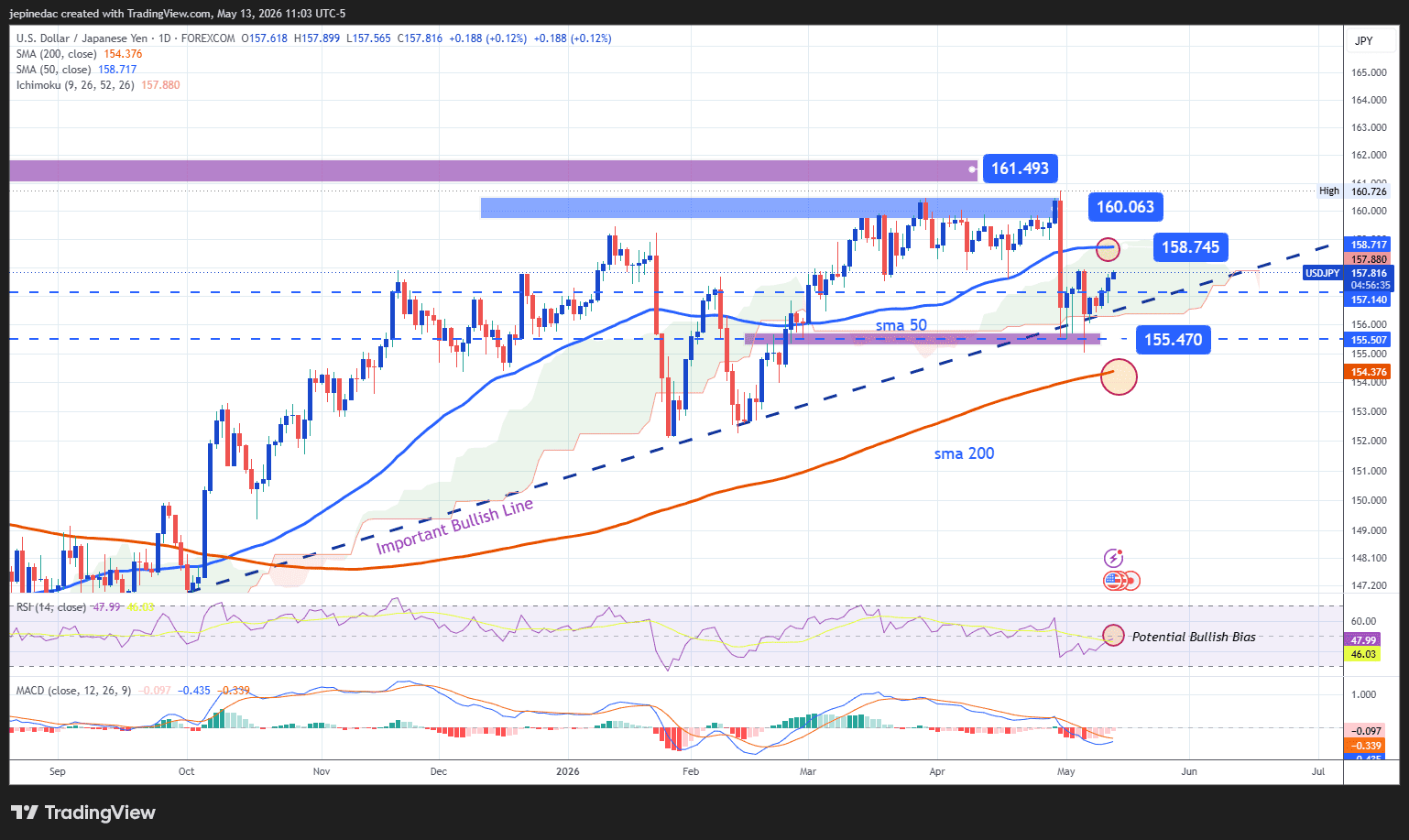
Source: StoneX, Tradingview
- Price continues to respect the trendline: Recent price action has been particularly relevant as the price managed to rebound from the long-term bullish trendline. This has allowed the bullish bias to regain traction, reaffirming this structure as the dominant technical pattern on the daily chart. While no significant bearish corrections appear that could threaten this formation, the trendline is likely to remain the main technical reference in the coming sessions.
- RSI: At present, the RSI has begun to show a consistent upward slope and is approaching the neutral 50 level. This suggests that the average selling momentum over the last 14 sessions is losing relevance, and if this dynamic continues, the indicator could begin to reflect a more relevant bullish bias in price action.
- MACD: The MACD shows a similar structure in the short term, as the histogram remains close to the zero line. As it begins to show more consistent upward movements, this could signal that buying pressure is starting to dominate short-term moving averages, reinforcing a stronger bullish tone in USD/JPY.
Key levels:
- 160.000 – Key resistance: A key psychological level aligned with recent highs. Moves toward this area could reinforce the current bullish bias and lead to an extension of the bullish trendline in the coming weeks.
- 158.244 – Near-term barrier: A neutral zone aligned with the 50-period moving average. Price action that remains too close to this level could reinforce a phase of indecision or even lead to the formation of a short-term range.
- 155.470 – Key support: A level of recent lows aligned with the base of the bullish trendline. This level is critical, as a break below it could fully invalidate the long-term bullish structure and trigger a more dominant bearish bias, potentially extending over several weeks.
Written by Julian Pineda, CFA, CMT – Market Analyst
Follow him on: @julianpineda25