



The last week of May is coming to an end, and the cryptocurrency market is once again showing signs of weakness, mainly due to significant capital outflows that reflect a decline in short-term confidence. So far, confusion around the situation in the Middle East and the threat of still-elevated interest rates in the bond market continue to weigh on appetite for risk assets.
For now, this environment has not allowed crypto demand to stabilize consistently. As long as the geopolitical and macroeconomic backdrop remains cautious, this renewed sense of weakness in the crypto market could remain relevant over the coming trading sessions.

Demand begins to fade
The trading week was marked by several updates related to the conflict in the Middle East. At first, new attacks and restrictions from the United States, aimed at pressuring the opening of the Strait of Hormuz, were seen as potential triggers for renewed short-term tensions. However, shortly after, reports suggested a possible 60-day ceasefire extension between the United States and Iran, with the possibility of new talks on Iran’s nuclear program.
Despite this, there is still no formal peace agreement. This back-and-forth in comments throughout the week has created a sense of indecision and confusion around the geopolitical outlook, leading market participants to remain more cautious toward risk assets such as cryptocurrencies.
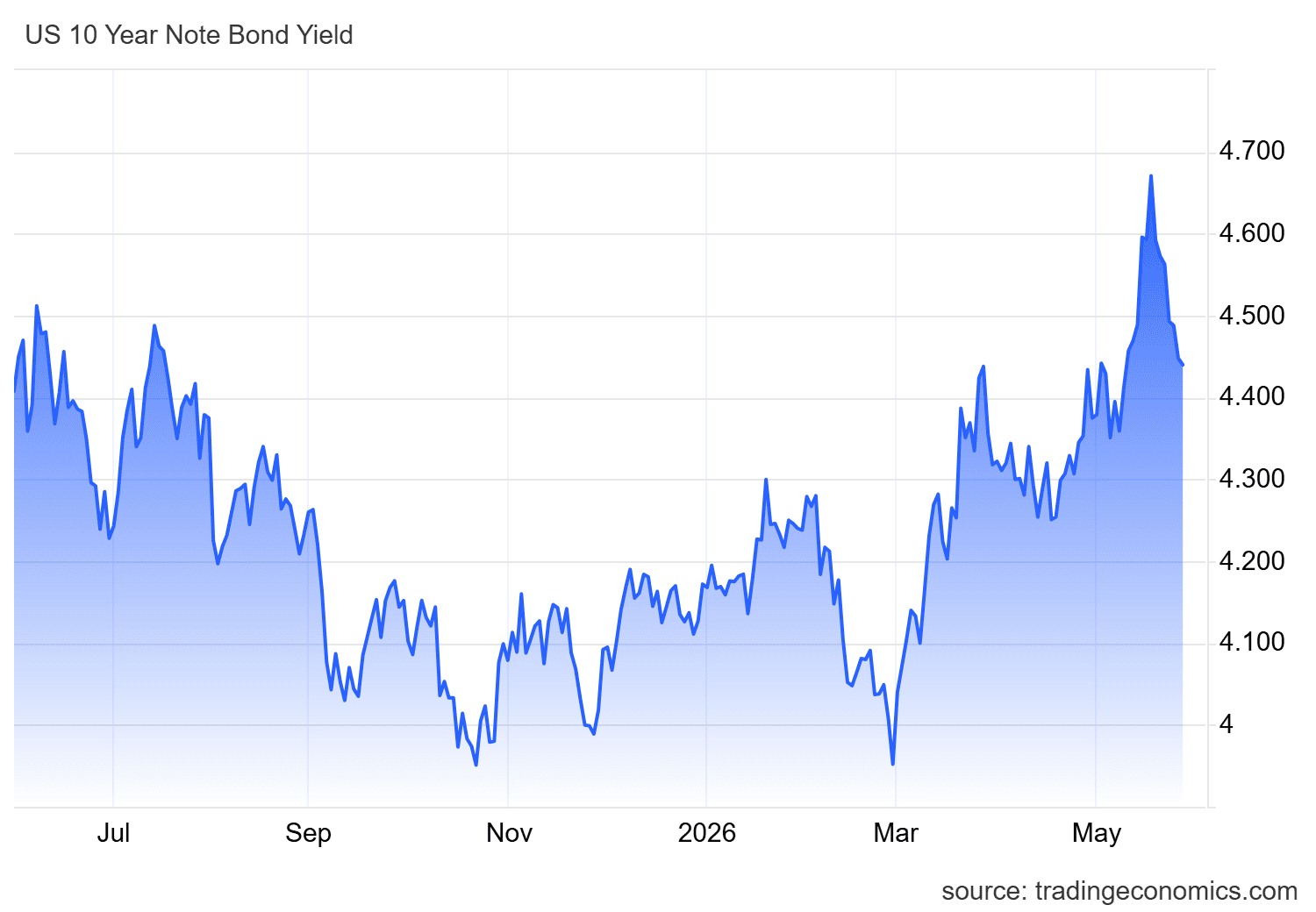
On the other hand, the bond market remains an important threat to confidence. Although US 10-year Treasury yields have declined somewhat and moved away from the 4.6% area, they remain above 4.4%, one of the highest levels of 2026 and a level not seen since July 2025.
This level remains attractive for fixed income markets, which are considered more stable than other risk assets. For this reason, bonds could continue to attract capital flows and reduce potential demand for markets such as cryptocurrencies, limiting a stronger recovery in appetite for these assets in the short term.
Source: TradingEconomics
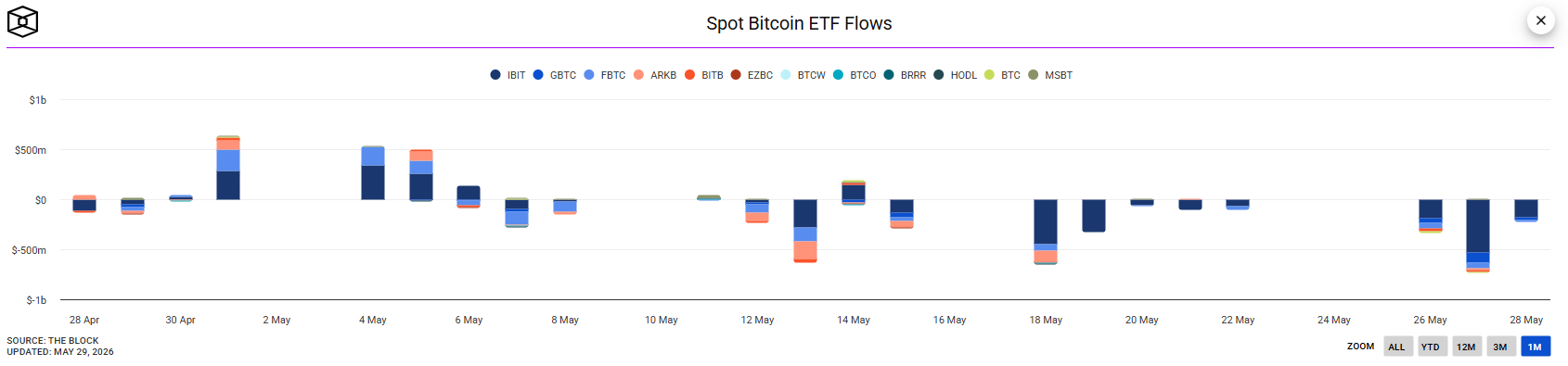
Geopolitical events and the relative strength of substitute markets, such as bonds, appear to be aligned with the internal dynamics of the crypto market. In average flows for Bitcoin ETFs, the sector’s reference asset, constant capital outflows have been observed throughout the week. May 27 stood out as the largest outflow day, with more than $700 million leaving the ETF market.
In addition, neither the current week nor the previous one recorded relevant positive flows, showing that capital had already been leaving even before the latest Middle East updates. This confirms a significant loss of appetite among market participants, aligned with the uncertain geopolitical environment and competition from more defensive assets such as bonds.
Source: THEBLOCK
The lack of appetite for markets such as BTC has become increasingly evident and could be spreading to the broader cryptocurrency market. As long as substitute markets continue to show appeal and the geopolitical situation does not provide clearer signs of stability, this lack of demand could continue to generate selling pressure over the coming trading sessions.
Bitcoin relative to other markets
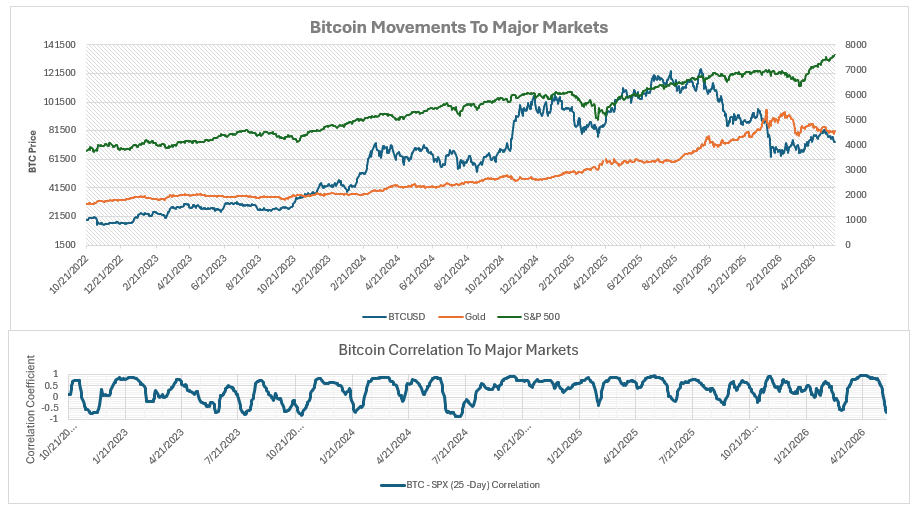
Now, there is a significant loss of correlation between BTC and traditional risk markets such as the S&P 500. The correlation coefficient between both assets is moving closer to -1 over the average of the last 25 sessions, reflecting an inverse relationship between the index and Bitcoin. It is important to remember that correlation coefficients can change over time.
Source: Data – TVC, StoneX, Tradingview
This relationship is relevant because, while the S&P 500 has shown a consistent short-term recovery, Bitcoin has not followed the same dynamic and has instead shown weakness. This suggests that BTC is not capturing demand in the same way as traditional risk markets and is moving away from the usual recovery dynamic seen when equity indices show confidence.
This behavior may indicate that the crypto market’s appeal is weakening relative to other assets, especially equities. In this context, cryptocurrencies do not appear to be functioning clearly either as an attractive risk market or as a safe-haven alternative during recent sessions.
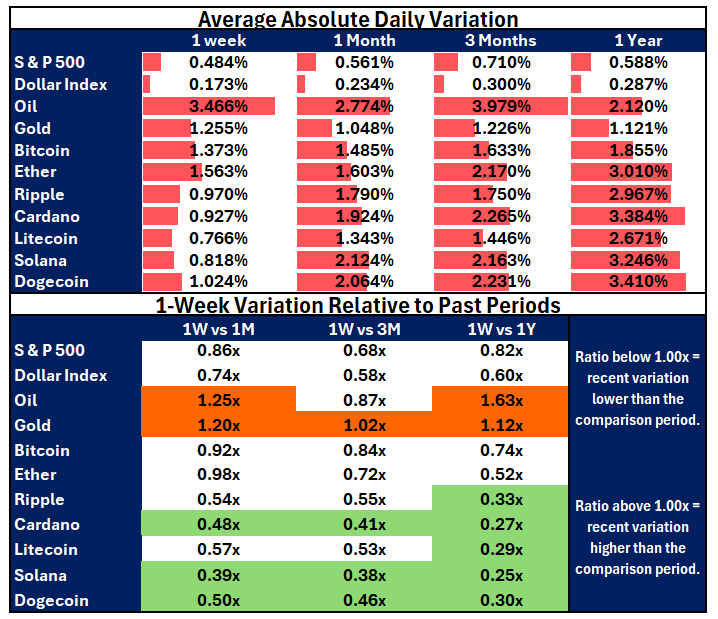
It is also important to mention that the average variation over the last week in the cryptocurrency market remains below the average variations of one month, three months, and one year. This shows that, beyond the weakness in price movements, there is also lower relative activity in the crypto market compared with its own historical records.
This lack of activity reinforces the idea that demand is not entering strongly into short-term price action and that part of market flows may be shifting toward assets outside cryptocurrencies.
Source: Data – TVC, StoneX, Tradingview
With all of this in mind, the loss of correlation between Bitcoin and traditional risk markets, combined with lower average price variation across cryptocurrencies, reflects a relevant lack of appetite for this market in the short term. Unless activity shows clearer signs of recovery or BTC realigns with the positive movements of other risk assets, this phase of weakness and indecision could remain consistent over the coming sessions.
Confidence fails to recover
Looking at the Fear and Greed Index, it stands out that there have been no relevant advances in recent sessions. The indicator remains near 34 points, within the “fear” zone, confirming that confidence is still fragile and showing signs of short-term weakness.
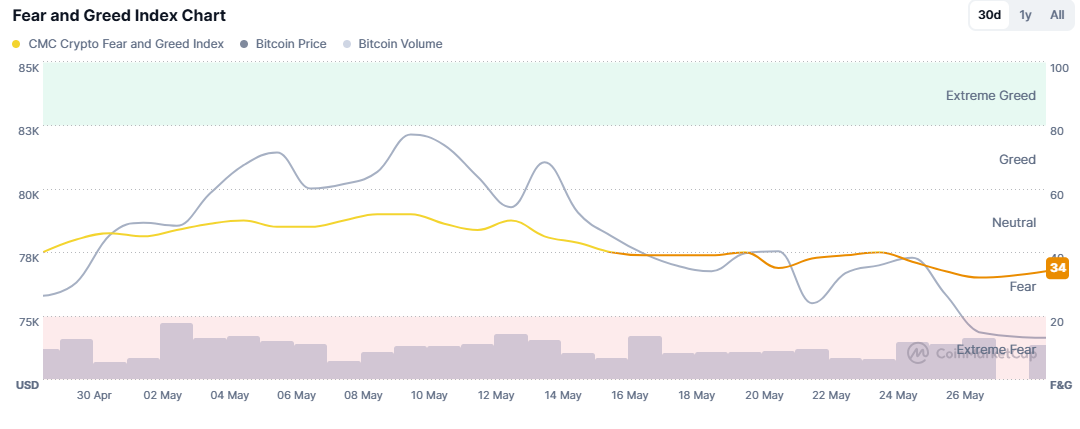
Source: Coinmarketcap
This behavior indicates that the market still does not show consistent appetite for cryptocurrency demand. If the index fails to move higher more clearly, it will continue to reflect that conditions are not ideal for sustaining a relevant demand environment. This could also be signaling a potential phase of indecision or weakness in crypto market price action over the coming sessions.
Written by Julian Pineda, CFA, CMT – Market Analyst
Follow him on: @julianpineda25