



The Japanese yen remains on the back foot into today’s Bank of Japan meeting, with policy divergence and persistent carry demand continuing to weigh on the currency. While the BOJ is widely expected to hold rates steady, markets remain focused on guidance — and whether officials signal any willingness to tighten policy in the near term. With AUD/JPY breaking higher and USD/JPY consolidating just below key resistance, attention now turns to whether yen weakness has further to run.
View related analysis:
- FX Futures Positioning: US Dollar, EUR, JPY, CAD | COT report
- Australian Dollar Outlook: AUD/USD Bulls Eye Breakout as CPI and FOMC Loom
- Bitcoin Price Outlook: Bulls Eye 80k Though Crypto Momentum Diverges
- Nikkei 225 Eyes Record High as Bullish Exposure Builds - But Headwinds Emerge
Tech Earnings to Test Valuations as Wall Street Hits Record Highs
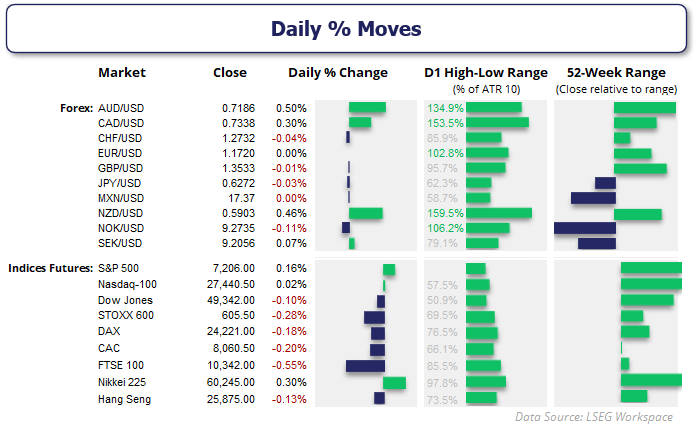
Sentiment remained buoyant at the start of the week, with the S&P 500 and Nasdaq pushing to fresh record highs ahead of a heavy slate of tech earnings. Microsoft (MSFT), Alphabet (GOOGL), Meta Platforms (META), Apple (AAPL) and Advanced Micro Devices (AMD) are all set to report, but the focus is less on headline beats and more on whether AI can justify its price tag.
Markets will be watching whether AI-driven revenues are keeping pace with surging capex, whether cloud growth is re-accelerating, and whether margins can hold under the weight of that investment. With valuations already stretched, this earnings cycle has the potential to either reinforce the rally — or expose cracks in the narrative.
Source: TradingView
AUD and NZD Gain as Yen Lags into BOJ Decision
That risk-positive backdrop spilled into FX, with the Australian and New Zealand dollars finding support as carry demand held firm, while the yen lagged as a funding currency. Focus now turns to today’s Bank of Japan meeting, where rates are widely expected to remain unchanged, leaving guidance — not the decision itself — as the key catalyst for JPY pairs.
BOJ in Focus as Japanese Yen (JPY) Weakness Persists
Today’s Bank of Japan meeting is expected to deliver no change in policy, keeping rates on hold at 0.75% as officials assess the durability of inflation and wage growth. As such, the focus will be squarely on guidance — particularly any shift in tone around the timing of further tightening, confidence in achieving sustainably higher inflation, and tolerance for yen weakness. While some major banks still expect the next hike later this year or into early 2027, conviction around the timing remains low.
With markets still unconvinced the BOJ can tighten meaningfully in the near term, the yen is likely to remain on the back foot, keeping the path of least resistance higher for crosses such as AUD/JPY, as the technicals now suggest.

USD/JPY Futures Positioning | COT Report
Futures traders remained net-short Japanese yen futures last week, according to the latest Commitment of Traders (COT) data. Large speculators hold a net-short position of -94.5k contracts, with bearish positioning having become entrenched since peaking in April 2025. Asset managers are less bearish with net-short exposure of -14.4k contracts, although their bullish positioning also appears to have peaked around a year ago and has trended lower since.
In both cases, gross long exposure continues to decline, while gross shorts trend higher, suggesting bearish conviction remains intact. With no clear signs of a sentiment extreme, positioning does not yet point to a meaningful reversal, leaving scope for further yen weakness. This could keep USD/JPY supported, particularly if the Fed delivers a relatively hawkish hold at this week’s meeting.

Source: CFTC (COT), CME, LSEG
AUD/JPY Technical Analysis: Australian Dollar vs Japanese Yen
Australian Dollar vs Japanese Yen: AUD/JPY Eyes 1990 High
Zooming out to the monthly chart shows the next major resistance level for AUD/JPY sits at the 1990 high of 124.19. The Australian dollar has remained supported against the Japanese yen, with the cross continuing to reflect diverging policy expectations. With the RBA on track to hike at least twice more this year — and tomorrow’s trimmed mean inflation potentially lifting bets for a third — a clear policy divergence theme remains in play, especially with the BOJ expected to keep policy on hold for now.
Bullish momentum has been building since the 2022 low, and price has now broken out of a three-decade range, reinforcing the broader bullish structure and keeping the bias tilted to the upside.
AUD/JPY Bullish Bias Holds Above 113.66 Support
The daily chart shows a classic uptrend, more commonly seen in equity markets. A small bullish triangle / pennant formed around cycle highs, with Monday’s session breaking higher with a clear expansion in range for AUD/JPY.
With bullish momentum building, traders could look to buy dips on lower timeframes or maintain a bullish bias while the Aussie yen holds above Thursday’s low (113.66), in anticipation of a move towards the 115 and 116 handles.

Source: ICE, TradingView
USD/JPY Technical Analysis: US Dollar vs Japanese Yen
USD/JPY Range Holds as Breakout Pressure Builds
Price action has been choppy on the daily USD/JPY chart since mid-March, with bulls failing to hold above 160 yet quick to snap up a discount around 158. With both the FOMC and Bank of Japan meetings looming, that choppy behaviour could remain a feature. However, with COT data showing a clear uptrend in bearish bets against the Japanese yen — and the potential for a more hawkish tone from the Fed — an eventual upside breakout could be on the cards.

USD/JPY Eyes Break Higher as Bull Flag Forms
For now, price action suggests USD/JPY may be preparing for another leg higher. A doji formed on Monday, holding above the 20-day EMA and 159 lows before momentum turned higher. A small but potential bull flag is forming on the 1-hour chart, with bulls likely to seek dips towards the weekly pivot point (159.25) for signs of a swing low, in anticipation of a move towards at least the 159.60 high. A break above this level brings the cycle highs at 159.85 into focus — just below the weekly R1 pivot and the 160 handle.

Source: ICE, TradingView
View the full economic calendar
-- Written by Matt Simpson
Follow Matt on Twitter @cLeverEdge
How to trade with City Index
You can trade with City Index by following these four easy steps:
- Open an account, or log in if you’re already a customer
• Open an account in the UK
• Open an account in Australia
• Open an account in Singapore
- Search for the market you want to trade in our award-winning platform
- Choose your position and size, and your stop and limit levels
- Place the trade