



AUD/USD is approaching a key juncture, with price action holding in an established uptrend and sentiment remaining broadly supportive. While recent pullbacks have been shallow, underlying correlations and positioning suggest the rally is still intact — though not without risk.
With Australian CPI and the Federal Reserve decision both due this week, volatility is likely to return. These events could determine whether AUD/USD breaks higher toward 0.75, or sees a deeper pullback before bulls step back in.
View related analysis:
- Bitcoin Price Outlook: Bulls Eye 80k Though Crypto Momentum Diverges
- Gold Loses Safe-Haven Appeal as Iran Skips Talks, Ceasefire Extended
- AUD/USD Outlook: Pullback Below 0.72 Underway as Geopolitical Risks Intensify
- FX Futures Positioning: USD, EUR, GBP, CAD | COT Report
Australian Trimmed Mean CPI and Fed Decision in Focus for AUD/USD
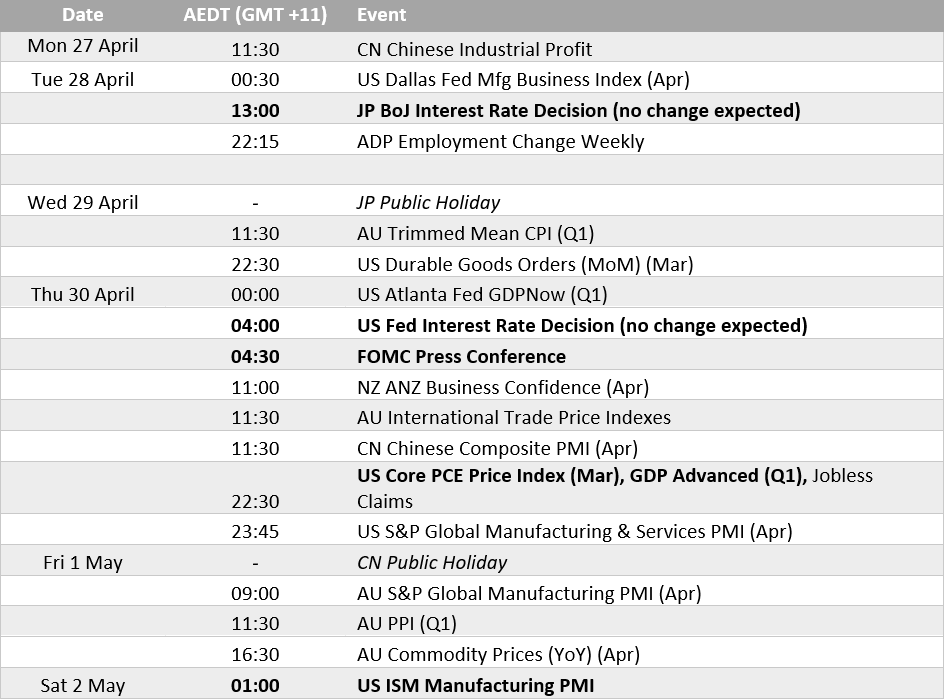
Fed Decision in Focus with GDP, ISM and Inflation on Tap
We have a busy economic calendar ahead, particularly from the US, with GDP, PCE inflation, ISM manufacturing, and a Federal Reserve rate decision all due.
The Fed is unlikely to change interest rates this week (early Thursday AEST), although policymakers may strike a slightly more hawkish tone given ongoing geopolitical tensions in the Middle East. The CME FedWatch tool implies a 99% probability of no change.
Markets are not expecting cuts any time soon, with pricing for rate reductions remaining distant. That said, expectations for easing remain subdued now that peak war uncertainty appears to be behind us.
Prices paid surged to a four-year high in the latest ISM manufacturing report, and it seems plausible that it could rise further. This may also weigh on the headline index, which last printed at 52.7. However, as the release lands on Friday, its market impact may be more limited. Still, a print below 50 could dent sentiment on Wall Street heading into the weekend.
It will be interesting to see how much of CPI’s recent inflation spike feeds through to the less volatile PCE price index. CPI rose 0.9% in March—its hottest monthly print since June 2022—lifting consumer prices to 3.3% y/y.
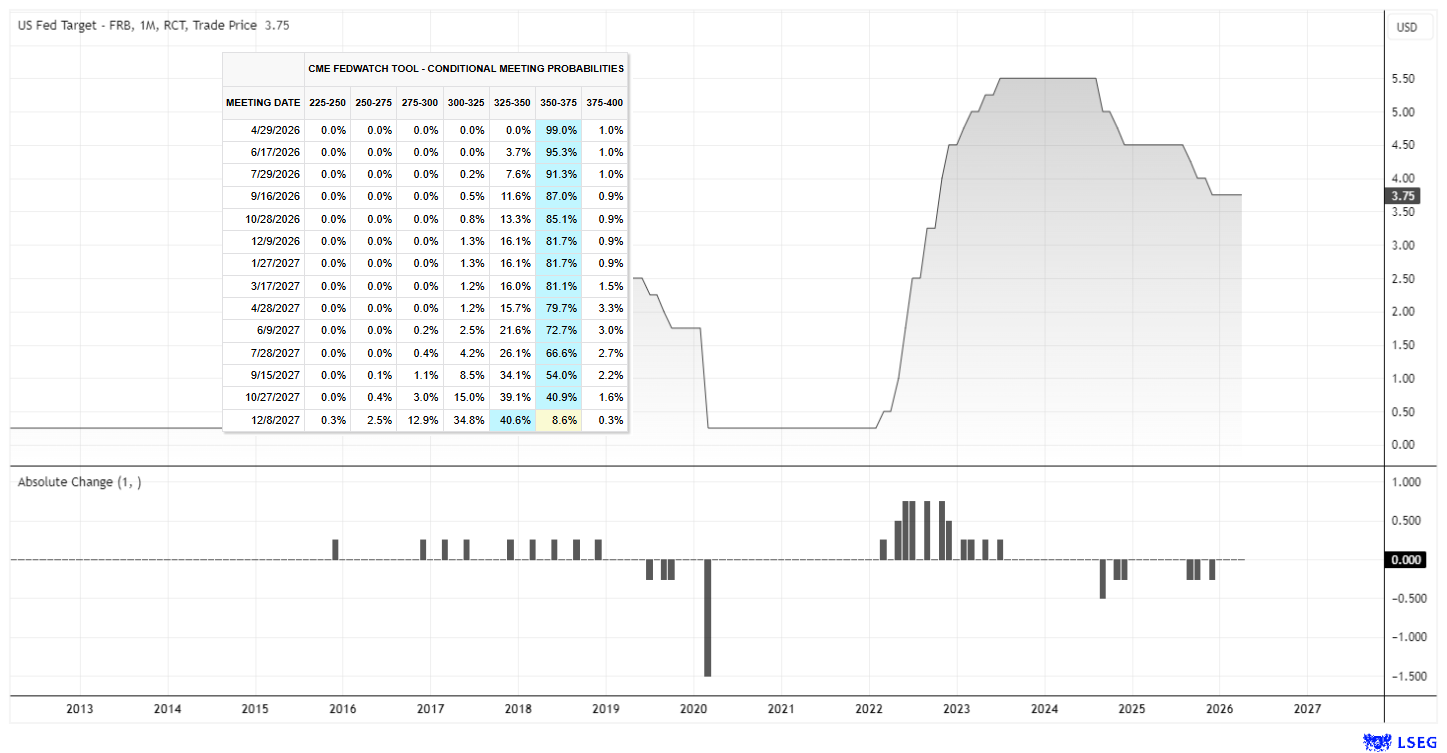
Source: LSEG, Federal Reserve (FRB), CME

Australian Trimmed Mean Inflation in Focus
As for Australia, trimmed mean inflation on Wednesday is the key event. It could remain above the RBA’s 2–3% target band for a second consecutive quarter and potentially accelerate, which would lift expectations for further tightening.
Markets currently price around a 69% chance of another RBA hike, with the cash rate seen peaking near 4.7% by January — roughly 60bp of additional tightening. A stronger-than-expected inflation print could push those expectations higher.
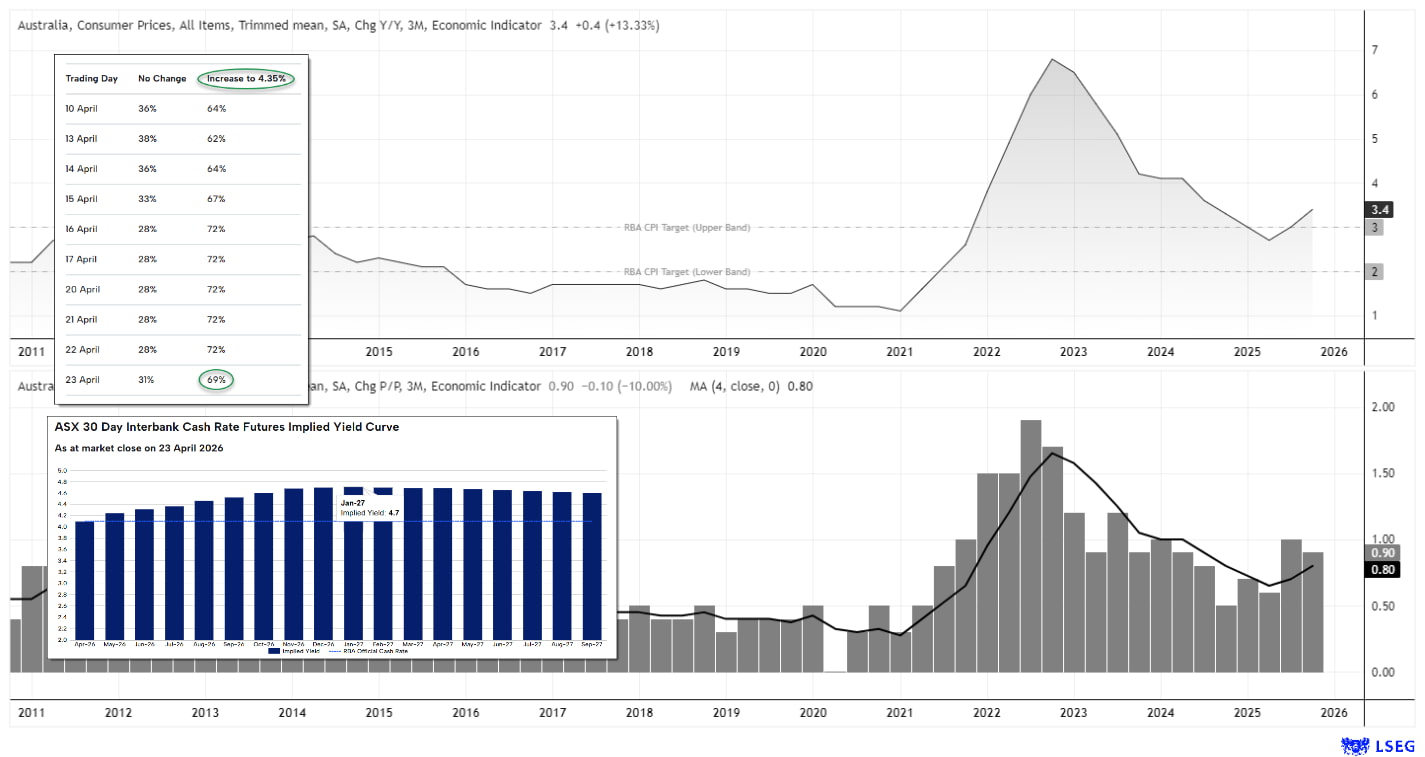
Source: S&P Global, Judo Bank, LSEG
AUD/USD Technical Analysis: Australian Dollar vs US Dollar
Aussie Dollar Outlook: Mixed Signals Across FX Pairs
It was a low-volatility week for the Aussie overall, and while it retraced against most major FX peers, losses were limited. Several pairs printed spinning top doji below resistance, signalling indecision and the potential for volatility to pick up. With a busy economic calendar ahead, volatility is likely to return this week.
- AUD/USD may be hinting at a break higher following a shallow pullback, with Wednesday’s inflation report a potential catalyst
- AUD/CAD formed its narrowest weekly range since August, with price finding support around the March–April 2021 highs — a potential pivot for traders to watch
- AUD/CHF rose for a fourth week to its highest weekly close in 14 months, although the spinning top doji and fading momentum suggest the rally may be losing steam
- AUD/EUR also printed a small spinning top doji, with firm resistance met at the 2025 high near 0.6100
- AUD/GBP shows more potential to fall further over the near-term relative to other Aussie pairs, with bearish momentum picking up into Friday and the cross rising for a second consecutive day
- AUD/JPY continues to trade within a tight range near multi-decade highs, suggesting pullbacks could remain shallow with dips likely to attract buyers
- AUD/NZD (daily) is hinting at a potential ending diagonal (rising wedge), which could see the cross target the 1.19 area if the bearish reversal pattern plays out
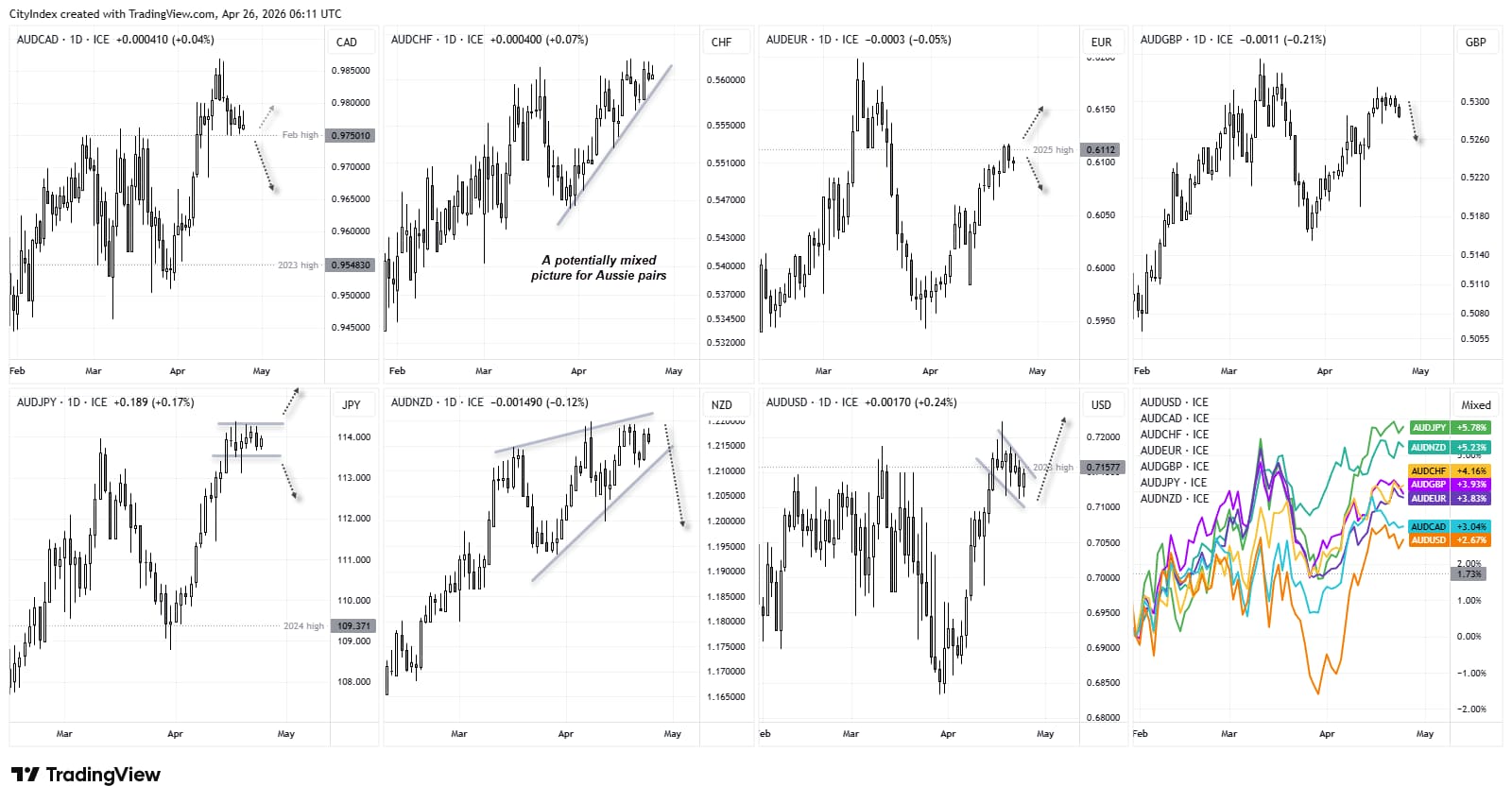
Chart prepared by Matt Simpson - Source: LSEG

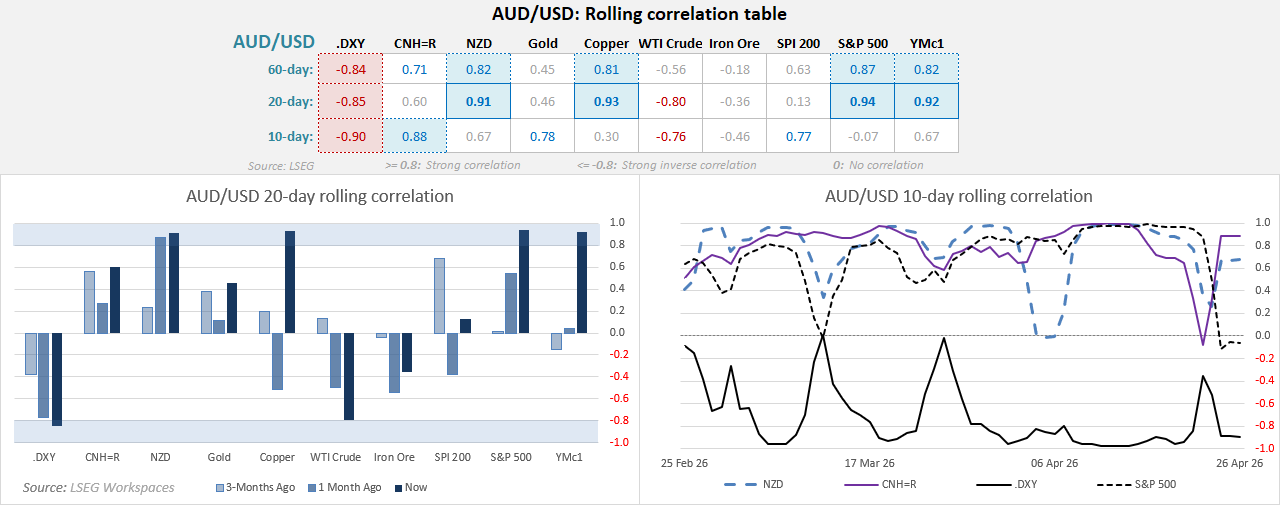
AUD/USD Correlations Signal Fragile Risk Alignment
AUD/USD correlations remain broadly supportive, with strong links to NZD, copper and equities, and a persistent inverse relationship with the USD.
However, 10-day correlations show cracks — particularly with equities and commodities — suggesting the rally is becoming less synchronised with its usual drivers.
Trend still supported, but weakening cohesion leaves AUD/USD more exposed to near-term data and volatility.
Source: LSEG
AUD/USD Eyes Breakout as Bullish Positioning Remains Elevated
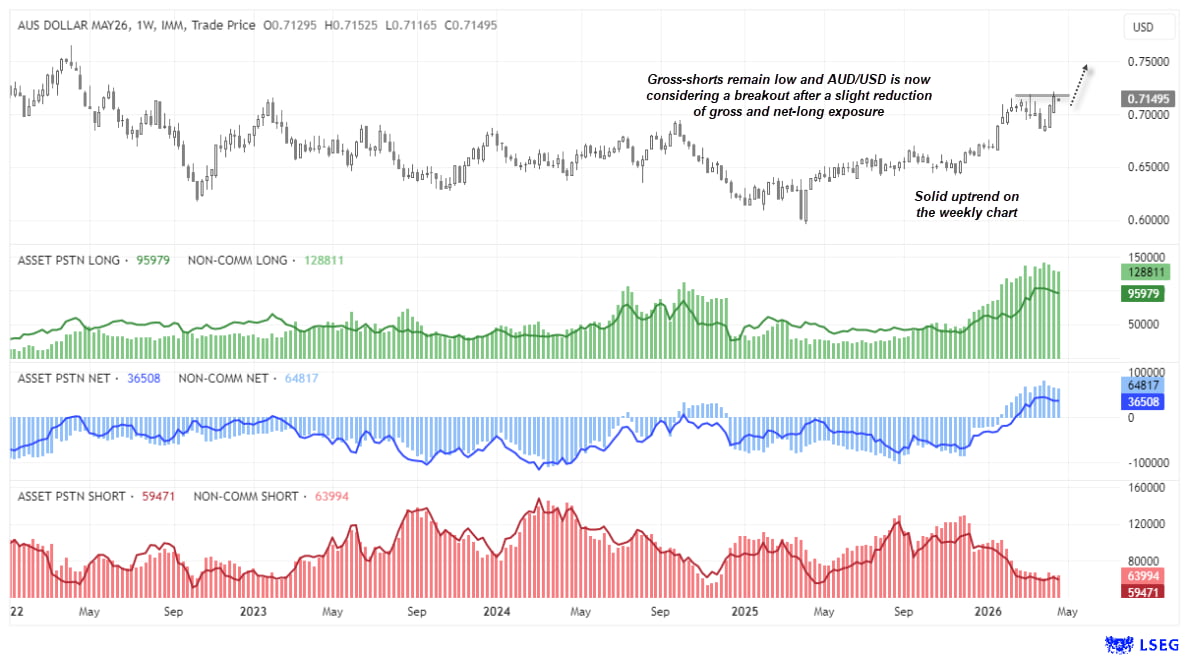
The Aussie dollar appears to be eyeing a fresh breakout, with the weekly chart showing momentum building into prior swing highs within an established uptrend.
Even if prices pull back in the near term, bulls are likely to step in on dips, suggesting a move toward 0.75 could come sooner rather than later.
Only minor adjustments were seen in Aussie dollar futures last week. Net-long exposure among large speculators fell by 258 contracts, while asset managers increased theirs by 25.
This leaves bullish positioning just below a 9-year high for speculators and near record highs for asset managers. However, I’m becoming less convinced that extreme sentiment signals from the futures market are as bearish as they’re often framed. Instead, positioning suggests bulls remain active and willing to buy dips.
Source: CFTC (COT) CME, LSEG
AUD/USD Options and Volatility Analysis (Risk Reversals, HVN Levels)
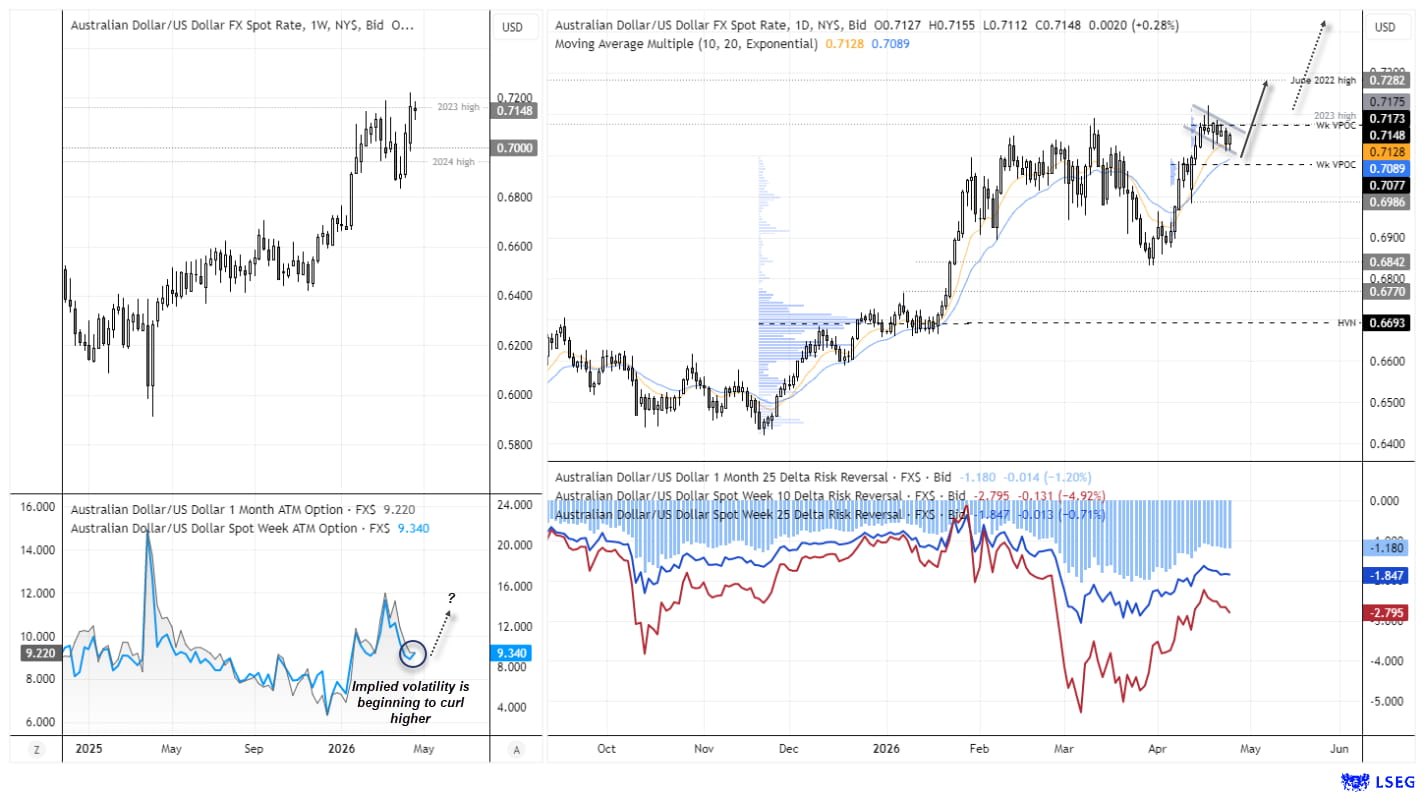
The daily chart shows a solid uptrend with a shallow, well-timed pullback. AUD/USD held above the 10-day EMA last week, and even if the retracement extends, the 20-day EMA (0.7089) and weekly VPOC (~0.7077) sit nearby as potential support.
The broader trend remains bullish while price holds above the 0.6986 low. Unless the macro backdrop shifts materially, a sustained break below 0.70 looks unlikely for now.
Risk reversals have softened alongside price, signalling increased demand for puts over calls. However, they remain elevated relative to cycle lows and do not yet reflect a strongly bearish bias.
Meanwhile, weekly implied volatility is attempting to turn higher after several weeks of decline, suggesting volatility may be set to pick up again.
Source: ICE, TradingView